You’ve been in this business long enough to know the feeling. You’re juggling everything: managing inventory, overseeing shifts, handling customer complaints, and trying to put out the small fires that pop up all day long. You feel like you’re doing everything you can to keep the place running, but you still feel a disconnect from your team. You tell them what to do, but it feels like the message just isn’t landing.
It’s easy to think that great leaders have some kind of natural, magnetic personality, that they’re just “charismatic.” But what if that’s the wrong idea entirely? What if the most effective leadership isn’t about flashy personality at all, but about something far more simple and powerful?
The truth is, a great leader is a clear, direct, and predictable presence for their team. It’s about providing an environment where your people can thrive. They know exactly what’s expected of them. They have the tools to succeed. This single skill, leading with clarity, is the key to solving some of the biggest problems we face in the industry today, from high turnover to low productivity.
This post is a tactical playbook. It is a blueprint for building a more engaged, more profitable business. This is achieved simply by changing the way you communicate with your team. And trust me, it’s a lot easier than you think.
This post is inspired by “Clarity Over Charisma: How Great Leaders Truly Communicate” from HuntScanlon.com.

The High Cost of an Unspoken Problem
Let’s start with the cold, hard facts. You’ve heard about the high turnover rates in our industry. But have you ever really dug into what it’s costing you? According to a NACS report, the convenience retail industry has been battling turnover rates exceeding 100% for over a decade. To put that in perspective, more than a third of your new hires will likely leave within their first month on the job. Exactly 36% will leave within their first month on the job.
This isn’t just a staffing headache; it’s a silent killer of your profitability. Research from TruRating calculates that the average cost of a single employee turnover event in retail is a staggering $10,000.
Let’s break down that number, so it really hits home:
- Hiring: Approximately $4,000 for job ads, recruiting platforms, and the valuable time your HR or management team spends interviewing.
- Onboarding & Training: Roughly $2,500 in manager time and resources to get the new hire up to speed.
- Lost Productivity: A massive $3,500 for the sales and service lost. This occurs while the role is vacant or the new employee is still ramping up.
That’s $10,000 for every single person who walks out the door. It’s money being lit on fire, and it’s a problem that goes far beyond low wages. While pay is the top reason employees leave (49%), the second most common reason is a “negative work environment and teamwork” (23%). This tells us that simply throwing money at the problem won’t solve it. The root cause is a breakdown in communication and a lack of connection between leaders and their teams. Turnover isn’t the disease; it’s a symptom of a deeper cultural issue, and that’s where a focus on clarity can make all the difference.
What You Should Be Doing
- Measure It to Manage It: You can’t fix a problem you don’t measure. Start by calculating your own turnover rate. The formula is simple but powerful: Turnover Rate (%) = (Number of Employees Who Left / Average Number of Employees) x 100. Use this data to track your progress and justify a focus on team culture.
- Conduct Exit Interviews: If you aren’t already doing them, start now. The data shows that a significant number of employees leave because of a negative work environment. Ask open-ended questions and listen to the responses. Don’t get defensive, use this opportunity to gather critical feedback that can help you fix the underlying issues.
- Create a Cost-of-Turnover Table: Use the following cost breakdown to show your management team the real financial impact of every employee who leaves. You can also use it to remind yourself of this impact. The average per-employee cost of turnover in retail is around $10,000. An estimated $4,000 is spent on hiring for job ads, recruiting platforms, and HR time. Another $2,500 goes to onboarding and basic training. A significant $3,500 is lost in productivity while the role is vacant or the new employee is ramping up. This makes the abstract concept of turnover a concrete, painful reality on your profit and loss statement.
For more information, see “Employee turnover in retail – what it’s costing you and how to fix it” from TruRating.com.

Why Your Communication Is Your Top-Selling Product
You’ve probably seen it. An employee steps right over a piece of trash in the aisle without even seeing it. Or a new team member gets a request from a customer and says, “I don’t know how to do that.” It’s frustrating, and it’s a sure sign of a lack of clarity. Employees often “misunderstand” or “don’t know how” because the instructions were not clear or consistent.
This directly impacts your bottom line. Unclear instructions lead to wasted time, operational errors, and a poor customer experience. When a team member fumbles with a task, it hurts the brand promise you’ve built. Asking a customer to wait while figuring something out also damages the brand. Clear, concise communication, as a piece from C-Store Thrive highlights, streamlines operations. It reduces errors, which in turn boosts customer satisfaction. This encourages repeat visits. A well-trained and confident team projects that confidence to customers. An employee who is clear on their role and tasks can respond to customer needs and questions “confidently” , making the customer feel valued and understood. This means your communication isn’t just an internal function, it’s a critical sales and marketing tool.
What You Should Be Doing
- Implement the “Tell, Show, Do” Training Method: This training method is simple but powerful. It is a three-part approach. It ensures every team member understands a task completely.
- Tell: Explain the task simply and clearly.
- Show: Demonstrate the task yourself, step-by-step.
- Do: Have the employee perform the task while you watch and provide feedback.
- Create Visuals and Checklists: Don’t rely on verbal-only instructions. Create easy-to-read notes, charts, or checklists for common tasks like closing procedures, shift handoffs, or restocking a specific section. This provides a tangible reference point and eliminates guesswork.
- Eliminate Jargon: Speak in simple, everyday language that everyone can understand. Don’t assume your team members know what an “SKU” is or what “up-selling at the POS” means. Use clear terms that get the point across without confusion.
For more information, see “Convenience Store Management: Overcome the Overwhelming” from ReadyConvenience.com and “Effective Communication Strategies for Convenience Store Success” from C-StoreThrive.com.)
The Technology That Bridges the Gap
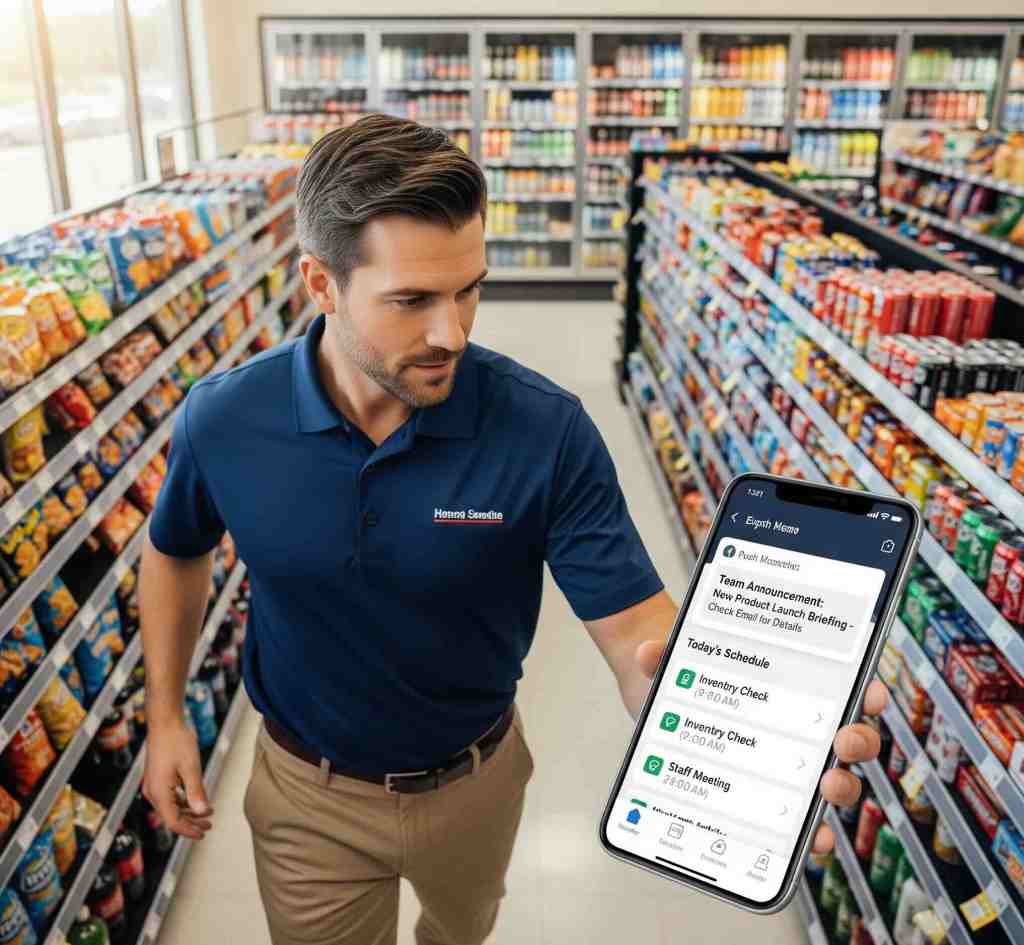
How do you communicate with a dispersed, hourly workforce? The old way, a crowded breakroom bulletin board, is inefficient. Relying on managers to relay information between shifts is full of holes. It’s a method that breeds miscommunication and is simply not sustainable in today’s environment, where 70% of employees don’t work at a desk.
This is where modern digital tools become a strategic advantage. They provide the clarity and consistency that you, as a leader, need to manage a business on the go. For example, AI-driven scheduling is a prime solution, providing the “flexibility” that a Legion survey found is the number one factor in persuading hourly employees to take a new job. Mobile employee apps, meanwhile, offer a way to instantly communicate with every team member. They deliver schedules, training materials, and announcements directly to their smartphones via push notifications. These tools solve the chronic problems of “unoptimized staffing” and “disorganized scheduling”.
Interestingly, a survey from Legion found that only 11% of hourly managers are actually using AI scheduling tools, which points to a massive opportunity for early adopters. These are not just tech upgrades; they are tools that directly enable the “Clarity Over Charisma” principle. These solutions reduce the “administrative overhead” of logistics. This reduction frees up your managers to focus on what matters most: coaching and training employees. The technology manages the logistics. This allows you to focus on the human element. This element is the most critical factor in your business.
What You Should Be Doing
- Evaluate AI Scheduling Solutions: Look into AI tools that automatically generate optimal schedules based on demand projections and employee availability. This not only makes your operation more efficient but also provides the flexibility your team members want, which is key for attracting and retaining talent.
- Explore Employee Communication Apps: Find a mobile app that allows you to reach your team members no matter where they are. Look for features such as a space for news updates, schedules, training materials, and feedback surveys. This replaces the unreliable “grapevine” with a single source of truth.
For more information, see “Three Common C-Store Labor Challenges (and How to Solve Them)” from RetailTouchPoints.com and “Why Internal Communication in Retail Is Hard but Oh-So Important” from Staffbase.com.
The “Soft Skills” That Build a “Sticky” Team
Let’s go back to that surprising statistic: 23% of employees leave because of a negative work environment. A former C-store worker was quoted in a report saying, “Nowadays, you don’t really get recognition for anything or even just a thank you from the manager”. This tells us that the “soft” factors, the culture you create, are a powerful determinant of employee retention. A positive, empathetic culture is a competitive advantage that directly combats the second-leading cause of turnover. It creates a “sticky” team that is emotionally invested in the business.
A leader focused on clarity, empathy, and consistent feedback can create an environment where employees feel “seen and valued“. This directly addresses the core emotional drivers of turnover and transforms your team into a resilient, highly engaged asset. This is where you, as a leader, can step in and make a monumental difference.
What You Should Be Doing
- Listen to Understand, Not Just to Reply: Practice active listening. When an employee comes to you with a problem or a suggestion, listen without interrupting. Ask open-ended questions like, “What feedback are you getting from customers?” and repeat back what you heard to confirm understanding. This not only gives you “critical frontline insight” but also makes your team members feel heard and valued.
- Provide Constructive Feedback with Clarity and Empathy: Feedback shouldn’t be a dreaded conversation. Use a simple framework like the SBI Method (Situation, Behavior, Impact). For example:
- Situation: “Yesterday, when you were stocking the soda cooler…”
- Behavior: “…you put the new drinks in the front instead of rotating the old ones to the front…”
- Impact: “…which means we have a greater chance of expired product and lost sales.”
- Deliver feedback in private, and always balance critique with praise to correct without “crushing confidence”.
- Recognize and Appreciate Genuinely: Simple gestures have a huge impact. Recognize personal milestones, provide snacks on a particularly busy day, or give a handwritten thank-you note. These small actions show your team you see them as human beings, not just roles to fill.
For more information, see “How Retail Leaders Can Improve Their Communication Skills” from MyHFA.org and “The pay problem: wages remain c-stores’ biggest labor barrier” from CStoreDive.com.
The Bottom Line: It’s Time to Lead with Clarity
At the end of the day, your convenience store is not just a collection of products; it’s a team of people. You can have the best merchandise. You might have the most modern pumps and the cleanest restrooms. However, if your team isn’t engaged, your business will never reach its full potential.
The most powerful thing you can do is focus on clear, consistent communication. This will build a more profitable, engaged, and resilient business. It’s not about charisma or having a bigger personality. It’s about creating an environment where every team member knows what’s expected, feels confident in their role, and knows they are valued.
Start with a single step. Implement the “Tell, Show, Do” method with your next new hire. Use an app to post a daily announcement. Listen actively during your next conversation with a team member. Building a better team is not a one-time event; it’s a continuous journey. And it all begins with you, the leader, choosing to lead with clarity.





 The5For
Leave a comment