(IMPORTANT: This seven-part series offers operational strategy and professional insights. It is provided for informational and educational purposes only and is not legal or regulatory advice.
Age-restricted sales regulations are constantly changing and vary significantly by locality (city, county, and state).
Before implementing any strategy or technology discussed here, you must verify all requirements with your local and state regulatory agencies and consult with legal counsel. Compliance remains your sole responsibility.)
You successfully implemented the profit-transfer strategies from Post 2 to offset your T21 losses; your next move was likely to maximize the sales of the alternative tobacco category: vapor products. This is where the compliance risk elevates from a potential fine to an existential, store-closing threat.
As an operator, you must understand a critical shift in enforcement: the FDA is no longer solely focused on whether your employee checked an ID. They are now primarily focused on whether the products on your shelf are legal to sell at all.
The catastrophic financial exposure is now rooted in inventory choice. The FDA is currently engaged in a massive, ongoing enforcement campaign against retailers selling unauthorized, disposable, flavored vaping products. Why? The agency has only granted marketing authorization (PMTA) to approximately 39 specific e-cigarette products and devices. These are primarily closed systems flavored with tobacco or menthol. The vast majority of the flavored, puff-bar-style disposable vapes that drive massive sales volume in your store are strictly prohibited from sale.

The Staggering Cost of Non-Compliance
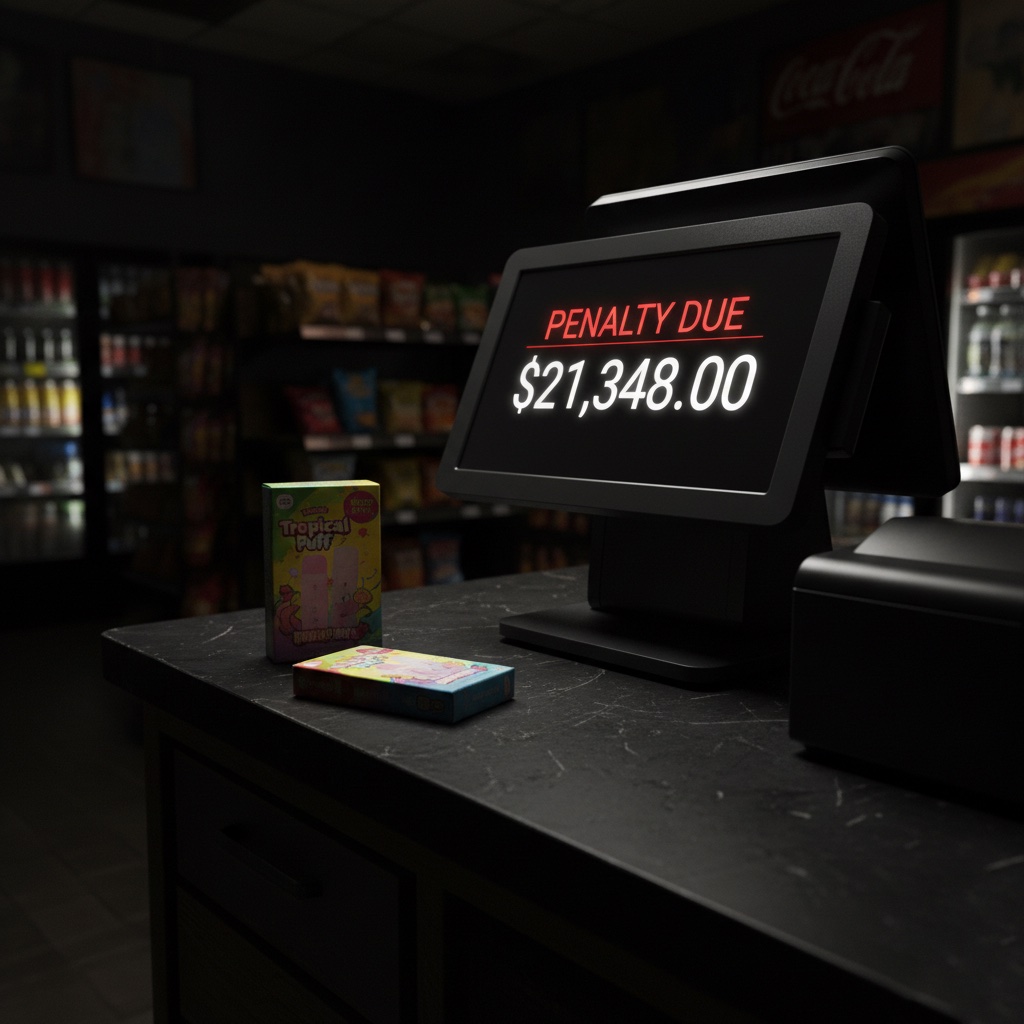
This situation presents an immediate, unforgivable threat to your cash flow. The FDA has been decisive. It issued warning letters to hundreds of retailers. It also filed Civil Money Penalty (CMP) complaints against 146 brick-and-mortar stores. The financial exposure is extreme: a single violation resulting in a CMP can carry a maximum statutory fine of up to $21,348.
Think about that number. For an independent owner-operator, $21,348 is not a budget line item; it’s the annual profit, or worse, the working capital that keeps your doors open. Selling unauthorized products like Geek Bar or Lost Mary is risky. The FDA is actively targeting these products. It is equivalent to carrying a ticking financial time bomb on your shelf. You cannot sell enough units to offset a single four-figure fine, let alone a multi-violation action.
This is why, as a small business consultant, I argue that the maximum regulatory fine is now driven by your procurement decisions, not just your cashier’s diligence. Furthermore, the statistics show independent C-stores are especially vulnerable, with high rates of sales violations (74.5%) even after T21 was implemented. This compliance disparity highlights the immediate need for a robust system that protects you at the supply chain level.

Auditing Your Assortment Before the Knock
The retailer is the last line of defense, and the entire liability rests with you at the point of sale. You cannot rely on a distributor’s assurance that a product is legal.
To mitigate this risk, you must adopt a strict, zero-tolerance assortment audit checklist.
What You Should Be Doing
Your immediate action is to treat every vaping product on your shelf as a potential financial liability until proven otherwise.
- Execute a Full Inventory Audit: Assign a management-level employee to cross-reference every vaping SKU you carry against the FDA’s official searchable database of Premarket Tobacco Product Marketing Granted Orders (PMTA List). This searchable list is designed specifically to help retailers determine what can be legally marketed in the U.S.
- Establish a Zero-Tolerance Policy for Unauthorized Disposables: If a product, especially a flavored disposable that appeals to youth (e.g., bright colors, candy names), is not on the authorized list, it must be pulled from the shelf immediately and returned to the supplier or destroyed. Do not wait for a warning letter.
- Educate Staff on Inventory Risk: Train your cashiers not just on age-gating, but on the type of product they are selling. They must understand that selling an unauthorized product, even to an adult over 21, is a direct, maximum-penalty violation.
- Log and Document Product Removal: Keep a log of all unauthorized products you identify and pull. This documentation proves your commitment to compliance and can serve as a mitigating factor should you face an auditor.
The Bottom Line: Don’t Fight It
By focusing on inventory legality, you secure your store against the FDA’s heaviest fines. We are looking for the next generation of high-margin products to replace these losses. In doing so, we move into the newest category, which is also the most volatile: hemp-derived cannabinoids.
In Post 4, we will dive into The Hemp Liability Trap: I will explain the fundamental conflict between federal and state law, why the FDA can seize your THC-infused beverages as “unapproved food additives,” and how a single product choice can lead to severe reputational damage.






 The5For
Leave a comment