(IMPORTANT: This seven-part series offers operational strategy and professional insights. It is provided for informational and educational purposes only and is not legal or regulatory advice.
Age-restricted sales regulations are constantly changing and vary significantly by locality (city, county, and state).
Before implementing any strategy or technology discussed here, you must verify all requirements with your local and state regulatory agencies and consult with legal counsel. Compliance remains your sole responsibility.)
In Post 4, we established the severity of the Hemp Liability Trap, driven by the conflict between federal hemp law and FDA food safety regulations. Now, we confront the most complex issue in this category: the regulatory patchwork. Since there is no federal age mandate for hemp products, compliance is defined by an ever-changing map of state and local rules.
For operators in states with minimal regulation, like Wisconsin, this creates maximum liability. Wisconsin is one of only a handful of states that neither ban nor comprehensively regulate Delta-8 THC. This lack of statewide control means local jurisdictions are forced to react to public crises, resulting in severe, inconsistent ordinances. For example, following a public incident, Milwaukee County adopted an ordinance setting a mandatory 21+ minimum sales age for all hemp-derived intoxicants, with fines up to $1,000 per occurrence for violations.
This environment of reactive, punitive local laws puts the entire burden of due diligence squarely on your shoulders.

The Power of Benchmarking: Using Regulated Neighbors
If you operate in an unregulated area, your most powerful legal defense is to adopt strict compliance standards. These should be from regulated neighboring markets. These standards act as your legal benchmark. They demonstrate that you instituted a robust protocol to minimize intoxication risk. This ensures community safety.
In this example, you could use the standards set by Minnesota as your operational ideal. Their laws provide clear, defensible guardrails that mitigate both public health risk and regulatory fallout.
Proactively adhering to the Minnesota standard ensures compliance with a 21+ age limit and a maximum of 5 mg THC per serving. This adherence provides the retailer with a strong legal defense. It proves that you operated above the minimum legal requirement in the interest of public safety.

he Supply Chain Vetting Shield: The COA
Your other non-negotiable compliance tool is the Certificate of Analysis (COA). The COA is the only way to prove you rigorously vetted a product before sale. Mislabeling is common in this unregulated sector. The COA is your shield to shift liability upstream. It protects you by placing the responsibility on the supplier or manufacturer if a product is later found to be non-compliant or contaminated.
What You Should Be Doing
Move beyond vague compliance promises and institute these hard, measurable standards immediately.
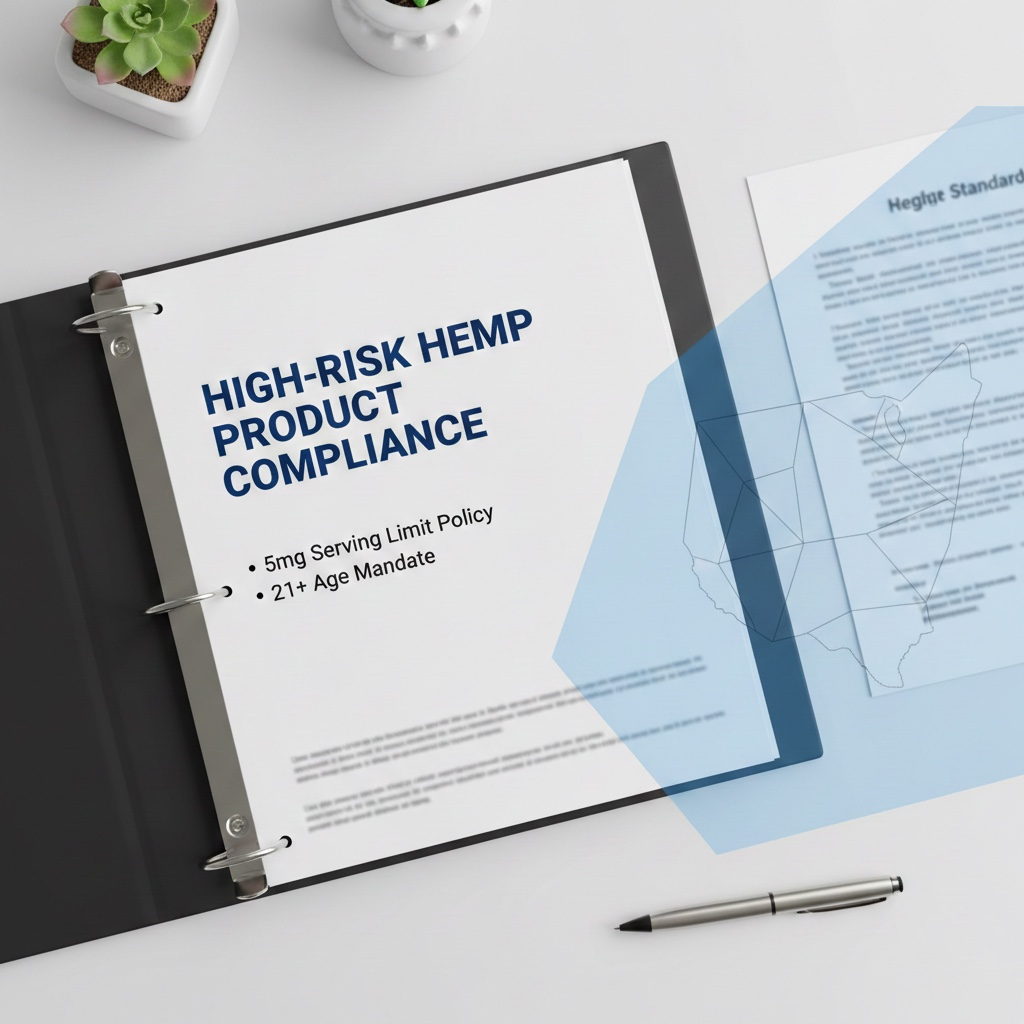
- Establish a 5mg Serving Limit Policy: For any intoxicating Delta-8 or THC product, mandate that it cannot exceed 5 mg of Delta-8 or Delta-9 THC per serving. If you sell a beverage, ensure it is limited to 10 mg total THC per container. This sets a safe, defensible product standard.
- Mandate the 21+ Age Check: Establish a store-wide policy. It should require that all hemp-derived cannabinoid products need an ID check. The ID must confirm the customer is 21 or older, regardless of the local or state law minimum.
- Implement a COA Vetting Checklist: Require a valid COA from every supplier for every batch. The COA must meet these criteria:
- Third-Party Validation: Issued by an ISO-accredited, independent laboratory.
- Potency Verification: Clearly shows Delta-9 THC content is below the 0.3% dry weight limit and that labeled potency is accurate.
- Contaminant Safety Clearance: Confirms the product is free from heavy metals, pesticides, and residual solvents.
- Document Traceability: Ensure the COA contains the manufacturer’s name, batch details, and contact information for full traceability.
The Bottom Line: Establish A Framework
We have now established the compliant framework for all your high-risk inventory. But a policy is only as good as the technology and people who enforce it. The next logical step is to invest in the tool that removes human error from the equation.
In Post 6, we will discuss License Insurance: Why Automated 2D ID Scanners are a Better Investment than $21K in Fines. I will quantify the incredible Return on Investment (ROI) of this essential technology.







 The5For
Leave a comment