From Afterthought to Asset, Reimagining Your Coffee’s Last Mile
As an owner or operator, you already know that your coffee program is an absolute powerhouse. It’s the engine that drives morning traffic. It fuels customer loyalty. It boasts average profit margins of around 40%. These margins are significantly higher than your store’s overall average. You invest heavily in beans, machines, and promotions to get that high-margin cup into your customers’ hands.
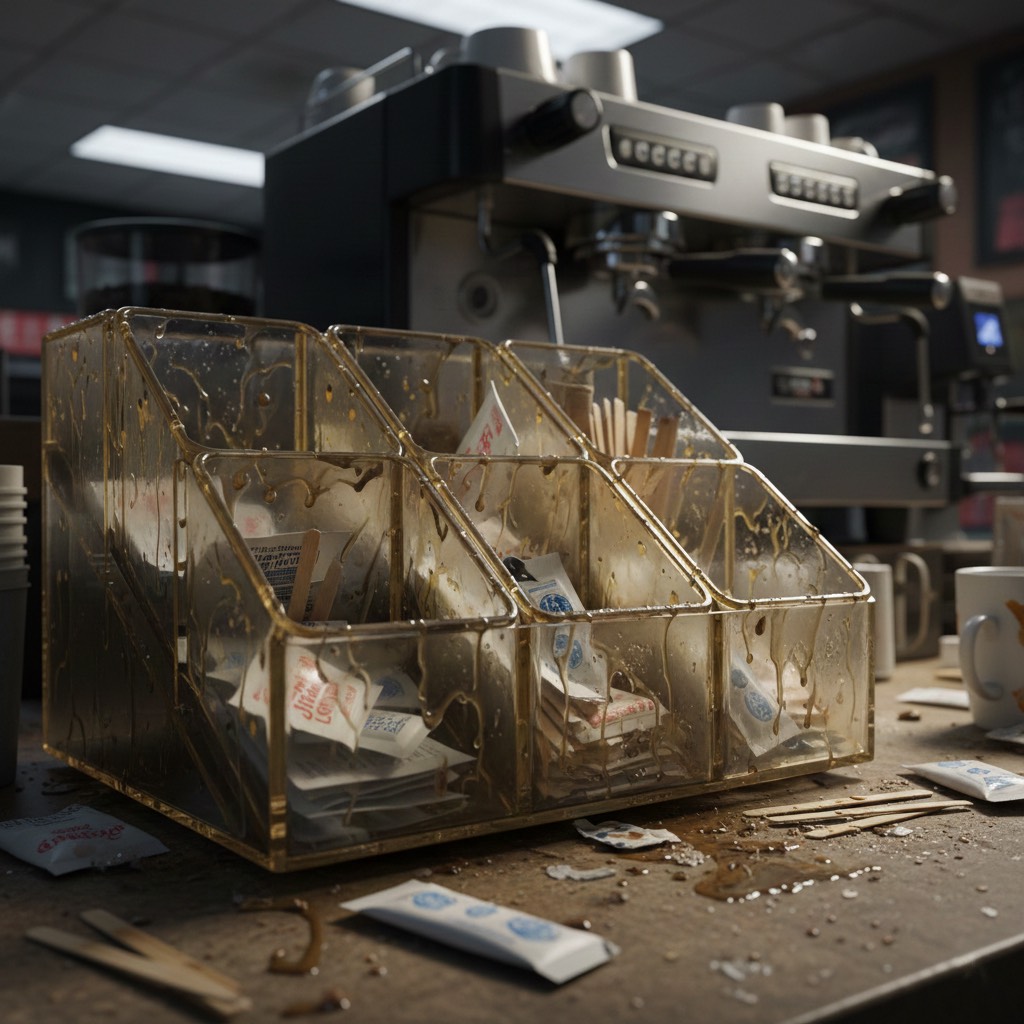
But here is the critical point: all that effort can be instantly negated by the customer’s final interaction, the “last mile” of the coffee journey, at a messy, cluttered, or visibly aged, self-service condiment station.
Think about it: A customer just paid a premium price for a specialty coffee. Now, they are confronted with sticky counters, scratched plastic bins, and disorganized packets. What message does that send about the quality of the product they just bought, and more importantly, the cleanliness of your entire store?
This is why I’m launching this comprehensive seven-part series. We are going beyond basic clean-up. We are addressing the underlying infrastructure problem. The issue is the failure of conventional, low-quality acrylic and plastic fixtures. We will make the strategic case for upgrading to a professional, engineered modular steel system. This system maximizes hygiene and optimizes counter space. It elevates your brand’s perceived value. Ultimately, it drives higher sales and stronger loyalty.
Over the next few posts, we will cover the transformation of your self-service area from a high-risk operational headache into a powerful, revenue-generating asset. We’ll break down:
- The Failure of Plastic: The hidden hygienic and structural vulnerabilities of traditional displays.
- The Material Advantage: Why durable, powder-coated steel is engineered for superior cleanability and a 10+ year lifespan.
- Operational Efficiency: How modular design maximizes tight counter space around existing equipment.
- The True Cost: A Total Cost of Ownership (TCO) analysis shows that cheap plastic seems inexpensive at first. However, it is actually the most expensive choice in the long run.
- The Premium Effect: How organized, attractive fixtures increase customer willingness-to-pay (WTP) and revisit intentions.
- Your Action Plan: A synthesis of the entire strategy with clear steps for implementation.
This series aims to equip you with the knowledge to make a strategic infrastructure investment. Such an investment will pay dividends for years to come. Let’s start today by establishing why this area is too critical to overlook.
The Condiment Station: The Crucial “Last Mile” of Profitability
Customers buy the experience as much as they buy the product. Your coffee program is a core traffic driver, accounting for 8.4% of your foodservice sales, and in some scenarios, margins can exceed 64%. That makes your hot beverage area a non-negotiable strategic focus.
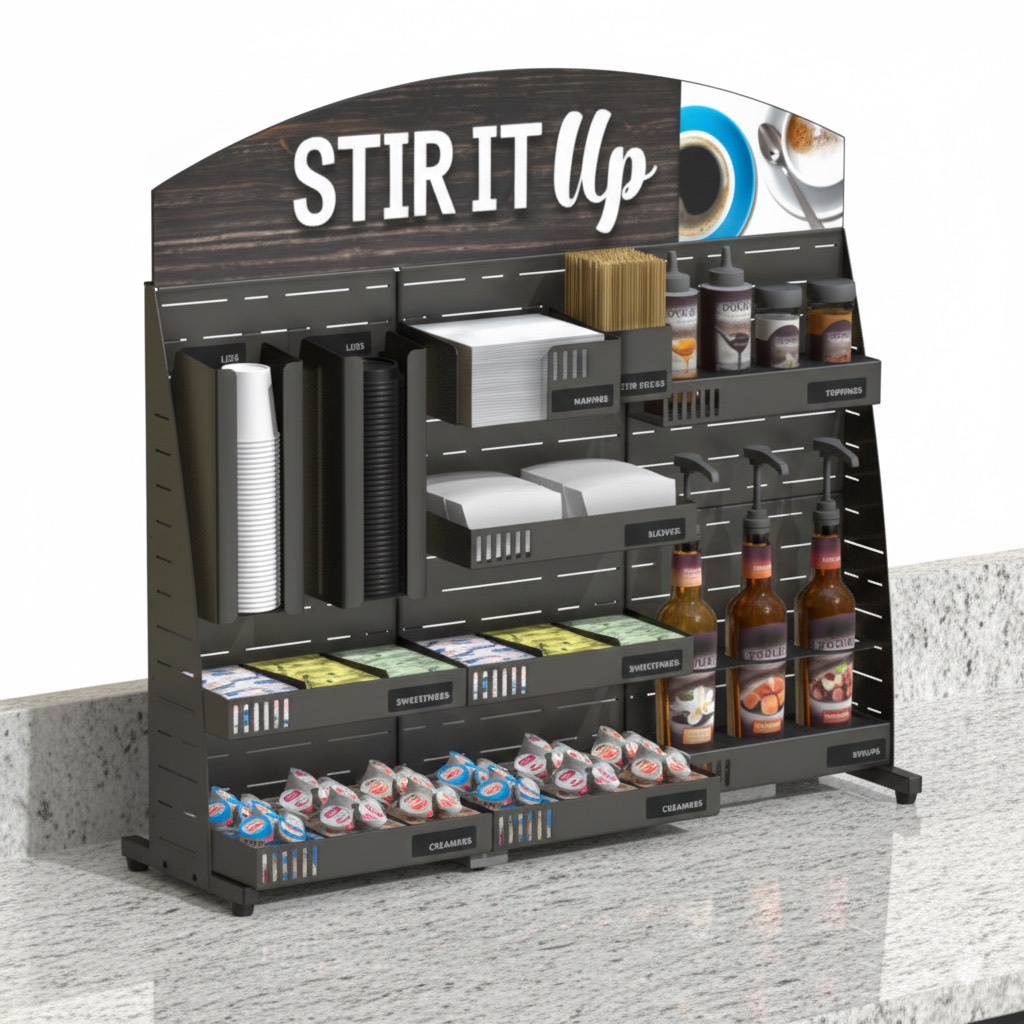
The condiment station is the final impression you leave. When customers see a clean, well-stocked, and highly organized space, they subconsciously assign a higher value and greater trust to the beverage they are about to drink.Conversely, a messy station suggests neglect, instantly eroding that perceived value. It’s a self-sabotage mechanism that high-performing competitors, like Kwik Trip and 7-Eleven, have worked hard to avoid by prioritizing a smartly designed and organized merchandising setup.
Think of this area as an extension of your brand’s promise. If you promise quality and convenience, but deliver clutter and grime, you’ve broken that promise at the worst possible moment. The display itself should be a silent salesperson, directing attention and encouraging an effortless, positive interaction. This ease of use (Perceived Ease of Use or PEOU) significantly contributes to customer satisfaction and leads directly to positive word-of-mouth and revisit intent.
What You Should Be Doing
To begin analyzing your “last mile” problem, take these immediate, actionable steps:
- Conduct a Critical Audit: Visit your condiment stations during the busiest daypart (e.g., morning rush). Photograph the station five minutes after a rush. Is it easy to find everything? Is the counter sticky?
- Establish a “First-Mile/Last-Mile” Metric: Ask your shift managers to monitor customer comments about the coffee program. Track how many complaints relate to the beverage itself versus the self-service area’s cleanliness or organization.
- Study the Leaders: Research how top C-stores manage their high-volume self-service stations. Note the materials they use, the visible organization, and the quality of their signage. Look for evidence of durable, engineered solutions rather than temporary plastic bins.
- Define Your Brand Standard: Stop viewing the condiment station as a necessary mess. Define a high standard, one that aligns with specialty coffee shops, and make that the visual goal for your team.
Investing in Engineered Excellence
The foundation of a successful C-store strategy in today’s market is a commitment to a premium experience, even in utilitarian spaces. This means moving past the limitations of low-grade materials and embracing engineered solutions like modular steel organizing systems.
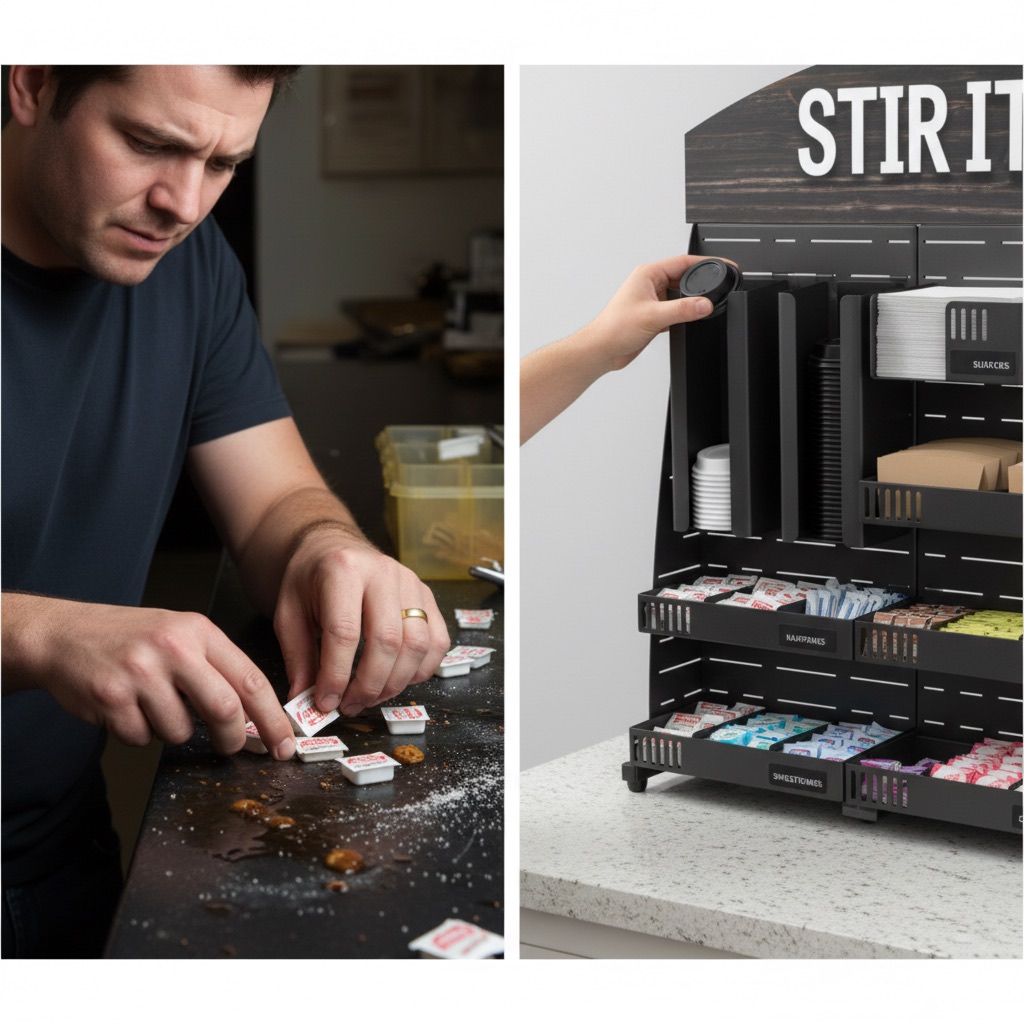
A robust system, such as PanelRak, constructed from powder-coated steel, offers durability, stability, and superior cleanability. The steel structure inherently resists scratching and provides a non-porous, smooth surface that is designed for standard, efficient cleaning. This longevity extends the fixture lifespan to 10 years or more, dramatically reducing the need for costly, disruptive capital replacement cycles.
But the benefit is not just in durability; it’s in perception. An organized, aesthetically strong display reinforces the high-quality image you want to convey. By presenting condiments and accessories in a clearly organized, robust fixture, you create a “sensory experience.” This drives customers to perceive higher prestige and quality value. In turn, this fuels their intent to purchase and revisit. This is how an infrastructure decision becomes a powerful sales and marketing tool.
This series is your guide to executing that shift. We will show you how to move from a reactive, messy, and costly system to a proactive, highly efficient, and revenue-enhancing asset.
Next Up: Deconstructing the Failure of Conventional Fixtures
I hope this has given you a compelling reason to stop accepting the status quo at your most critical self-service station. We’ve established that the condiment bar is a high-profit, high-risk area, and that traditional plastic displays are a core liability.
In our next post, we will take a deep dive into the material science and operational failures of low-cost acrylic and plastic. We will meticulously break down the hygienic flaws and the aesthetic liabilities that guarantee early replacement and compromise your food safety standards. We will look closer at the specific ways acrylic is vulnerable to scratching and how that directly translates into bacteria harborance and increased maintenance labor.
Join me next time as we begin Part 2: Stop Sabotaging Your Sales: Why Your Plastic Condiment Displays Are a Hidden Hygiene and Profit Risk.

 The5For
Leave a comment