In our last post, “Gas to Gourmet,” we explored the incredible potential of high-quality foodservice to drive basket size and redefine the customer experience in 2026. We talked about global flavors, fresh ingredients, and the shift from “fuel stop” to “food destination.” But as I was writing that, I could almost hear the collective sigh from operators across the country. I know exactly what you’re thinking: “This sounds great, but I can barely find enough staff to run the register, let alone manage a custom beverage bar or a complex international food menu.”
That is the million-dollar question for 2026, isn’t it? How do we execute higher standards with a labor pool that remains tight and expensive? The answer lies in technology. But before you roll your eyes, let me be clear: I am not talking about buying robots that look like humans or investing in “vaporware” that promises to fix everything by magic.
We have moved past the era of generic “AI hype.” In 2026, the successful c-store operator is using task-specific technology to solve very particular operational headaches. You can use camera vision to monitor your roller grills, so your staff doesn’t have to. You can also deploy automated hiring platforms that screen candidates while you sleep. Technology is no longer an “extra.” It is the backbone of your workforce strategy.
I’ve spent the last year watching retailers like Circle K, RaceTrac, and even agile single-store operators. They bridge the gap between their marketing and IT teams. This creates a seamless customer experience. They are using data not just to “track” sales, but to drive them through Retail Media Networks and AI-powered loyalty programs that offer the right discount to the right customer at the exact moment they’re at the pump.
In this post, I will break down the five most practical, profitable, and accessible technology applications for convenience stores in 2026. This isn’t about science fiction. It’s about tools you can implement today. Use them to reduce waste, solve labor shortages, and create new revenue streams from your shopper data. Let’s look at the tech that actually moves the needle and frees you up to focus on what matters most: your business.
1. Task-Specific AI for Operational Efficiency
Forget the buzzword “chatbots” or the idea that AI is going to take over the world. In the convenience store industry of 2026, the best AI is “invisible.” It works in the background, handling the mundane, repetitive tasks that humans generally dislike or forget to do. The most powerful application we are seeing right now is Computer Vision.
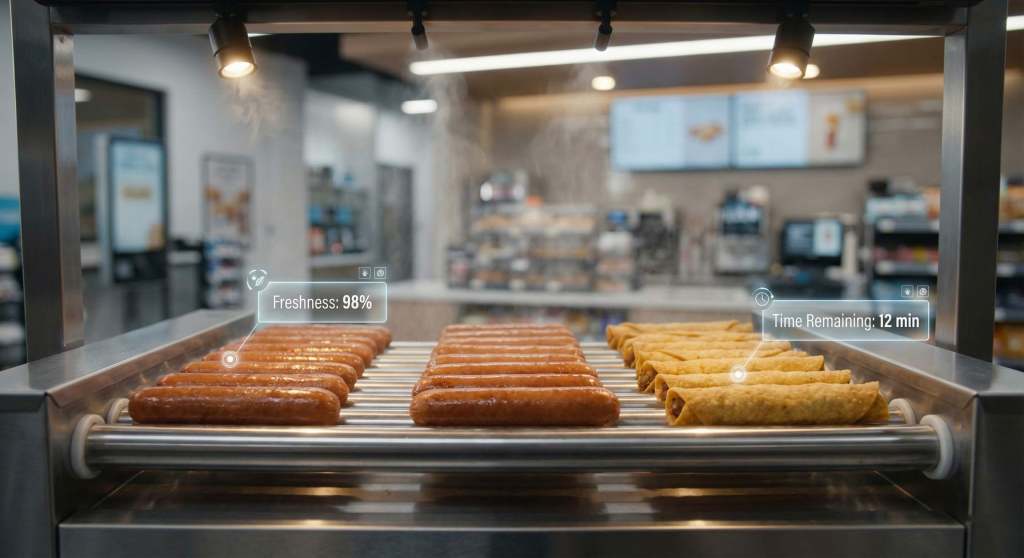
Retailers like Stinker Stores have pioneered the use of camera vision to monitor food on roller grills. In the past, you relied on a busy cashier to remember to check the grill every 30 minutes, write down waste logs, and guess how many hot dogs to put on at 2:00 PM. Humans are bad at this; we get distracted.
Computer vision systems, however, know exactly which hot dog is selling and when. They track freshness levels based on visual cues and time on the grill. This creates an actionable production plan that tells your staff exactly what to cook and when to cook it. The result is a reduction in waste by over 60% in many cases. More importantly, it ensures your high-margin food is visually appealing and available during peak hours, preventing that dreaded “empty grill” look that kills sales.
What You Should Be Doing
- Audit Your “Boring” Tasks: Identify which tasks take up the most staff time or suffer from the most human error (e.g., restroom checks, monitoring cooler stock levels, or grill logs).
- Start Small with Vision: Look for a “plug-and-play” camera solution specifically for your food service area. You don’t need a full store overhaul; start with the high-waste areas.
- Digitize Checklists: If AI is out of budget, move from paper checklists to digital apps that timestamp when tasks are done. This creates the data baseline you’ll need for AI later.

2. Automated Hiring and Labor Optimization
Hiring is, without a doubt, the industry’s biggest pain point. The “ghosting” phenomenon, where applicants apply and never show up for an interview, is rampant. In 2026, we are seeing the rise of AI-driven recruitment tools that use science-backed assessments to screen candidates for reliability and service skills in under 20 minutes.
These platforms integrate directly with your job postings. When a candidate applies, an AI chatbot immediately engages them via text message. It asks pre-screening questions (e.g., “Can you work weekends?”, “Do you have reliable transportation?”) and, if the answers match your needs, it automatically schedules an in-person interview on your calendar.
This frees your managers from hours of reviewing resumes and playing phone tag. It also capitalizes on speed. In the current market, the operator who responds first usually gets the hire. AI ensures you respond instantly, 24/7, helping you fill roles faster with better matches.
What You Should Be Doing
- Streamline Your Hiring Process: Test an AI-based recruitment tool (like paradoxical.ai or similar platforms) for your next open position.
- Measure Time-to-Hire: Compare the time-to-hire and the quality of the candidate from the AI tool versus your traditional manual process.
- Automate Scheduling: Ensure your system syncs with your store manager’s calendar, so interviews are booked automatically, removing the administrative bottleneck.
3. Monetizing First-Party Data with Retail Media Networks (RMNs)
Your store is a data gold mine, but for years, only the big grocery chains knew how to dig it up. That has changed. Retailers like Loop Neighborhood Markets have launched proprietary networks, such as “LoopMedia Connect,” to monetize their customer insights.
Retail Media Networks (RMNs) allow you to sell digital ad space to CPG brands, like Coke, Frito-Lay, or Monster. You can do this on your own digital assets. These include your fuel pump screens and in-store digital signage. You have the data on what customers are buying. This allows you to integrate ads directly onto fuel pump screens. You can “nudge” customers with personalized offers before they even finish fueling.
This is significant because these networks can support margins of up to 90%. You are essentially selling “eyeballs” and “data,” not physical inventory. It provides a completely new revenue stream that helps offset the tight margins on fuel and cigarettes.
What You Should Be Doing
- Explore “Pump-to-Store” Conversions: If you have digital screens at your pumps, start a pilot program with a vendor to feature “Limited Time Offers” (LTOs) that are only available for the next 15 minutes.
- Audit Your Screens: Take inventory of every digital screen in your store. Are they playing static loops, or are they dynamic?
- Reach Out to Vendors: Ask your top 5 DSD (Direct Store Delivery) vendors if they have “trade marketing” budgets available for digital advertising in your store. You might be surprised to find they will pay for placement on your screens.
4. Frictionless Checkout and Unattended Retail
To combat labor shortages, some stores are moving toward fully automated models. We aren’t just talking about the clunky self-checkout lanes of the past. We are talking about “scan and go” apps and robotic kiosks like VenHub that run 24/7.
Frictionless checkout reduces wait times to as little as 90 seconds. For the morning rush coffee customer, speed is the primary loyalty driver. If they see a line, they leave. By offering a mobile checkout option, you capture that sale.
Furthermore, automated retail has a security component. For overnight shifts, some operators are utilizing unattended kiosks or “window service” modes where the store is locked, and transactions happen through a secure automated drawer. This eliminates the risk of violent crime against workers during vulnerable hours while keeping the revenue stream open.
What You Should Be Doing
- Identify Bottlenecks: Watch your counter during the morning rush (7 AM – 9 AM). If lines exceed 3 people, you are losing sales.
- Test Mobile Checkout: Investigate your current POS provider’s capabilities. Many modern systems (like Clover, Square, or Verifone) have “scan and go” modules you can activate.
- Review Night Shift Safety: If you struggle to staff the graveyard shift, consider if a tech-enabled “kiosk mode” or window service could allow you to operate with fewer (or safer) staff hours.
5. AI-Powered Hyper-Personalized Loyalty
The 2026 loyalty program is about more than just “buy 6, get 1 free.” That is a punch card, not a strategy. We are now using AI to deliver one-to-one offers based on real-time behavior.
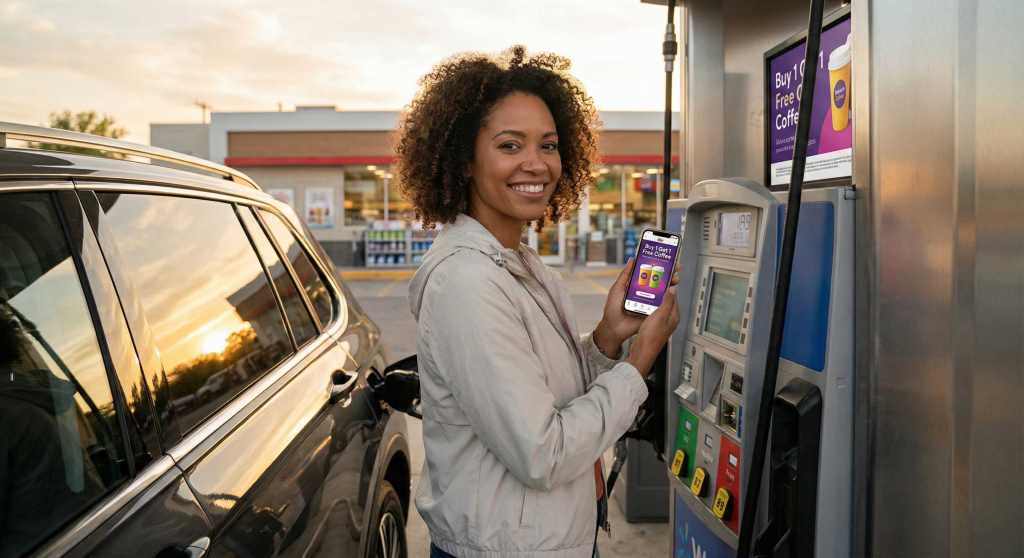
For example, if a customer is at the pump and the system recognizes it is a Tuesday morning, the AI knows this specific customer usually buys a coffee but hasn’t in two weeks. It can instantly send a “Buy 1, Get 1” coupon to their phone while the gas is still pumping.
This “nudge” strategy has been shown to lift wallet share by 17% in a single month. It shifts marketing from “broadcasting” (sending the same email to everyone) to “narrowcasting” (talking to one customer at a time). It makes the customer feel seen and valued, which is the ultimate retention tool.
What You Should Be Doing
- Optimize Your Loyalty Data: Ensure your loyalty program isn’t just a “paper punch card” in digital form. You need data on who is buying what.
- Segment Your List: Talk to your POS or Loyalty provider about using AI to segment your members into “Loyalists,” “Frequent,” and “Infrequent.”
- Run A/B Tests: Try sending a coffee offer to one group and an energy drink offer to another based on past purchase history. Measure the redemption rates to see the power of personalization.
The Bottom Line: Make Technology Your Partner
When we look at the landscape of 2026, one thing is abundantly clear: Technology is the great equalizer. In the past, only the massive chains had the budget for data intelligence and automation. Today, SaaS (Software as a Service) models have made these tools affordable for single-store operators and small chains.
It allows a small operator to have the same “data intelligence” as a massive chain like Circle K. By “walking before you run” and focusing on the basics, like inventory accuracy, labor scheduling, and digital loyalty, you build a foundation that can support future innovations.
The most important takeaway for 2026 is that technology should serve your staff and your customers, not replace the human touch entirely. While 93% of consumers still prefer human interaction for complex support, they absolutely want the speed that technology can provide. They desire the personalization that only technology can offer for their daily transactions. Our goal is to use tech to handle the “boring” stuff, the counting, the scheduling, the monitoring, so our people can handle the “hospitality” stuff.
I know the cost of technology can be daunting, especially with higher interest rates making loans more expensive. However, when you look at the ROI, like the 19% increase in transactions seen through unified loyalty platforms or the 60% reduction in food waste from computer vision, it becomes clear that the “cost of doing nothing” is much higher.
In our next post, we’re going to look at the other side of the profit equation: margin protection. We’ll talk about why private labels are the ultimate defense against tariff-driven price hikes and how managing your energy and refrigerants can “find” thousands of dollars hidden in your operational budget.
Join me for Post 6: 5 Margin-Protecting Strategies for Private Labels and Energy Efficiency.

 The5For
Leave a comment