How to turn Condiments and Snacks into Traffic Drivers
Welcome back to The Swangy Paradigm. If you have been following along with our series, you are already well-versed in the theory behind the flavor revolution taking over the convenience channel. In Part 3, we identified the “Who”, the Hero Ingredients like Chamoy, Tamarind, and Hot Honey that act as the vehicles for this flavor profile. We discussed how these ingredients bridge cultural gaps and satisfy the biological cravings we identified in Part 2 (thanks again, Ozempic!). We established that the demand is real, the science is sound, and the ingredients are available.
But now, the rubber meets the road. I know exactly what many of you are thinking right now because I hear it from operators in the field every single day: “I get it. ‘Swangy’ is popular. But I don’t have a full commercial kitchen; I can’t hire a sous chef, and I certainly can’t afford to overhaul my equipment package just to chase a flavor trend.”
If that thought crossed your mind, I want you to take a breath. Here is the best news you will hear all day: You don’t have to.
“Swangy” is what we in the retail industry call an Accessory Trend. Unlike structural trends, which might require you to install new vent hoods, high-speed ovens, or dedicated fryers, accessory trends live in the toppings, the sauces, and the pre-packaged goods. You do not need to rebuild your kitchen or remodel your floor plan to capture this market. You just need to change what goes on the food you already sell and rethink how you merchandise the shelves you already have.
In this post, we are moving from theory to hard tactics. I am going to guide you on how to operationalize the Sweet, Tangy, and Spicy profile. This will apply across your condiment bars, your foodservice programs, and your center store gondolas. We are going to focus on low-drag, high-impact changes that drive immediate traffic and increase basket size without breaking your capital expenditure budget.
The Sauce is the Boss: The Condiment Bar Upgrade
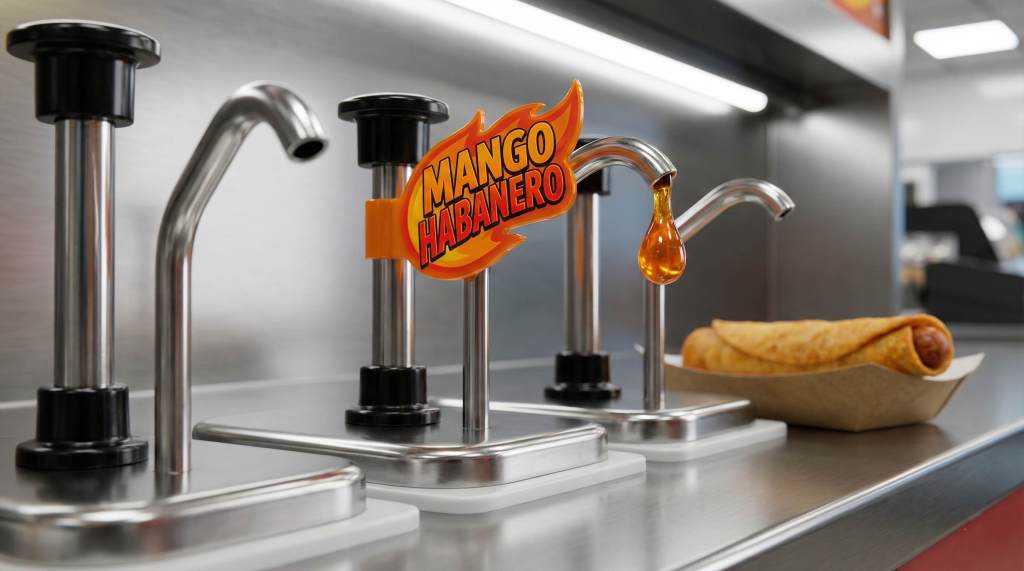
The single most effective, low-cost way to operationalize a flavor trend in a convenience store is through your condiment station. For decades, the industry standard has been the “Holy Trinity” of ketchup, mustard, and relish. While these are operational necessities, relying on them exclusively means you are ignoring 40% of your potential flavor profile.
Today’s consumer, especially the Gen Z and Millennial demographic driving c-store food sales, views food as a customizable experience. They want to be the architect of their own flavor. Industry data consistently shows that sauces featuring Mango Habanero, Sweet Thai Chili, and Spicy Maple are seeing triple-digit growth in foodservice sectors. If your pumps are only dispensing yellow mustard, you are essentially telling these customers that your food is stuck in 1995.
The strategy here is what I call the “Pump Swap.” You don’t need to add counter space; you need to optimize it. Replace a redundant tub of yellow mustard with a “Swangy” Limited Time Offer (LTO) sauce. Swap a slow-moving relish with this new sauce. You instantly premiumize every item on your roller grill. A standard corn dog becomes a “Sweet Chili Corn Dog.” A basic breakfast sandwich becomes a “Maple-Sriracha Biscuit.” The cost of switching the bag-in-box is negligible, but the perceived value to the customer is massive.
What You Should Be Doing
- Execute a “Sauce Audit”: Walk your store immediately after reading this. Look at your condiment pumps. If you do not have a spicy-sweet option, contact your supplier to order a Mango Habanero, Honey Sriracha, or Pineapple-Jalapeño option immediately.
- Signage is Key: Don’t just put the sauce out and hope people notice; market it. Use “flavor flags” or pump toppers that say, “Try it Swangy” or “Spice Up Your Morning.” Guide the customer to the new experience.
- Rotate Quarterly: Treat your sauce pumps like rotating beer taps. Keep the staples (Ketchup/Mustard) but rotate that “Swangy” pump every 90 days to keep the menu feeling fresh without changing the core food items.
Case Study: The Casey’s Masterclass
When we talk about operationalizing trends without reinventing the wheel, we must look at Casey’s. They are absolute masters at utilizing existing SKUs to create “new” products that feel premium and trendy.
Recently, Casey’s launched a BBQ Brisket Pizza as an LTO. Let’s break down the anatomy of this product to see why it worked so well. They didn’t invent a new dough; they used their existing, beloved made-from-scratch crust. They added brisket (signaling a premium protein perception) and jalapeños (providing the spicy element). But the linchpin that tied it all together was the sauce: Sweet Baby Ray’s BBQ Sauce.
This is the “Swangy” paradigm in action. The sauce provided the Sweet and Tangy elements, while the peppers provided the heat. It was a perfect execution of the flavor profile we are chasing.
Why it worked
- Brand Leverage: They used a recognizable CPG brand (Sweet Baby Ray’s) to signal quality.
- Flavor Balance: It hit the specific craving profile we discussed in Part 2.
- Low Operational Drag: It required no new equipment, just a variation in assembly using ingredients that are easy to source.
You can replicate this logic even if you don’t have Casey’s scale. It is about combining a familiar base (pizza, hot dog, chicken tender) with a bold, branded sauce that elevates the profile.
What You Should Be Doing
- The “Swangy” LTO: Look at your current hot food menu. Can you create a “Friday Night Flavor” bundle? For example, a pepperoni pizza sold with a side of Mike’s Hot Honey dip cups. You aren’t changing the pizza; you are selling the experience of the drizzle.
- Leverage Branded Ingredients: If you use a recognizable sauce (like Frank’s RedHot or Sweet Baby Ray’s), put that brand logo on your menu board. It builds trust and justifies a higher price point.
- Cross-Merchandise: Place bottles of the sauce you use on the pizza next to the warmer. If they like the slice, they might buy the bottle.
Trendjacking: The “Viral Kit” Opportunity
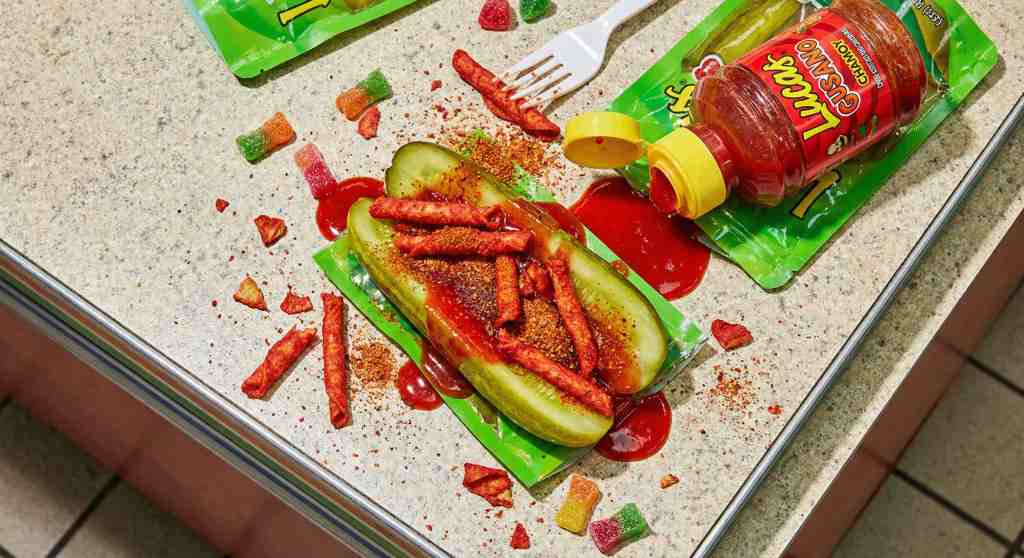
We touched on this briefly in the introduction, but we need to drill down on the Chamoy Pickle Kit. This is a trend that was literally born in convenience stores and gas stations, yet many operators watched it happen without participating.
On TikTok, users began filming themselves buying a large “Pouch” dill pickle, a bottle of Chamoy, some Tajín seasoning, and spicy gummy candies (like Takis or spicy worms). They would take these items out to their car, hollow out the pickle, stuff it with the candy, pour in the Chamoy and Tajín, and eat it. It was messy, visceral, and incredibly viral.
This is “Trendjacking” at its finest: taking a social media moment and turning it into an impulse buy. Smart operators stopped waiting for customers to find these items separately and started bundling them. This turns a $2.00 transaction into a $10.00 “experience” transaction.
What You Should Be Doing
- Build the Kit: Don’t make the customer hunt. Create an “As Seen on TikTok” endcap or counter display. Bundle a Big Papa Pickle, a small bottle of Lucas Chamoy, and a bag of spicy rolled tortilla chips.
- Pre-Packaged Solutions: If you don’t want to bundle it yourself, look for distributors selling pre-made kits like the Food Crush Chamoy Pickle Kit.
- Watch the “Pickle” Space: Pickle-flavored everything is trending up because it is the entry-level “tangy” flavor for the American palate. Stock Spicy Dill Pickle chips and pickle-infused sunflower seeds to capture the overflow interest.
Snack Aisle Reinvention: Let the Manufacturers Do the Work
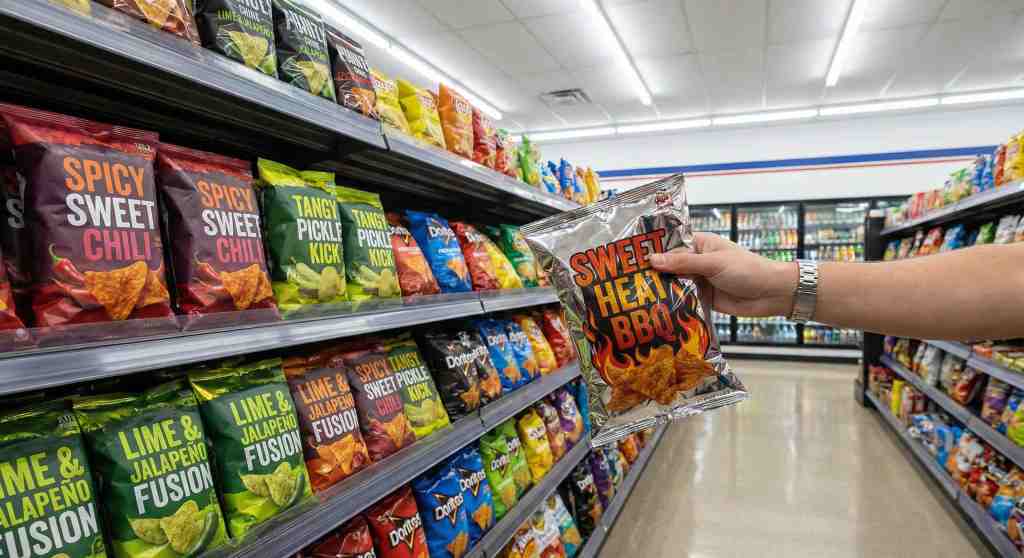
Finally, let’s look at the “Center Store.” This is where “Swangy” scales without you lifting a finger. The major CPG manufacturers have entire R&D departments dedicated to tracking these flavor trends, and they are aggressively launching products that fit the profile.
Frito-Lay has been aggressive here. We are seeing products like Doritos Tangy Pickle and Lay’s Flavor Burst Sweet Tangy Chili hitting the shelves. These aren’t niche items for health food stores; these are mass-market volume drivers intended for your core demographic.
Similarly, look at the explosion of “Protein Popcorn.” Brands like Omaha Protein Popcorn are moving beyond butter and salt into “Sweet Chili Lime” profiles. This hits the “Healthy” snacker who wants flavor density without the guilt, a direct operationalization of the Ozempic effect we discussed in Part 2. When customers eat less volume, they demand more flavor per bite. These products deliver that.
What You Should Be Doing
- Talk to your DSD Rep: Ask your Frito-Lay or Snyder’s-Lance rep specifically for their “Spicy/Tangy” SKUs. Ask them what is testing well in urban markets and get it on your shelves.
- Prioritize “Flavor Density”: When deciding between a third facing of Plain Potato Chips or a new “Sweet Heat BBQ” chip, choose the flavor. The consumer is bored with plain.
- Bundle with Beverages: The “Swangy” flavor profile induces thirst. Merchandise these spicy-tangy snacks next to craft sodas that cut the heat, like grapefruit sodas (Squirt) or citrus-heavy energy drinks.
The Bottom Line: Low Effort, High Impact
We have covered a lot of ground today, but I want you to notice the common thread: Low Effort, High Impact.
Operationalizing “Swangy” is not about spending thousands on renovations. It is about strategic swaps. It is about letting the sauce do the heavy lifting at the condiment pump. It is about leveraging LTOs in your foodservice to create excitement without complexity. And it is about letting the CPG giants fill your shelves with the chips and snacks that your customers are already looking for.
This is a game of curation, not renovation. By making these small adjustments, swapping a pump, building a kit, prioritizing a new SKU, you are signaling to your customer that you understand them. You are offering them the bold, customizable, high-stimulation flavors they crave, and you are doing it in a way that protects your bottom line.
However, we are not done yet. We have covered the snacks and the roller grill, but what about the heavy hitters? What if you run a robust foodservice program? What if you are competing directly with the big guys, the KFCs, the Taco Bells, and the Popeyes of the world?
In the next post, Part 5: The QSR Battlefield: Chili Crab, Fast Food Giants, and Stealing the Playbook; we are heading to the front lines. We will look at how major fast-food chains are engineering their menus around specific “Swangy” flavors, specifically the global phenomenon of Chili Crab, and how you can steal their playbook to win the lunch rush.

 The5For
Leave a comment