Building the “Glass Box” to Win Customer Loyalty
Welcome back to the penultimate entry in our series on the future of convenience store personalization. If you’ve been following along, we have covered a lot of heavy ground. In Part 2, we discussed the valid fears customers have about data privacy. In Part 3, we looked at the surveillance machinery that fuels those fears. In Part 4, we broke down the psychology of the “Privacy Paradox,” and in the last post, Part 5, we navigated the complex, tightening web of privacy laws like California’s SB 446.
To be honest, after reading that last post, you might feel like the walls are closing in on your marketing strategy. If customers don’t trust us, and the law restricts us, are we supposed to just give up on personalization? Are we going back to the days of hanging a generic banner in the window and hoping for the best?
Absolutely not. The answer isn’t to stop personalizing. The answer is to radically change how we personalize. We need to move away from “Surveillance Personalization”, where we guess what customers want by spying on them, toward “Consensual Personalization,” where we simply ask them what they want.
We need to build a “Glass Box.”

In this post, I am going to detail the specific technologies and strategies that allow you to deliver hyper-relevant offers without triggering privacy alarms or legal headaches. We are going to look at the power of Zero-Party Data, the safety of Contextual Personalization, and the necessity of the Transparency Dashboard. Let’s open the box.
Contextual Personalization: The Safe Bet
If you are worried about stepping on a legal landmine, the safest path through the privacy minefield is Contextual Personalization.
To understand this, we need to distinguish between two types of targeting:
- Behavioral (Risky): “You bought coffee yesterday, so you will probably buy it today.” This requires tracking history, storing Personally Identifiable Information (PII), and building a profile on a specific individual.
- Contextual (Safe): “It is currently 7:00 AM and 35°F at this store location. Offer hot coffee.” This requires no personal data. It only requires time, weather, and location data.
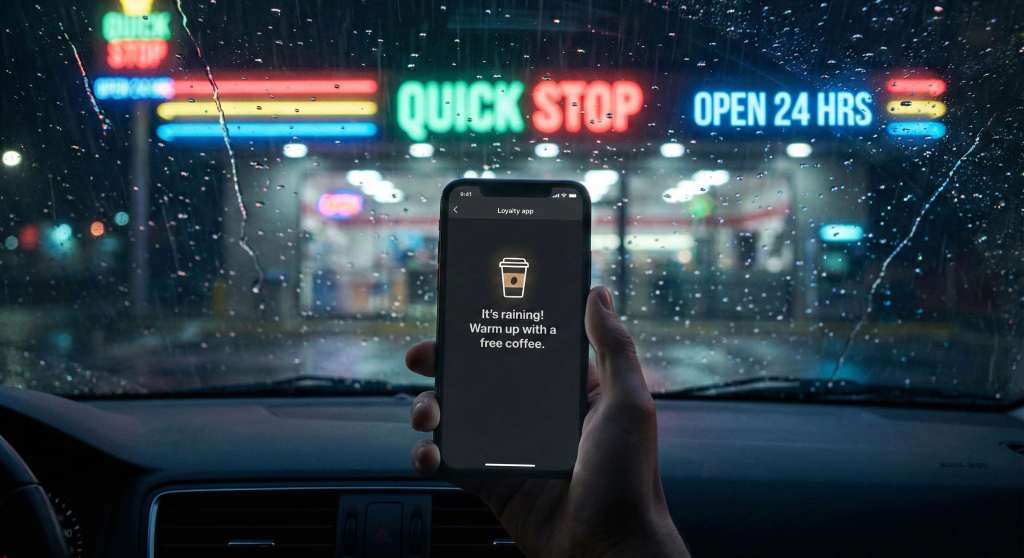
For convenience stores, context is king. Unlike Amazon, where a purchase might be driven by a long-term hobby, most c-store purchases are driven by immediate physiological need (thirst, hunger, caffeine, fuel). You don’t need to know a customer’s life story, their political affiliation, or their browsing history to know that when it is 95°F outside, they probably want a cold drink.
Contextual advertising is largely immune to regulations like SB 446 because it targets the moment, not the person. It is effective, it is compliant, and quite frankly, it is often more relevant to the customer’s immediate needs than their past behavior.
What You Should Be Doing
- Audit Your Digital Signage: Are you running generic loops on your pump screens and in-store displays? Switch to weather-triggered content management systems (CMS).
- Implement “Day-Parting” on Steroids: Don’t just swap breakfast for lunch menus. Use real-time data to trigger “Rainy Day Specials” (comfort food) or “Heat Wave Alerts” (slushies).
- Leverage Local Events: Context isn’t just weather. If there is a local football game ending nearby, your app should push a “Post-Game Snack” notification to anyone inside that specific geofence.
Zero-Party Data: Just Ask
The second pillar of the Glass Box strategy is Zero-Party Data.
First-party data is data you collect passively (transaction history). Zero-party data is data the customer intentionally and proactively gives you. It is the gold standard of trust.
For years, marketers have used AI to infer that a customer likes energy drinks based on their purchase frequency. While accurate, this can feel “creepy” to the consumer. The better approach? Just ask them.
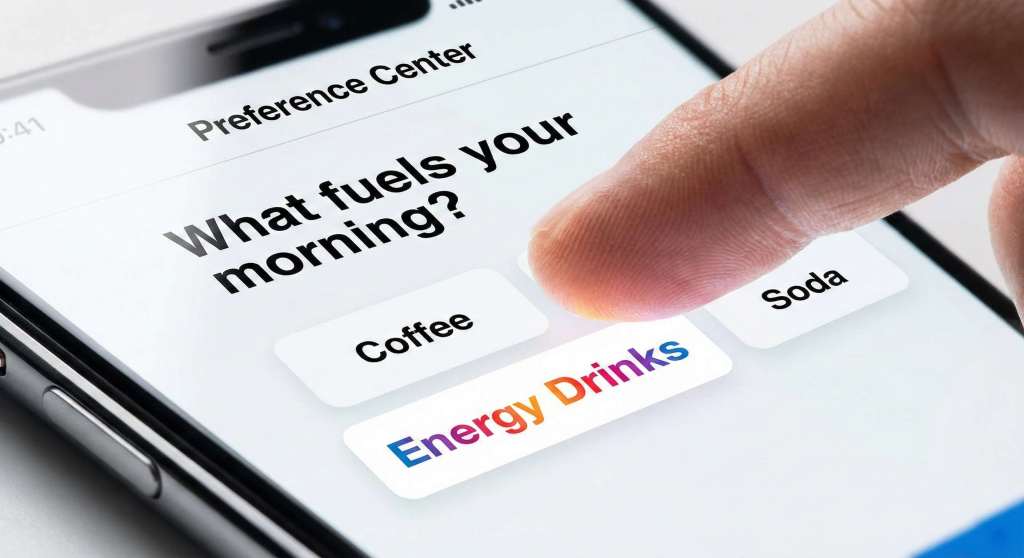
In your app onboarding or via a gamified interface, include a simple “This or That” quiz. “What fuels your morning? Coffee, Energy Drinks, or Soda?”
When the customer taps “Energy Drinks,” two powerful things happen:
- Explicit Consent: They are giving you permission to market to them.
- Psychological Shift: When you send them a Red Bull coupon three days later, it isn’t viewed as “stalking”; it is viewed as “service.” You are fulfilling a request they made.
This transactional approach builds trust because the “deal” is transparent. You aren’t guessing; you are listening.
What You Should Be Doing
- Launch a Preference Center: Update your loyalty app profile section to include a “Favorites” selection. Let users check boxes for “Spicy Snacks,” “Craft Beer,” or “Healthy Options.”
- Gamify Data Collection: Don’t make it a boring form. Create a “Build Your Ultimate Snack Stash” mini game in the app where users drag and drop their favorite items. Use that data to personalize future coupons.
- Respect the “No”: If a customer indicates they are not interested in tobacco or alcohol products, ensure your system hard-blocks those offers immediately. Listening to a “no” builds as much trust as acting on a “yes.”
The Transparency Dashboard and The Value Ledger
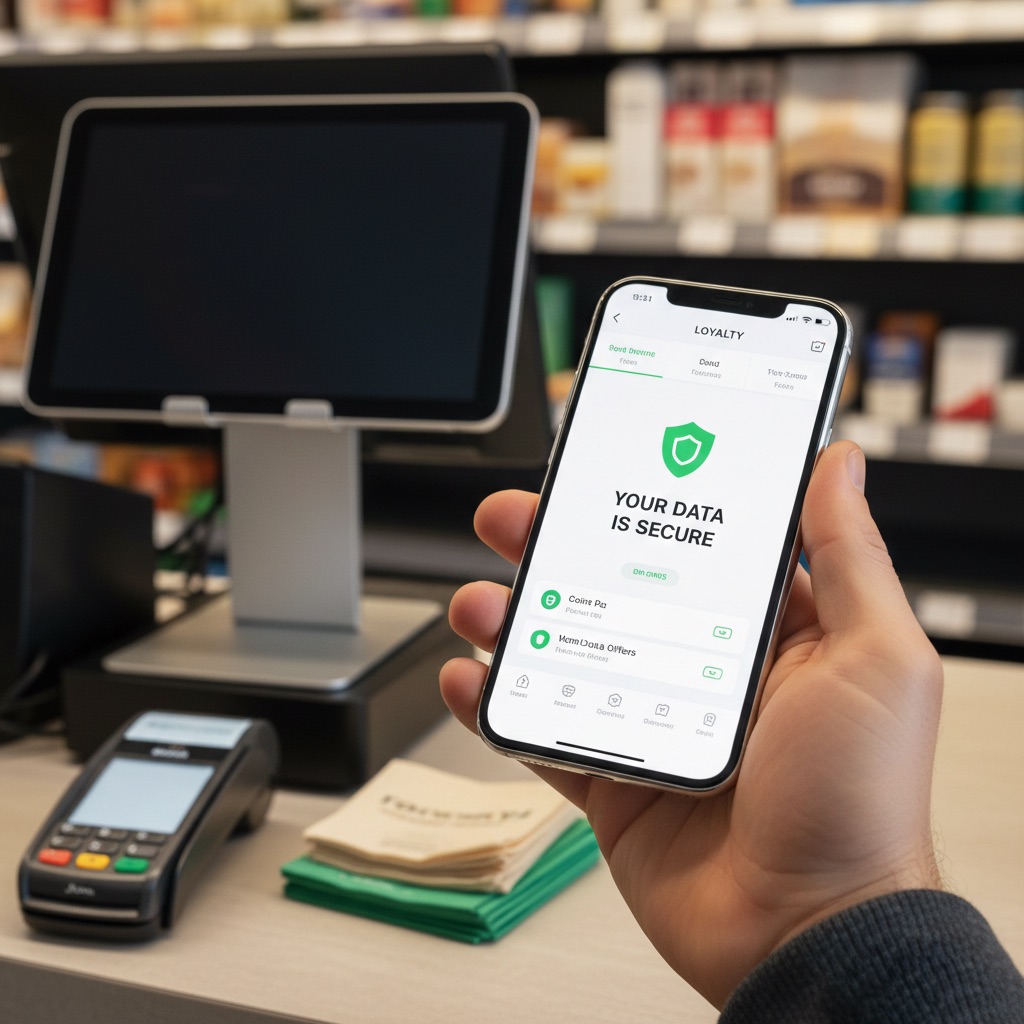
If we are going to operate in a Glass Box, the customer needs to be able to see inside. Every modern loyalty app should have what I call a Transparency Dashboard.
This goes beyond the legally required “Terms and Conditions” link that nobody reads. This is a user-facing, easy-to-understand section in the app settings where the customer can see exactly what you know and, more importantly, how you use it to their benefit.
Features of a Trust-Building Dashboard:
- Data Vitals: A clear visual toggle of what is active. “Location Services: ON. Purchase History: ON.”
- The “Why” Button: On every digital coupon you send, add a small “Why am I seeing this?” link. When clicked, it should provide a plain-English explanation: “Because it is lunchtime and you told us you love spicy snacks.”
- The Value Ledger: This is the most critical part. You need to show them the math. Create a section that says, “You shared your location data with us.” In exchange, you saved $45.00 this year.”
You must constantly reinforce the Value Exchange. When customers see that their data sharing results in tangible cash back in their pocket, their anxiety drops and their loyalty increases.
What You Should Be Doing
- Visualize the Savings: In your monthly loyalty summary emails, bold the “Amount Saved” and explicitly link it to their membership status.
- Simplify Privacy Settings: Rewrite your privacy settings menu. Instead of legalese, use headers like “How we customize your deals.”
- Add the “Why”: Work with your app developer to implement the “Why am I seeing this?” feature on your primary offer feed.
Zero-Latency Data Stacks
To make all of this work, especially the contextual triggers, you need speed. Traditional Customer Data Platforms (CDPs) are often too slow. They take data, send it to the cloud, process it, and send it back. By the time the offer arrives, the customer has already pumped their gas and driven away.
You need a “Zero-Latency” Data Stack.
When a customer enters your geofence, you have milliseconds to act. You need to query the local weather, the store inventory (is the f’real machine actually working?), and the time of day to generate the right message. This requires moving data processing to the “edge” (the store server) rather than sending it all back to a central cloud.
If you invite a customer in for a milkshake and the machine is broken, you haven’t just lost a sale; you’ve broken trust. Real-time inventory integration is a privacy feature because it ensures you aren’t spamming customers with irrelevant or impossible offers.
What You Should Be Doing
- Check Your Tech Speed: Ask your loyalty provider about their “latency.” If it takes more than 3 seconds to trigger a push notification upon arrival, it’s too slow for the forecourt.
- Integrate Inventory: Ensure your offer system can “read” your POS or back-office system to verify stock levels before sending a coupon.
- Invest in Edge Computing: Talk to your IT consultants about processing simple data (like weather and time) locally at the store level to speed up response times.
The Bottom Line: Compliance is an Opportunity, Not a Cost
Trust is essentially an engineering problem. You build it by designing systems that are transparent, consensual, and mutually beneficial.
By moving to a “Glass Box” model, you protect your business from the tightening grip of regulation. But more importantly, you win the confidence of that skeptical 88% of consumers who currently feel spied on. When you stop guessing and start asking, and when you stop stalking and start serving based on context, you transform your brand from a “data broker” into a trusted partner in their daily routine.
We have covered the fear, the law, the psychology, and now the technology. In the final post of this series, I’m going to bring it all together. We will look at the retailers who are already winning this game, industry titans like Sheetz and Wawa, and I will give you a final, comprehensive roadmap to future-proof your business.


 The5For
Leave a comment