Operationalizing Clinical Cleanliness in Your C-Store
Welcome back to part two of our four-part series on transforming your convenience store into a high-profit destination. In our last discussion, we explored the foundational psychology of the Halo Effect, the mental “shortcut” customers use to judge your coffee or sandwiches based on how clean your parking lot looks. We established that the economic shift toward foodservice demands a retail environment free of “cognitive friction.”
But as we look toward the future of this industry, “looking” clean is only half the battle. With new FDA Food Code updates on the horizon and a generation of shoppers who are more health-conscious than ever before, the old “eyeball test” is officially obsolete. As an industry partner who designs the very cabinetry and equipment your customers interact with every single day, I’ve seen firsthand how a lack of measurable, scientific cleaning standards can sink even the most beautiful, newly remodeled store.
Today, we are moving from the “what” to the “how.” We’re diving into the literal science of sanitation, exploring how to operationalize clinical cleanliness. We will look at advanced metrics, the restroom gold standard, and the hard financial data that proves a clean store is definitively a more profitable store. By the end of this post, you will have the operational insights needed to turn your maintenance routine into a highly measurable performance metric that drives bottom-line growth.
The Science of “Safe”: Measuring with ATP

For years in the convenience store industry, if a counter looked shiny, we confidently called it clean. But the International Sanitary Supply Association (ISSA) has redefined the goalposts for modern retail. Professional hygiene is now measured using ATP (Adenosine Triphosphate) testing. ATP is a microscopic molecule found in all living cells, think bacteria, food residue, and human skin.
By using a simple swab and a handheld monitor, operators can now measure Relative Light Units (RLU) to see exactly how much biological “gunk” is lingering on a surface. To be considered truly effective and safe, a surface must register 500 RLU or below. If it hits between 501 and 1,000, your team’s process needs improvement. Anything above 1,001 RLU is a total failure, signaling that your cleaning protocols aren’t just missing spots, they’re failing to kill dangerous pathogens. When you give your team a definitive “score” to hit rather than a vague instruction to “wipe things down,” you transform cleaning from a mundane chore into a measurable performance metric.
What You Should Be Doing
- Invest in ATP Tech: Purchase a handheld ATP monitor for your management team to use during weekly audits.
- Spot-Check High-Touch Areas: Use ATP swabs specifically on your POS touchscreens, coffee dispensers, and door handles. If you aren’t testing, you aren’t managing.
The Restroom: Your Most Sensitive Profit Center

Let’s be honest: the public restroom is the single most important brand touchpoint in your entire store. It is no longer an “annoying overhead” to be managed cheaply; it is a primary driver of where people choose to stop. The data on this is irrefutable: 62% of Americans specifically plan their road trips and daily stops at businesses known for clean restrooms. Furthermore, 75% of your customers will think twice before returning after just one unpleasant experience. This metric is especially true for female consumers, who will frequently bypass a station with lower fuel prices to pay a premium elsewhere just to access a washroom they can trust. If you lose them at the restroom door, you’ve lost the fuel sale, the coffee sale, and the high-margin foodservice sale in one fell swoop.
What You Should Be Doing
- Adopt the “Top-Down” Method: Train your staff to clean mirrors and counters first, moving down to the floors, and always working from the back of the room toward the exit to prevent re-contamination.
- Enforce “Dwell Time”: Most EPA-approved disinfectants require 3 to 10 minutes of “sit time” to actually killviruses. If your staff sprays and wipes immediately, they are just moving germs around.
- Audit Like an Owner: Don’t just check the paper log on the door. Step into the restroom and look for “secondary cues” like dust on the vents or grime on the door handles. These are the signals that tell a customer you don’tcare.
The Financial Ripple Effect: Lighting, Traffic, and Dwell Time

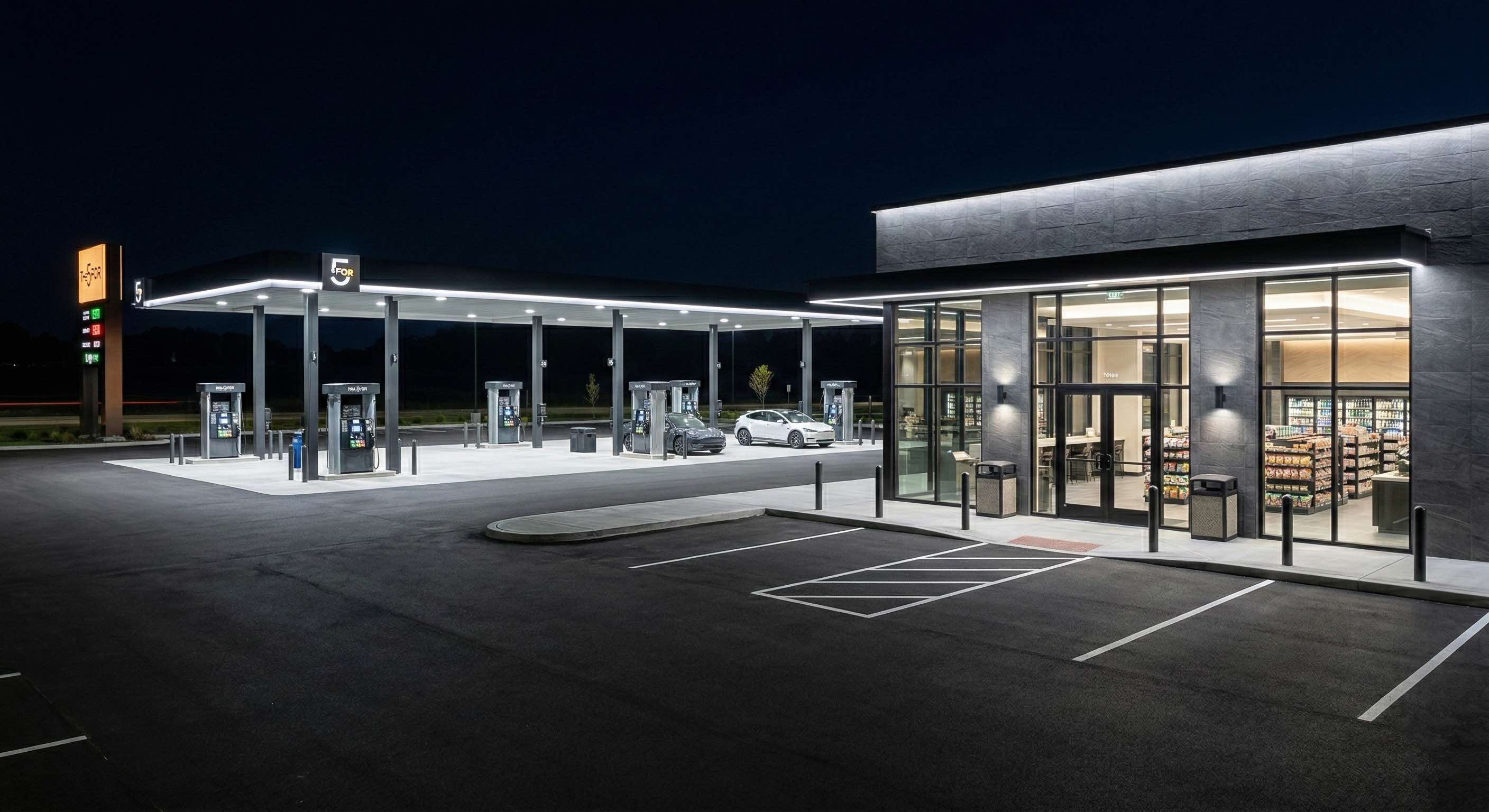
Cleanliness has a direct, mathematical impact on your bottom line. Stores with above-average cleanliness ratings see a massive 33% increase in foot traffic. But remember, the “filter” starts before the customer even turns off their engine. Lighting is your best recruiter. Studies show that 8.5% of consumers are deterred by poor outdoor lighting, a factor that actually carries more weight than poor customer service or coffee quality when deciding where to pull off the road. Stations with superior, bright lighting see a 50% increase in overnight traffic. If your canopy is dim, you are essentially hanging a “Closed” sign for a huge segment of the market.
Once the customer is inside, cleanliness dictates how long they stay. When a customer feels comfortable and safe, they browse. The Boston Consulting Group found that brands in the top five for cleanliness capture nearly 40% of the consumer’s “share of wallet,” while those at the bottom capture less than 18%. You can literally double your revenue from a single customer just by being the cleanest option on their route.
What You Should Be Doing
- Audit the Forecourt at Night: Walk your perimeter at 9:00 PM. Are there dark corners or flickering bulbs? Fix the lighting “filter” immediately to capture that overnight traffic.
- Invest in High-Output LED: Ensure your fuel islands and entryways are “daylight bright” to reduce customer anxiety before they even step through the doors.
The Bottom Line: The New Operational Standard
Operational excellence in 2026 isn’t about working harder; it’s about working smarter with hard data. When you move your store operations from “it looks okay” to “it tests safe,” you build a level of consumer trust that your competitors simply cannot touch. You aren’t just mopping floors; you are actively protecting your margins and ensuring that 33% traffic bump becomes a permanent feature of your P&L.
Now that we have mastered the operational “how,” it’s time to look at how to market this massive advantage. Coming up in Post 3, we are moving into Categorical Innovation. We will examine the “Buc-ee’s Masterclass” in hygiene branding, discuss the intense impact of #CleanTok on your digital reputation, and reveal how advanced tech like electrostatic sprayers and cobotics can give your team a 360-degree advantage. Get ready to turn your spotless store into a viral sensation.


Leave a Reply