Building a Brand Moat with Hygiene and Tech
Welcome to part three of our comprehensive series on elevating your c-store’s profitability through environmental excellence. In our last post, we moved well beyond the “eyeball test” to look at the clinical science of ATP testing, dwell times, and the massive financial lift that comes from superior lighting and restroom hygiene. We established the exact operational protocols needed to ensure your physical space is undeniably safe.
But here is the reality of the modern retail landscape: even the best, most rigorous cleaning schedule can be undermined in a matter of seconds by the most powerful force in the world, the smartphone. As an industry partner helping you design and build the physical footprint of your store, from the custom cabinetry to the exterior graphics, I’ve watched the definition of “clean” migrate from your store floor directly into the digital world.
Today, we are exploring Categorical Innovation. We are going to look at how to turn hygiene from a maintenance chore into a high-level marketing strategy. We’ll analyze the “Buc-ee’s Masterclass,” dissect the viral power of social media movements like #CleanTok, and introduce the advanced technology that allows even a small, stretched staff to maintain hospital-grade standards. By the end of this post, you will know exactly how to leverage cleanliness as your ultimate competitive moat.
The Buc-ee’s Masterclass: Hygiene as a Brand Moat
If you want to see the pure financial power of extreme hygiene in action, look no further than Buc-ee’s. They didn’t build a legendary cult following by having the cheapest gas on the highway; they built it by unapologetically having the world’s cleanest restrooms. They took a basic human utility and turned it into their primary brand value proposition.
By aggressively marketing their “world-famous” clean bathrooms, Buc-ee’s completely removes the “psychological friction” of the highway pit stop. When a customer knows the environment is impeccably safe, they stop rushing. They browse the apparel, the home decor, and the fresh BBQ. The result? Impulse spending that often averages $75 or more per visit, a truly staggering figure for our industry. They even protect this pristine environment by banning semi-trucks to reduce wear-and-tear and congestion. They’ve proven that when hygiene is woven deeply into your corporate DNA, you stop being a commodity and start being a destination.
What You Should Be Doing
- Market Your Cleanliness: Don’t just clean your restrooms; advertise them. Use your exterior graphics and signage (which we can help you design) to loudly proclaim your commitment to a pristine environment.
- Redefine the Goal: Stop aiming for “acceptable” and start aiming for “destination-worthy.” Make your restrooms a reason to stop, not just a convenience.
The Digital Reality: #CleanTok and Your Reputation

We live in an era where a single unhygienic event can go from a local mess to a global liability in minutes. Platforms like TikTok have birthed massive communities like #CleanTok, where millions of users obsess over pristine environments, while “horror story” creators actively aggregate terrifying experiences at poorly maintained gas stations.
Younger demographics, specifically Gen Z and Millennials, are driving the current increase in c-store trip frequency. However, they don’t just “hope” your store is clean; they check Google Maps and Yelp for social proof before they even pull off the exit. If your reviews mention “dirty bathrooms” or “cockroaches,” you are entirely invisible to the modern, mobile consumer. In 2026, maintaining a spotless store isn’t just about physical health; it is the absolute cornerstone of your digital reputation management. A pristine store generates positive organic content; a dirty one guarantees a damaging digital footprint.
What You Should Be Doing
- Audit Your Digital Footprint: Search your store on Google and Yelp right now. Filter the reviews for keywords like “clean” or “dirty”. If the sentiment is negative, your first marketing “spend” should be a deep-clean, not an ad.
- Leverage Social Proof: If you’ve invested in new equipment or a rigorous cleaning protocol, tell people! A highly visible “Cleaned and Sanitized” sign with a digital timestamp is a powerful psychological nudge for the modern shopper.
Future-Proofing with Technology: Electrostatics and Cobotics

The biggest hurdle for most operators when trying to implement these strategies is labor. How do you maintain”Buc-ee’s level” standards with a limited, often high-turnover staff? The answer lies in embracing two major technological shifts:
- Electrostatic Sprayers: Manual wiping often fails to reach the undersides of fixtures, complex cabinetry, or beverage nozzles. Electrostatic technology applies a positive electrical charge to disinfectant droplets. As the mist leaves the sprayer, it is magnetically drawn to surfaces, literally “wrapping” around objects for 360-degree coverage. This ensures a total pathogen kill rate in high-traffic zones in a fraction of the time it takes to wipe by hand.
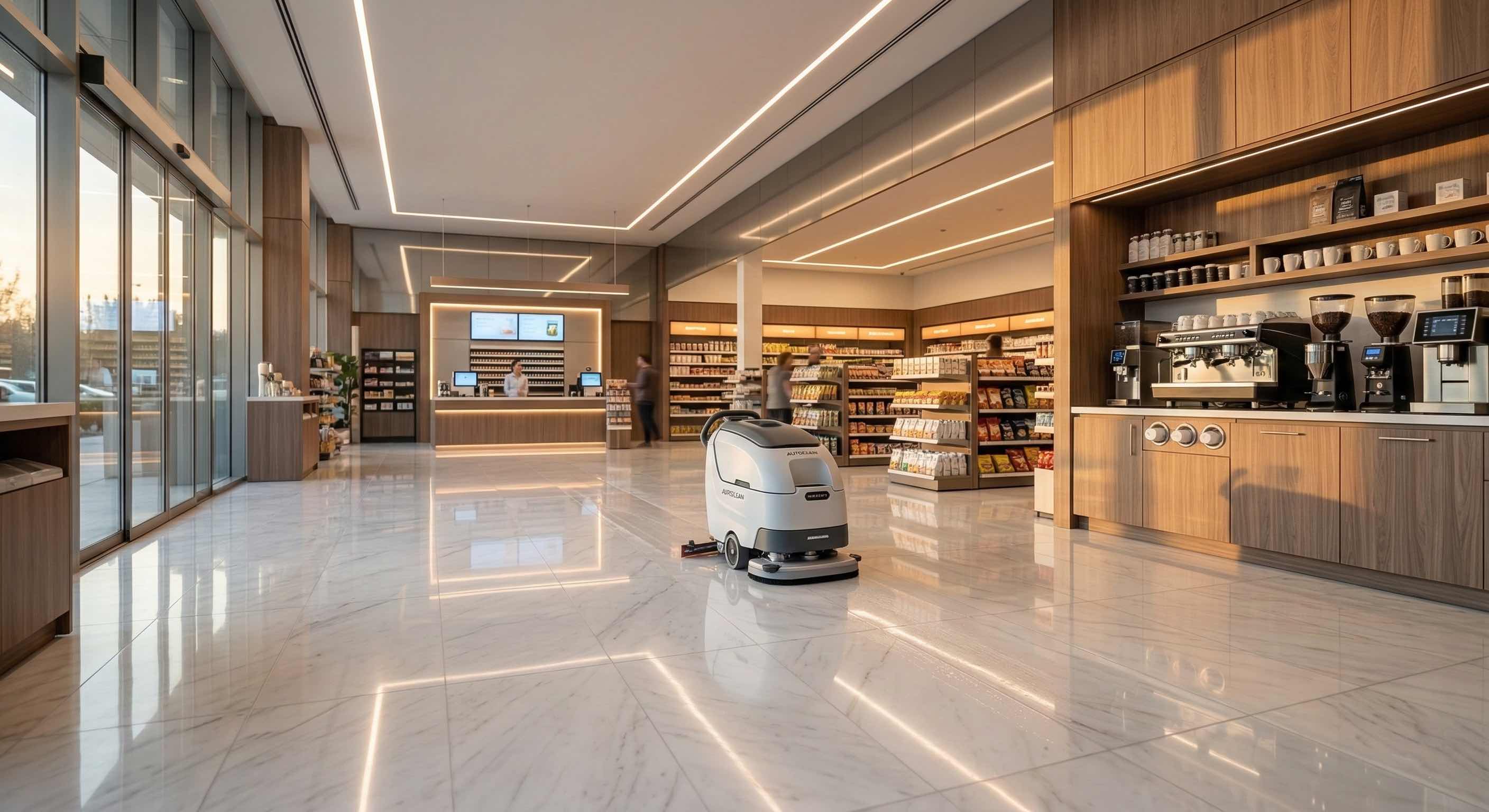
- Cobotics (Collaborative Robotics): We are seeing a massive surge in autonomous floor scrubbers. These “cobots” map your store and maintain floor hygiene entirely independently, freeing up your valuable human associates to focus on high-value tasks like fresh food preparation and actual customer service.
What You Should Be Doing
- Explore Electrostatic Tools: If you have a high-volume foodservice program, these sprayers are the most efficient way to guarantee safety on complex surfaces like wire shelving and POS kiosks.
- Evaluate Cobotics: Investigate leasing or purchasing autonomous scrubbers if your square footage warrants it. Calculate the labor hours saved versus the equipment cost.
The Bottom Line: Innovation is the Competitive Moat
The battle for the modern consumer is won by the operators who recognize that hygiene is a high-margin category all of its own. By leveraging advanced technology and deeply understanding the power of digital reputation management, you aren’t just “cleaning”, you’re building an impenetrable competitive moat that encroaching dollar stores and QSRs simply cannot cross. When you eliminate the “disgust factor,” you open the door to fanatical customer loyalty and massive basket sizes.
Coming Up in Post 4: The Executive Action Plan. We’ve covered the psychology, the science, and the categorical innovation. In our final post, we are bringing it all together. I will give you a comprehensive, step-by-step roadmap to transform your store from a quick “stop” into a dominant retail “destination”

Leave a Reply