Proving the Intangible
In our previous installment, we gave you the definitive three-step plan for implementing Emotional Safety (ES) in your C-store, from assessing psychosocial risk to building a “system over blame” culture. You’ve initiated the changes, you’re training your leaders on vulnerability, and you’re managing operational friction. This is fantastic progress.
But here is the inevitable question every small business consultant and operational expert faces: How do I prove this investment is worth it?
The beauty of emotional safety is that while it starts with intangible concepts like trust and respect, its ultimate impact is profoundly tangible. As we established in Post 1, the ROI of supporting employee mental health is documented to be as high as $8.13:1 for large retailers. To capture that return, you must track the right metrics.
This post is dedicated to the Measurement pillar of your strategy. We’re going to integrate the perspective of a data analyst and an HR specialist to show you exactly which Key Performance Indicators (KPIs) to monitor. We will organize your metrics into two categories: Hard Metrics (financial and attendance-based) and Soft Metrics (cultural and engagement-based).
By formally measuring your success, you turn a compassionate investment into a demonstrable profit driver, ensuring the long-term governance of your ES program.
Hard Metrics: The Financial Proof

These are the numbers that hit your General Ledger, the true cost of low emotional safety, and the savings you gain through better retention.
Cost of Employee Fatigue
Hard metrics measure the direct financial, time, and labor costs associated with a high-stress, unstable workforce. These are the measurable consequences of psychosocial hazards like high job demands and poor support.
The primary metric here is Turnover Cost. When an employee leaves, the cost includes recruitment, onboarding, training, temporary productivity loss, and administrative overhead. This cost often vastly outweighs the expense of retaining a stable, happy employee.
Restoring Productivity: Why it Matters to You
Tracking these metrics proves that your ES investment is a fiscal protection plan. The savings aren’t hypothetical; they are documented in:
- Reduced Absenteeism: Employees who feel supported and safe take fewer unscheduled sick days.
- Restored Productivity: Employees who are not distracted by stress and anxiety are more focused and efficient.
- Lower Insurance Premiums: A safer, more stable environment signals lower risk to insurance providers, potentially reducing premiums.
By focusing on ES, you are actively restoring productivity that was previously lost to burnout and stress.
Track and Trend: What You Should Be Doing
Use your existing payroll and HR software to establish these baselines.
- Calculate Turnover Cost (KPI 1): Measure your annual turnover rate and calculate the average cost to replace an employee. Track the reduction in this cost year-over-year after implementing your ES strategy.
- Monitor Absenteeism Rates (KPI 2): Track the number of unscheduled employee sick days and total hours lost to absenteeism. A reduction signals that in-the-moment support is effectively addressing staff fatigue.
- Track Incident Frequency (KPI 3): Monitor the frequency of security incidents (theft, verbal abuse, internal conflicts). A reduction can indicate the effectiveness of de-escalation training and CPTED measures.
Soft Metrics: The Cultural Pulse
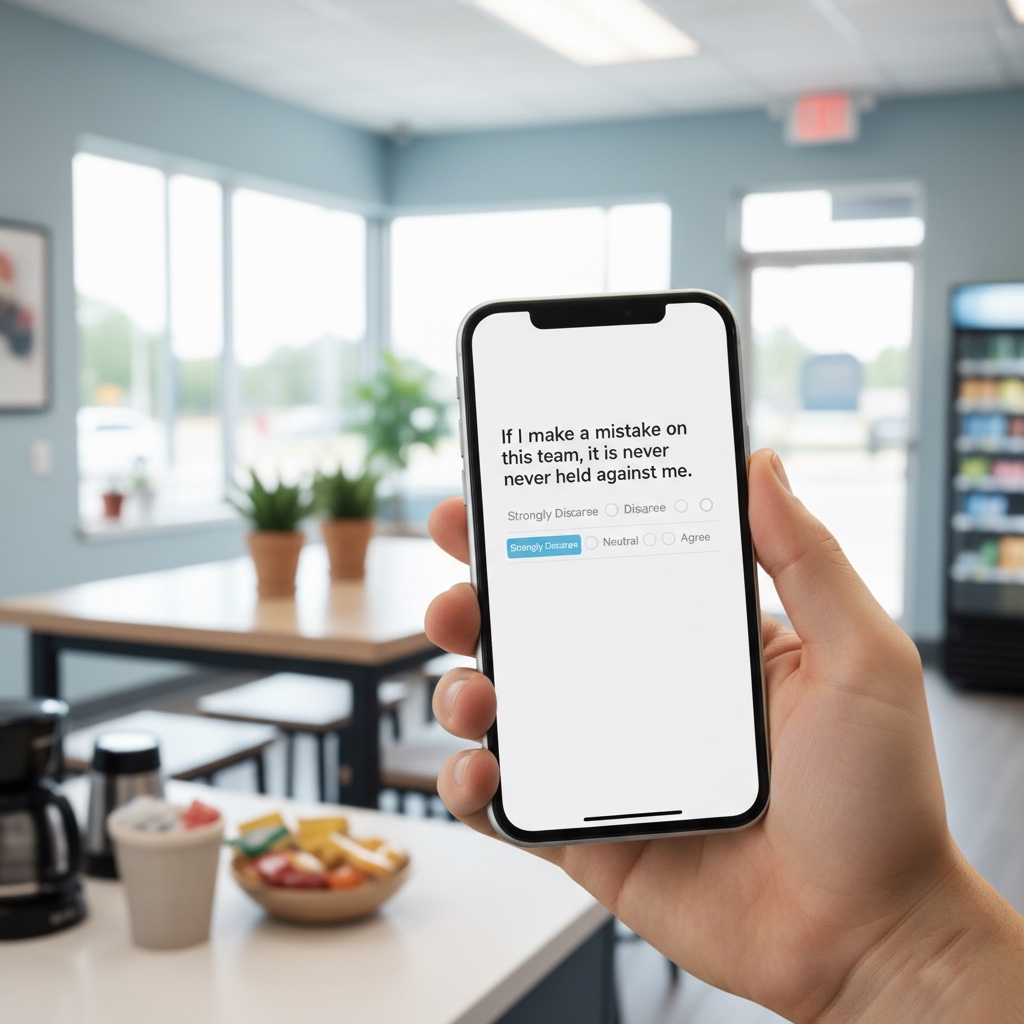
Hard metrics tell you what is happening; soft metrics tell you why, revealing the cultural pulse of your organization.
Shared Belief and Trust
Soft metrics focus on the subjective experience of the employee, their belief in the safety of the environment. These are non-financial indicators that measure the success of your managerial and HR policies. A key indicator is the degree to which employees feel valued and safe to ask for help or admit a mistake.
These metrics are essential because psychological safety relies on shared belief. If employees don’t believe the change is real, the culture won’t shift.
Identifying Hidden Pain Points: Why it Matters to You
Soft metrics act as an early warning system. By anonymously gathering feedback, you can identify hidden psychosocial hazards. For example, there might be an isolated shift manager who lacks support. Or, there could be a specific process causing undue stress. Identifying these issues early helps prevent measurable turnover.
Furthermore, tracking these metrics ensures proper governance. Studies show that compliance with safety initiatives often fades quickly (with compliance rates sometimes dipping to 9% for single-owner operators). Regular soft metric reviews force accountability and ensure that the cultural commitment remains strong.
Survey and Listen: What You Should Be Doing
Implement consistent tools for gathering employee sentiment.
- Run an Engagement Survey (KPI 4): Annually or semi-annually, run a brief engagement survey. Include specific questions related to the core tenets of psychological safety. Ask questions like, “Is it easy for me to ask other members of this team for help.? Another question could be, “If I make a mistake on this team, is it ever held against me?”
- Monitor Manager Effectiveness (KPI 5): Include anonymous upward feedback questions. Use these questions to assess how well managers are modeling vulnerability. Evaluate their curiosity and non-punitive behavior.
- Track Feedback Utilization: When staff offers a suggestion for process improvement (e.g., in a staff meeting or survey), track how quickly that idea is acknowledged and if an action is taken. High utilization confirms that staff’s unique skills and talents are valued.
Governance: Ensuring Long-Term Success

Data is only useful if it informs continuous action and accountability.
Closed-Loop Feedback
Governance in ES means having a formal process for using your data to inform policy updates and training. It’s a closed-loop system: Measure -> Analyze -> Act -> Measure Again.
Nearly half (46%) of organizations are already using data generated by security technologies to enhance employee and customer experiences and increase operational efficiencies. You must similarly integrate your HR data with your operations data.
Sustaining the $8.13:1 ROI: Why it Matters to You
The long-term ROI is only sustainable if the initial cultural commitment doesn’t fade. History shows that without rigorous, analytical governance, initial enthusiasm for safety measures will drop off.
Governance ensures that the focus remains on systemic improvement. If your engagement scores drop after a major technology rollout, your governance process should immediately trigger an investigation. This will determine whether the change introduced new high-friction or low-control psychosocial hazards.
Formalize the Review Cycle: What You Should Be Doing
Commit to a regular review cycle for your data.
- Quarterly Leadership Review: Dedicated time each quarter for management to review the 5 core KPIs (Turnover Cost, Absenteeism, Incident Frequency, Engagement Scores, Manager Effectiveness). Do not postpone or skip this meeting.
- Policy Audit: Annually, review your anti-harassment and non-retaliation policies to ensure they remain relevant, clear, and are consistently enforced as intended.
- Use Data for Training: Use the soft metric results (e.g., low scores on “safe to ask for help”) to directly inform and customize your next round of manager training and coaching.
The Bottom Line: Beyond Measurement to Mastery
By establishing these five core KPIs, three hard and two soft, you move Emotional Safety from an abstract concept to an accountable business unit. You can now definitively prove that your investment in your people is driving lower costs, greater stability, and higher productivity, securing that invaluable $8.13:1 return. Measurement turns commitment into mastery.
However, even the most stable, well-measured team still operates in a high-stress, unpredictable environment. Your C-store staff must be ready to face conflict, aggression, and theft with professionalism and confidence. The best culture can still be shattered by a single, poorly handled hostile interaction.
Our next post is a deep dive into the practical skill set that protects your people, your customers, and your investment. We will focus entirely on: De-escalation Training and Handling Conflict. We will show you exactly what mandatory training modules should cover. You will learn how it fulfills your legal duty of care. It also dramatically increases staff confidence when facing unpredictable customer behavior. Don’t miss this critical next step in protecting your bottom line.






 The5For
Leave a comment