Challenging the Sticker Price Trap
We’ve established the case for modular steel on performance: it’s more hygienic, structurally superior, and operationally efficient. Yet, I know what many of you, the pragmatic C-store owners, and operators, are thinking: “But the plastic display is cheaper upfront.”
This common pitfall is focusing only on the initial sticker price. It is one of the most financially damaging habits in retail procurement. When you’re dealing with high-volume food service equipment, the initial cost often accounts for only 20% to 30% of the true financial impact over a decade. The remaining 70% to 80% is absorbed by hidden operational expenses (OpEx) that drag down your profitability.
To make a truly strategic investment decision, you must adopt a Total Cost of Ownership (TCO) model. TCO evaluates the complete financial impact of an asset over its lifecycle, factoring in maintenance, labor, downtime, and eventual disposal.
Today, we make the unavoidable financial case for engineered fixtures like PanelRak by:
- Defining the crucial difference between simple price and long-term cost.
- Quantifying the significant Capital Expenditure (CapEx) avoidance achieved by eliminating frequent replacement cycles.
- Breaking down how material durability directly leads to lower, recurring labor and maintenance costs.
It’s time to stop making reactive purchases and start making calculated investments. Let’s crunch the numbers.
Price Versus True Cost: The TCO Formula
Focusing solely on the initial purchase price is a short-term approach that fails to account for the long-term liabilities of low-quality materials. For retail fixtures, TCO is dictated by hidden costs that accrue over time. These costs are often intangible but have a measurable impact on your bottom line:
- OpEx Labor: The cost of staff spending time on intensive, “careful cleaning” of fragile acrylic surfaces.
- CapEx Frequency: The recurring cost of purchasing, shipping, installing, and disposing of replacement fixtures.
- Risk Cost: The cumulative cost of potential hygiene failures, customer dissatisfaction, and lost business due to a messy appearance.
For C-stores, a comprehensive TCO model must also factor in external supply chain risks. Offshore-sourced, low-cost plastic is common. You face added costs for duty and freight. There are also quality control issues and loss of opportunity due to shipping delays. By comparison, focusing on high-quality, long-lasting domestic manufacturing, as PanelRak often does, mitigates these intangible, high-risk costs. This approach provides greater certainty in long-term expense forecasting.
What You Should Be Doing
Adjust your procurement process to align with TCO analysis:
- Mandate TCO Reporting: For any new equipment purchase over a certain threshold, require your procurement team to present a TCO analysis covering a 10-year period, not just the sticker price.
- Factor in Supply Chain Risk: For any fixture sourced from a complex, non-local supply chain, add a risk premium to the initial purchase price. This accounts for potential duty, freight, and quality control issues.
- Track Downtime: While fixture failure rarely results in full “downtime,” monitor the loss of opportunities. These include lost sales or customer frustration when a display is out of service, sticky, or confusing to use.

Quantifying the Cost of Replacement Cycles (CapEx Avoidance)
The single biggest financial win for durable steel fixtures is the elimination of frequent Capital Expenditure (CapEx) cycles.
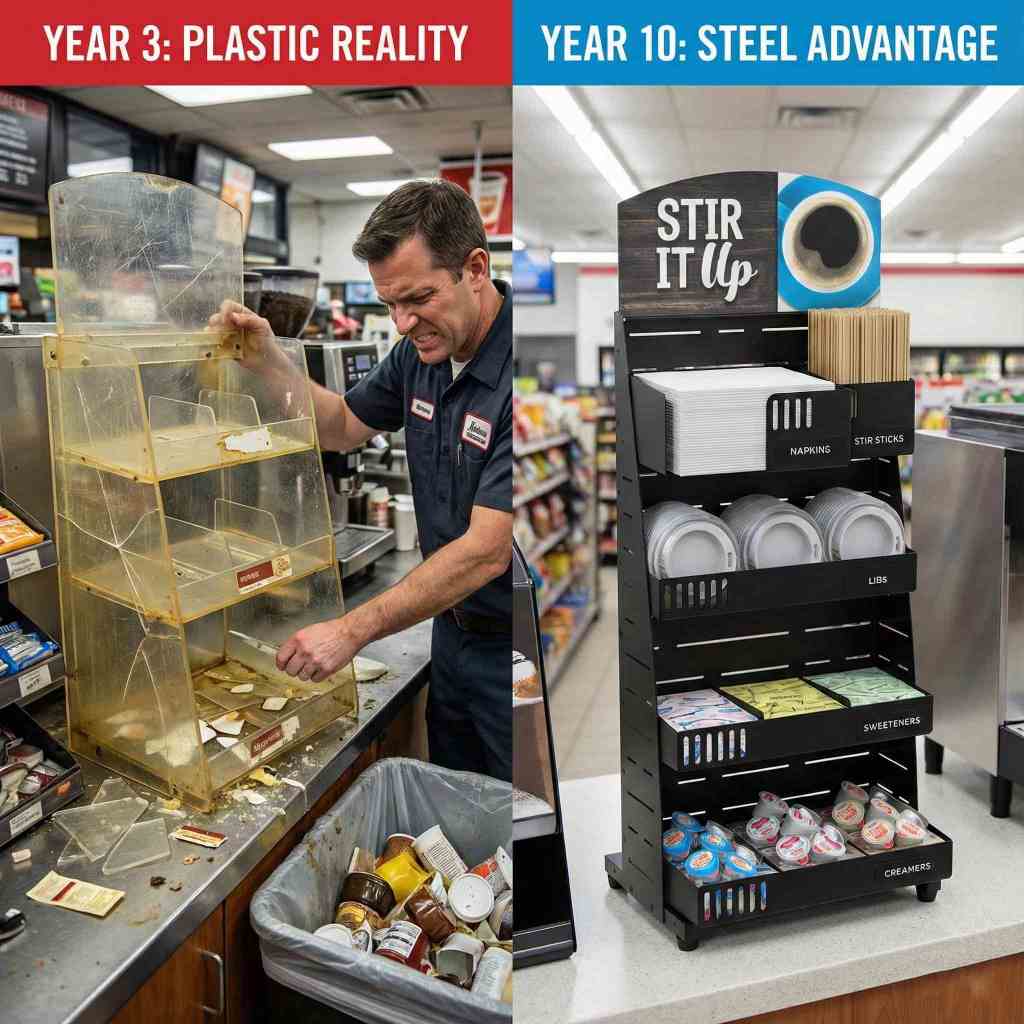
As we discussed, low-durability plastic or PETG fixtures typically have a lifespan of 3 to 5 years. Aesthetic degradation, like scratching and yellowing, or hygienic failure forces replacement. Conversely, engineered steel fixtures are projected to last 10 years or more.
Let’s look at a simple 10-year scenario for a store fleet:
- Traditional Plastic: You would need to purchase and install at least two cycles of acrylic displays. You might even need three cycles. Then, you have to dispose of them within that decade.
- PanelRak Modular Steel: Making a single investment in a durable, modular steel system is expected to suffice. This system should last for the full 10-year period.
This avoidance of two CapEx cycles, including the cost of the unit, shipping, installation labor, and disposal, translates into massive, avoided costs. Furthermore, fixtures usually require a detailed inspection and assessment for replacement or renovation around the five-year mark. The superior durability of steel pushes this decision point far past that midpoint, often delaying or entirely eliminating the costly replacement project.
Finally, consider the liquidation value. Durable materials like steel and aluminum retain significantly higher residual value upon liquidation compared to plastic materials, improving the system’s long-term financial performance.
What You Should Be Doing
Take these immediate actions to leverage replacement cycle analysis:
- Calculate Avoided CapEx: For every fixture you replace with a 10+ year steel alternative, calculate the future CapEx. This includes the purchase price and installation cost. You have avoided these costs by skipping the next one or two replacement cycles.
- Implement Scheduled Assessments: Adopt a formal 5-year maintenance cycle. Use this checkpoint not just for cleaning, but for making the critical renovation or replacement decision. Durable steel will consistently pass this assessment, while acrylic will likely fail.
- Factor in Residual Value: When budgeting for a new fixture, include the projected residual or liquidation value of the steel at the 10-year mark. This value serves as a measurable asset return. Plastic cannot offer this benefit.

Labor Efficiency: Reducing the High OpEx Tax
Labor is a primary driver of commercial cleaning costs. The final financial advantage of steel is its ability to reduce the intensity of the cleaning job, thereby cutting your recurring OpEx labor costs.
We know that acrylic imposes a high labor tax because it requires “careful cleaning” to prevent scratching. This meticulous process increases the labor intensity per cleaning cycle.
The durable, non-porous powder-coated steel surface, by contrast, is designed for standard, non-specialized cleaning. The PanelRak system eliminates the need for specialized care. It reduces the time spent navigating clutter, thanks to superior organization. This system supports significant daily time savings.
Even a marginal reduction, such as saving five minutes per station per shift, will accumulate quickly. Over a decade, this can add up across a multi-unit store fleet. It yields substantial, measurable reductions in operational labor expenditure. The TCO disparity is driven by this simple fact: plastic forces high labor and frequent replacement; steel minimizes both.
What You Should Be Doing
Optimize your maintenance labor with efficient materials:
- Set a Cleaning Time Standard: Establish a goal for how quickly a condiment station should be cleaned and restocked. Choose fixtures, like modular steel, that allow your team to consistently meet that efficient time standard without compromising hygienic results.
- Support PM Discipline: Utilize reliable, long-lasting fixtures to support a disciplined Preventive Maintenance (PM) program. When you minimize reactive maintenance, which involves fixing things that broke prematurely, you save on costly, unplanned labor. You also improve key facility management metrics.
Next Up: Converting Efficiency into Revenue
We have now systematically proven the case for modular steel on performance, hygiene, space utilization, and long-term financial cost. The investment in a premium, engineered fixture is clearly the most responsible financial decision for long-term profitability.
But the benefits don’t stop at cost avoidance. That superior look and organization directly impacts consumer behavior. It makes customers trust you. It encourages them to spend more. It increases their likelihood of coming back.
In our final strategic post, Post 6: Strategic Premiumization: How Fixture Quality Elevates Perceived Value and Drives Purchase Intent, we will connect the dots between the material quality of your condiment station and your customers’ willingness-to-pay and loyalty.




 The5For
Leave a comment