
What the 2026 Numbers Mean for Your Staffing and Store Design
If you’ve run a convenience store for any length of time, you already know the fuel island isn’t what it used to be. What you might not have seen yet is just how clearly the 2026 data confirms it, and how directly that shift should be shaping decisions about your team and your floor plan.
I’ve spent years working on the design, equipment, cabinetry, and graphics side of this industry, which means I’ve walked through a lot of stores mid-transition: some thriving, some struggling with the same layout and staffing model they had a decade ago. What separates the two usually isn’t luck. It’s whether the operator adjusted to where the profit actually lives now.
According to the National Association of Convenience Stores (NACS) State of the Industry data, total industry sales reached $817.5 billion, but fuel sales declined 5.4% to $476.3 billion. Fuel still makes up 65.0% of total sales dollars, yet it now accounts for only 38.8% of gross profit. Meanwhile, foodservice and merchandise sales inside the store grew to $341.2 billion, the 23rd consecutive year of inside-sales growth.
At the same time, physical traffic is softening. Stores are averaging 45,160 transactions a month, or roughly 1,484 a day, down 2.7% year-over-year. That’s happening while direct store operating expenses climb 4.2% and card swipe fees eat another $21.3 billion industry wide.
Put those trends together and the direction is unmistakable: fewer visits, higher costs, and a growing share of your profit sitting inside the store rather than at the pump. Foodservice alone now makes up 28.5% of inside sales and 38.9% of inside gross profit, with prepared food driving 73.9% of that category.
This post walks through what’s actually behind those numbers, the labor market forces reshaping who you hire and how you schedule them, the store design and equipment choices that make a leaner team more effective, and the day-to-day habits on the sales floor that turn a fuel stop into a real purchase. None of this requires ripping out your whole store. It requires understanding where the pressure points are and making deliberate changes where they’ll count.
The Labor Market Has Changed the Job, Even If the Job Title Hasn’t
For a long time, convenience stores hired for one role: cashier. Post a listing, check for basic experience, and put someone behind the counter. That model is increasingly out of step with both the technology on your floor and the workforce you’re hiring from.
Self-checkout kiosks and back-office automation are absorbing the repetitive, transactional parts of the job. What’s left, and what actually drives sales now, is the human part: how a customer is greeted, whether they feel looked after, whether someone notices what they might want. Research on retail customer experience backs this up directly: a customer’s perceived value of their shopping trip correlates strongly with overall satisfaction (r = 0.806), and that perception is shaped far more by service quality and empathy than by product selection alone.
That reframes the job. It’s less “ring people up” and more “make this stop worth coming back for.” Some operators have started reflecting that shift in title and training, moving away from “cashier” toward something like “brand ambassador” or “service host”, not as a rebrand for its own sake, but because it signals to both staff and customers what the role is actually for.
This matters more, given how expensive turnover has become. Frontline turnover in convenience retail has historically averaged 141%. Here’s what that costs a typical store: with roughly 19.9employees per location and an estimated $10,000 to replace each hourly worker, the math works out to:
1.41 (turnover rate) × 19.9 (employees) × $10,000 (replacement cost) ≈ $280,590 per year
That’s not a hypothetical, it’s a real, recurring line item most operators aren’t tracking as one number. And a lot of it traces back to rigid, unpredictable scheduling rather than pay alone. McKinsey research has found that 44% of workers who recently left traditional full-time retail roles have no interest in returning to standard, inflexible employment. They’re not necessarily leaving the industry, they’re leaving jobs that don’t respect their time.
The 2026 Numbers at a Glance
- Total industry sales: $817.5 billion
- Inside-store sales: $341.2 billion, up 1.7%
- Foodservice share of inside sales: 28.5%
- Foodservice share of inside gross profit: 38.9%
- Prepared food share of foodservice sales: 73.9%
- Monthly transactions per store: 45,160, down 2.7%
- Average hourly wage: $15.04
- Frontline turnover rate: 141%, costing an average store roughly $280,000+ annually
What You Should Be Doing
- Review your job postings and swap rigid title requirements for skills-based language, communication, reliability, and active listening.
- Consider retiring “cashier” in favor of a title that reflects the actual job, if your team and customers would benefit from that clarity.
- Calculate your own store’s turnover cost using the formula above. Seeing the real number tends to change how a scheduling or culture investment gets evaluated.
- Look honestly at your scheduling practices, are they a reason good people are leaving?
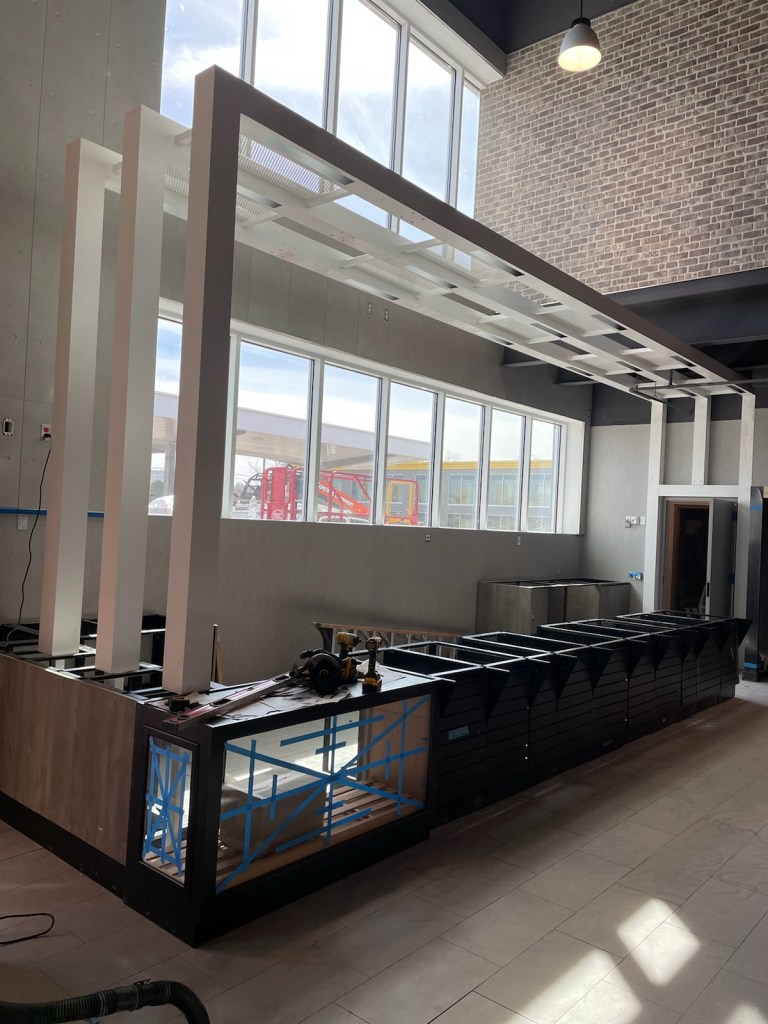
Store Design and Equipment Should Make a Smaller Team More Capable

A skills-based, empathetic frontline team can only perform if the physical space supports them. If staff are backtracking around each other, hunting for tools, or buried in manual back-office work, the customer interaction suffers no matter how well-trained they are.
The linear kitchen model.
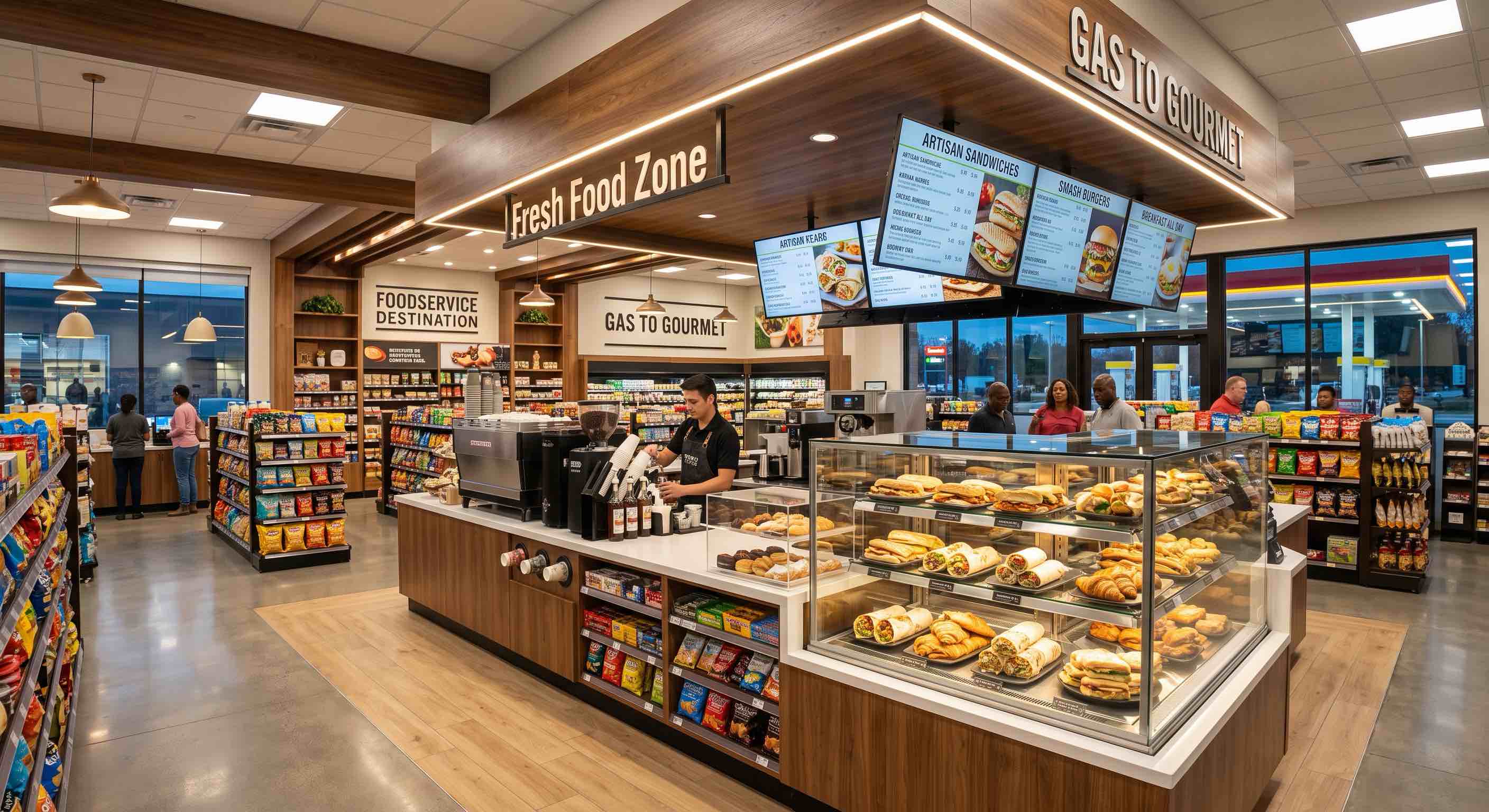
Many convenience foodservice areas are still built in U-shaped or galley layouts, which create crossing traffic during rushes. A linear layout, storage, prep, cooking, assembly, and packaging arranged in a straight line that mirrors the order flow, lets one cross-trained employee handle an order start to finish without colliding with a teammate. Operators who’vemade this switch have seen back-of-house labor needs drop by roughly 15–20%.
Equipment that shortens training, not just labor.
A few specific upgrades matter here:
- Pre-programmed rapid-cook ovens cut training time from weeks to days by replacing manual timing and temperature control with a single button press.
- Digital date-labeling tools remove the need for staff to manually calculate shelf life and handwrite labels, reducing both time spent and compliance risk.
- Bean-to-cup coffee dispensers eliminate the constant brewing and monitoring that traditional carafe stations require, freeing labor hours for the sales floor.
- Computer-vision monitoring over hot food equipment like roller grills can track compliance and inventory automatically, flagging issues before a customer ever notices.
Kiosk placement affects labor, not just convenience.
Where you put self-checkout and self-ordering kiosks changes how efficiently your team can supervise them. Placing self-checkout near a manned register lets one associate oversee several transactions and step in for age verification when needed. Placing self-ordering foodservice kiosks near the entrance gives the kitchen a head start on hot food orders while the customer browses.
Back-office automation matters too.
Robotic floor scrubbers keep aisles clean without pulling staff off the floor, and automated vendor payment platforms remove hours of manual check-writing and invoice entry for alcohol deliveries each week.

Workforce management platforms like Legion, TimeForge, or Shyft use historical sales data, weather, and local events to build demand-based schedules, and let employees trade shifts or set availability from their phones. Pairing that with Earned Wage Access tools like DailyPay, which let employees draw down earned pay after a shift rather than waiting for payday, has been associated with a 30% reduction in turnover at some retailers, and roughly 56% of hourly associates say instant access to earned pay motivates them to pick up hard-to-fill shifts.
What You Should Be Doing
- Walk your foodservice area and identify where staff cross paths or backtrack, that’s usually your first sign a linear layout would help.
- Prioritize equipment upgrades that shorten onboarding, not just ones that look modern.
- Evaluate a workforce management platform if your scheduling is still done by spreadsheet.
- Look into Earned Wage Access as a low-cost way to reduce turnover, especially among newer hires.
Empathy on the Floor Is What Converts a Fuel Stop Into a Sale

Roughly 58% of drivers who stop for fuel come inside, but only about a third of them make an impulse purchase. Given that inside categories carry strong margins, around 44% on packaged beverages, 39% on alternative snacks, and over 50% on hot prepared food, closing more of that gap has a real effect on profitability.
The conversion doesn’t come from a harder sales pitch. It comes from staff who are comfortable being genuinely conversational and observant. A few real examples of what that looks like in practice:
Cross-selling a promotion naturally:
Associate: “We actually have a special promotion today, buy two of those and the third one’s free.” Customer: “Oh really? Let me grab another one, then.”
Suggesting something timely:
Associate: “Those cookies were finished about twenty minutes ago, if you wanted one with your coffee.” Customer: “That sounds great, I’ll take a chocolate chip.”
A warm, low-pressure close:
Associate: “Good morning! Find everything okay? Your total’s $19.50.” Customer: “Yes, thanks, your team’s always so friendly here.”
None of these require a script. They require staff who feel supported enough, by their schedule, their training, and their workspace, to actually engage rather than just process the transaction.
Benefits that reinforce that engagement.
A few targeted, relatively low-cost benefits tend to matter more to frontline retail workers than a broad, generic package:
- Fuel or transit discounts, high perceived value for commuting employees, low actual cost to the retailer (just the wholesale-to-retail margin).
- Daily shift meal vouchers, a modest daily amount, like the $10 voucher some chains offer, that also builds staff familiarity with the food they’re selling.
- Tiered referral bonuses ($250–$1,000 depending on role) to bring in pre-vetted candidates through your existing team.
- Educational support, such as GED completion programs, which can build an internal pipeline toward management roles.
- Low-cost health access, such as a small monthly fee for on-site or same-day care, which addresses a real gap for many hourly workers.
Safety is a real recruiting barrier, not a minor one.
Roughly 49% of people with no interest in convenience retail cite crime as their main reason. Investing in visible security, cameras, well-lit forecourts, and de-escalation training for staff, addresses both hiring hesitation and existing employees’ day-to-day comfort.
Local partnerships build goodwill beyond the transaction.
Sourcing baked goods, dairy, or produce from local suppliers and highlighting those partnerships with clear in-store signage positionsyour store as part of the neighborhood, not just a stop along the way. Paid volunteer time off for staff can extend that same goodwill further.
What You Should Be Doing
- Train staff on conversational, low-pressure suggestive selling rather than scripted upsells.
- Review your benefits against what actually matters to hourly workers, commuting cost, food security, and flexibility tend to outweigh generic perks.
- Audit your forecourt and store lighting and security signage, especially if hiring has been difficult.
- Identify one local supplier relationship you could feature more visibly in-store.
A 30-Day Plan to Start Acting on This
You don’t need to do all of this at once. Here’s a reasonable sequence if you’re starting from scratch:
Days 1–10: Audit and plan
- Review your transaction data, basket sizes, and turnover rate.
- Walk your store and note where staff experience physical friction, cramped counters, awkward kitchen paths, poorly placed kiosks.
- If a layout change is on the table, bring in a design and equipment specialist to map out a linear kitchen and merchandising flow before you commit to anything.
Days 11–20: Technology and equipment
- Evaluate a workforce management platform for demand-based scheduling.
- Look into an Earned Wage Access provider if you don’t already offer one.
- Bring in equipment, rapid-cook ovens, digital labeling, that shortens training time.
Days 21–30: Training and floor activation
- Train staff on conversational selling and active listening.
- Update signage to highlight local partnerships and any security improvements.
- Roll out any new benefits and make sure staff actually understand how to use them.
What You Should Be Doing
- Pick one bottleneck from your walkthrough and address it first, rather than trying to overhaul everything at once.
- Set a realistic timeline for equipment or layout changes, and loop in a design partner early if a physical change is involved.
- Publish schedules at least two weeks out if you aren’t already, since that alone reduces last-minute callouts.
The Bottom Line: Where This Leaves You
The direction of the industry isn’t really in question anymore. Fuel is still important, but it’s no longer where most of your profit comes from, and the data backs that up year after year. The stores that are adapting well aren’t necessarily spending more, they’re spending more deliberately, on the layout, equipment, and scheduling choices that let a smaller, better-supported team do more.
None of this has to happen overnight, and it doesn’t have to happen all at once. Pick the one bottleneck that’s costing you the most right now, whether that’s turnover, a cramped kitchen, or a scheduling system nobody trusts, and start there.

Leave a Reply