The Convenience Store Thanksgiving Rush and Turning It into Foot Traffic, Loyalty, and Sales
Why Thanksgiving Is the Ultimate Stress Test for Your Store
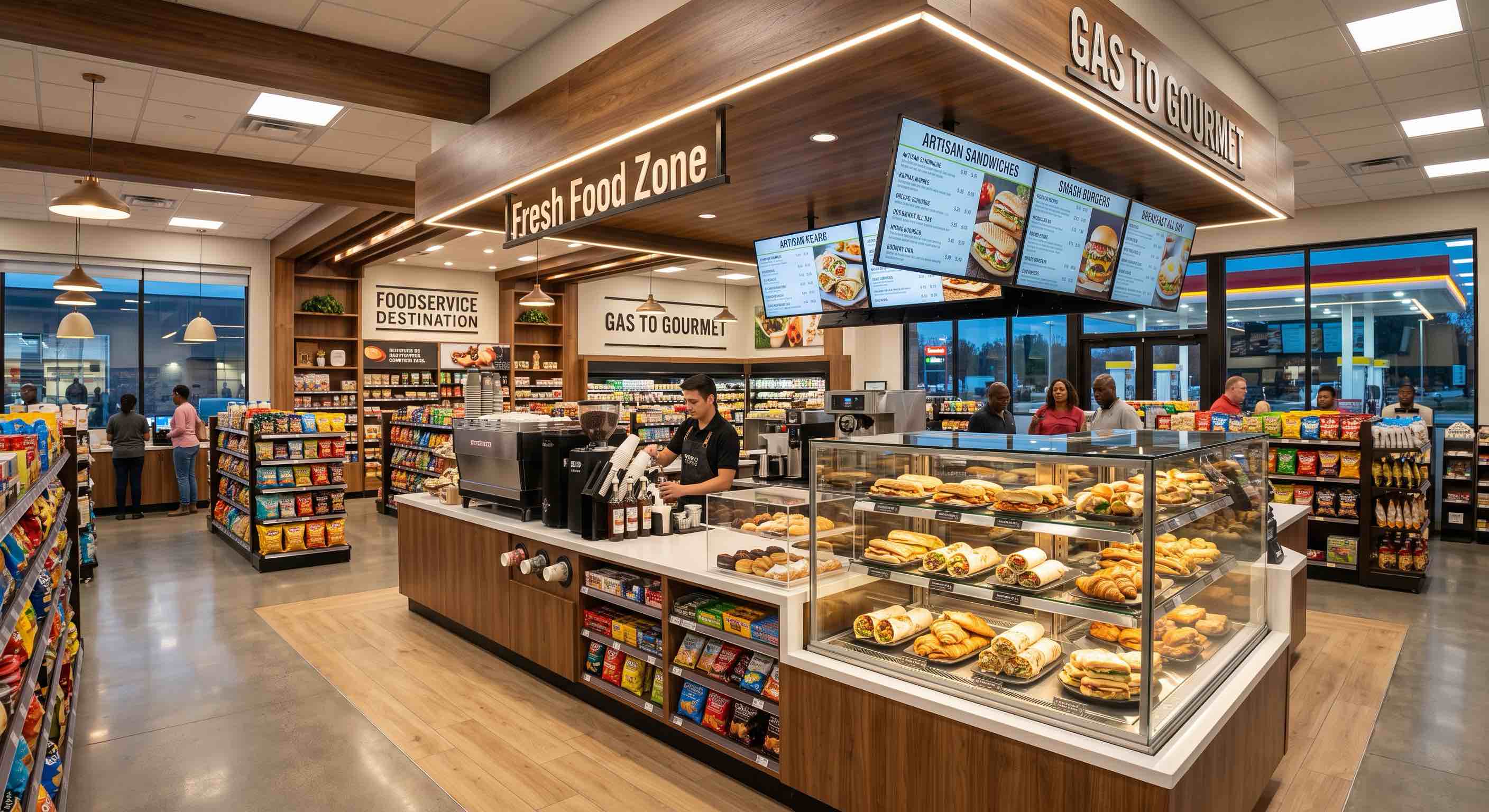
Convenience stores have officially shed the old “gas and gum” reputation. Today’s convenience store is a dynamic, omnichannel foodservice destination, and no week proves that more than the one surrounding Thanksgiving. Travelers are on the road, hosts are making last-minute runs, and everyone is hungry, short on time, and open to a good reason to stop.
Consider the scale of it. Thanksgiving weekend 2025 saw a record 202.9 million consumers shopping for deals, with in-store traffic up 3%. In Wisconsin alone, projections showed 1.65 million residents traveling for the holiday, with 88% of them driving more than 50 miles. Multiply that pattern across every state, and one of the largest road-trip events of the fall is passing directly by your front door.
Here’s the catch: you can’t count on fuel margins to carry you through it. Direct store operating expenses, including labor, utilities, and credit card swipe fees, are climbing faster than gross profit industry-wide. The modern mandate is to cover your site’s entire overhead using inside gross profit alone.
That is the problem, and it’s also the opportunity. A traveler who stops for fuel and leaves with only a coffee is a missed chance. A traveler who stops, finds a spotless restroom, gets a hot meal in under three minutes, and grabs a bundle on the way out is a customer you may see again.
This guide is built to help you capture that second traveler. I’ll walk you through four pillars, each one building on the last:
- The Foundational Landscape: the shifts in traffic, dwell time, and customer expectations that decide who gets the stop.
- Strategic and Operational Execution: the equipment, staffing, and layout decisions that keep service fast under pressure.
- Innovation and Profit Maximization: seasonal menus, bundles, digital tools, and community partnerships that set you apart.
- The Executive Action Plan: a prioritized 30-day roadmap that ties it all together.
By the end, you’ll know how to pull travelers off the highway, extend their time on your property, convert them into high-margin foodservice purchases, and send them back on the road safely. I’m not here to sell you anything. I’m here to share what I see working in stores like yours, so you can decide what fits your footprint and budget.
Let’s get started.
The Foundational Landscape
Before we talk about ovens and menus, we need to get something more basic right. What actually gets a traveler out of the car and through your door?

EV Charging Has Rewritten the Rules of Dwell Time
A traditional gas fill-up gives you three to five minutes with a customer. A driver on a DC fast charger is on your property for 15 to 30 minutes. That is a completely different kind of visit, and most stores haven’t adjusted their layout or merchandising to match it.
Run the math. If a charger handles 12 sessions a day and you convert 75% of those drivers into the store with an $11 basket, that single charger can generate close to $3,000 in incremental monthly in-store revenue. That only happens if the store gives them a reason to walk in.
Think about what a charging customer sees. If the first thing they notice is a dim entrance and a wall of cigarettes, they’ll stay in the car with their phone. If they see a coffee bar, a fresh food case, and a clear path to seating, they have a reason to come in.
What You Should Be Doing: Dwell Time
- Audit your dwell zones. Are high-margin impulse items visible from your seating areas, coffee counters, and EV charging sightlines?
- Walk from each charger to your front door and note what the customer sees along the way.
- Give charging customers a reason to enter: a clearly signed coffee, snack, or fresh food offer near the entrance.
- Make sure seating, outlets, and Wi-Fi expectations match a 15-30 minute stay.
Cleanliness Is Currency
Here is a number that should stop you in your tracks: 70% of customers judge the freshness and safety of your food based on how clean your restrooms are and how dust-free your shelving looks. Think about a mother traveling with her family the Wednesday before Thanksgiving. If she finds a neglected restroom, she is not walking anywhere near your hot food counter, no matter how good it is.
GasBuddy data backs this up. Stores with above-average restroom ratings see a 33% increase in overall foot traffic compared to stores rated below average. Cleanliness isn’t a back-of-house chore. It’s one of your most effective forms of marketing.
Cleanliness also includes the physical condition of your store. Scuffed cabinetry, peeling laminate, faded graphics, and cluttered counters all signal that standards may be slipping. Travelers make that call in seconds.
What You Should Be Doing: Cleanliness
- Move to hourly, documented restroom and forecourt checks from the Tuesday before Thanksgiving through the following Sunday.
- Dust shelving, wipe down coolers, and clean glass before the rush begins.
- Repair damaged cabinetry and replace faded or outdated graphics.
- Assign one person per shift as the cleanliness owner, with a visible checklist.
Know Your Numbers Before the Rush
New-to-industry builds now run anywhere from $2.2 million to over $14 million for travel centers. That investment only pays off if the store produces enough inside profit, day after day, to cover its operating costs. I call this your Breakeven Pool Margin: the daily inside gross profit you must generate to cover your site’s expenses.
Most operators know their fuel gallons. Fewer know exactly how much inside profit they need each day to break even. Sit down with your financial team before the rush, not after.
Your location matters too. If your site sits on a route with 5,000 to 15,000 Annual Average Daily Traffic (AADT), pass-by highway traffic typically accounts for more than half of your daily visits. That is a sweet spot, and it means holiday travelers will make up a large share of your sales. Know where you fall on that spectrum, and stock accordingly.
What You Should Be Doing: Know Your Numbers
- Calculate your Breakeven Pool Margin with your finance team and break it down by daypart.
- Look up your AADT using your state DOT’s traffic count map.
- If you’re in the 5,000-15,000 AADT range, prepare inventory and staffing for a heavy wave of pass-by traffic.
- Review last year’s Thanksgiving week sales by day and hour to find your real peaks.
Strategic and Operational Execution
Once travelers are inside, speed becomes the whole game. Pillar 1 earned you the visit. Pillar 2 is about delivering on it.

Why Foodservice Deserves Your Best Attention
Foodservice makes up only about 28.7% of in-store sales, but it drives 38.9% of in-store gross margin dollars. On top of that, 72% of shoppers now see convenience stores as a legitimate alternative to a quick-service restaurant. For a Thanksgiving traveler, getting fuel, a clean restroom, and a restaurant-quality meal in one stop is a major competitive edge, as long as you can deliver it fast.
A 57% profit margin on a slice of pizza means nothing if the customer walks out of a 15-minute line. Margin only counts when the sale happens. That is why throughput, not just menu, is where holiday weeks are won or lost.
Rapid-Cook Technology and Ventless Design
This is where rapid-cook technology earns its keep. High-speed commercial ovens from brands like TurboChef, Merrychef, and Ovention combine microwave, convection, radiant heat, and air impingement. They can cook food up to 80% faster than traditional methods. A 16-inch par-baked pizza can finish in under three minutes, and a hot panini in about 45 seconds.
From a store-design standpoint, many of these units also use ventless technology with internal catalytic converters. That means you can add a genuine hot food program without the cost and permitting headaches of a traditional exhaust hood. Always confirm local code requirements with your jurisdiction and equipment supplier before you commit.
When you evaluate any oven, look beyond speed. Consider footprint, power requirements, ease of cleaning, how simple it is for a new employee to operate, and the service support available in your area. The right oven is the one your team can run confidently on your busiest day.
What You Should Be Doing: Equipment
- Evaluate ventless high-speed ovens (the Merrychef conneX 16 and TurboChef Double Batch are two examples) if ticket times or hood costs are holding your menu back.
- Compare footprint, power needs, cleaning time, and local service coverage, not just cook speed.
- Service all equipment now. A breakdown on the Wednesday before Thanksgiving is the worst possible time to find a mechanical issue.
- Keep spare parts and a service contact list at hand for ovens, coolers, and chargers.
Staffing for the Busiest Day of the Year
None of this works without the right people running it. The Wednesday before Thanksgiving is the single most demanding staffing day in our industry. Currently, 81% of U.S. retailers rely on cross-training to stay flexible during holiday crunches.
Every employee should be comfortable on the POS, the rapid-cook oven interface, and your sanitation protocol. That way, a food-prep worker can step onto a second register the moment a line backs up. Flexibility is what keeps a line from turning into a walkout.
Protect your team from burnout, too. Don’t tell staff to “take a break when you can.” Schedule 15-minute recovery intervals with the same rigor as any shift assignment.
Also consider a temporary holiday wage differential, such as an extra $2.00 an hour for the Wednesday through Sunday of Thanksgiving week. It’s a modest cost compared with the sales you lose when someone calls out on your biggest day.
What You Should Be Doing: Labor
- Cross-train every employee on the POS, oven interface, and sanitation.
- Restructure holiday pay with a peak-hour wage premium for the Wednesday-Sunday window.
- Build mandatory recovery breaks into the posted schedule.
- Publish the holiday schedule early so staff can plan their own holiday travel.
Let Your Layout Do Some of the Selling
Shoppers only cover a fraction of your total square footage on any visit. And 73% of in-store transactions are anchored by just three categories: packaged beverages, beer, and nicotine. That tells you where the traffic is, and where your high-margin items need to be to catch it.
Place high-margin bottled beverages, single-serve snacks, and seasonal treats within arm’s reach of your deli counter and roller grill. Put grab-and-go items near the path customers take to the register. The goal is to make the add-on purchase feel effortless.
Good layout also supports speed. Clear sightlines to the food counter, obvious queuing space, and menu boards that can be read from the door all reduce hesitation. Every second a customer spends confused is a second your line gets longer.
What You Should Be Doing: Layout
- Realign cross-merchandising around your three anchor categories.
- Move high-margin impulse items to countertops and endcaps near food pickup zones.
- Check that menu boards are readable from the entrance and from the front of the line.
- Keep aisles clear and queue paths obvious for holiday volume.
Innovation and Profit Maximization
With a solid operation in place, you can start differentiating. This is where you give travelers a reason to choose you over the next exit.

The Power of a Thanksgiving Limited-Time Offer
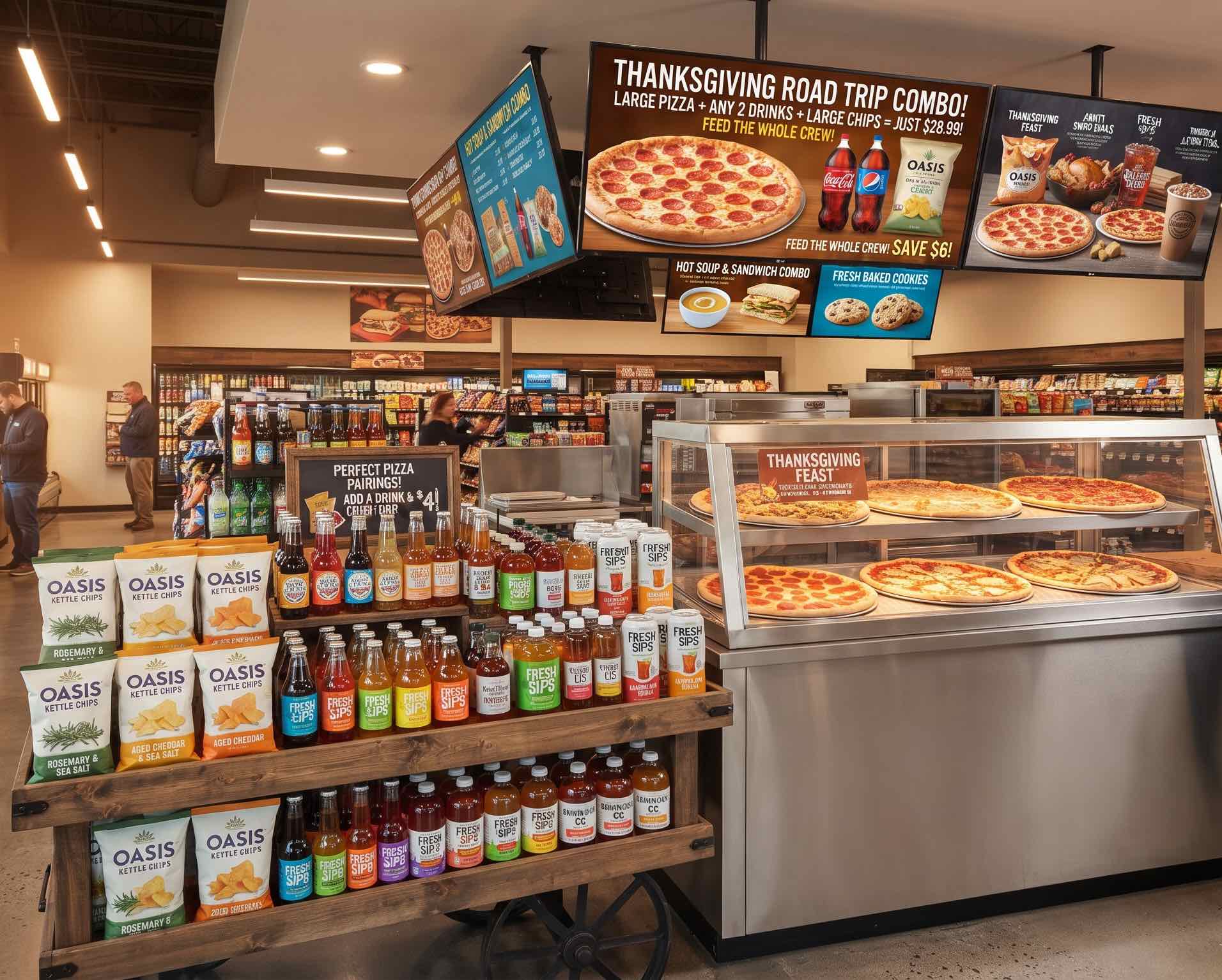
Thanksgiving is an ideal moment for a seasonal Limited-Time Offer (LTO). National chains lean on this heavily. 7-Eleven has run a Thanksgiving turkey sub on a stuffing-flavored roll, and QuickChek has offered a seasonal sub with cranberry relish and homestyle gravy.
A strong seasonal LTO commands premium pricing, adds excitement, and removes the “let’s stop somewhere else for a real meal” objection from passengers. It also pairs naturally with high-margin snacks. You don’t need a national chain’s budget. A simple, well-executed turkey hoagie or seasonal pizza with a clear name and a clear sign can do the job.
What You Should Be Doing: Seasonal LTOs
- Develop a Thanksgiving-themed hoagie, sub, or pizza variant to drive excitement and premium pricing.
- Keep ingredients simple and shared with your existing menu to limit waste.
- Lock in recipes, portion specs, and pricing early so nothing is a last-minute scramble.
- Train staff to describe the LTO in one sentence at the register.
Engineer the Bundle
To maximize that LTO, build it into a bundle. A well-built combo meal is one of the most effective ways to push your average basket past $10. The most successful format pairs four items: a beverage, an entrée, a salty snack, and a sweet confection.
Price these to hit a profit margin of 35% or higher after food and packaging costs. That way you’re offering a perceived deal while protecting your overall transaction profitability. A turkey sub, premium kettle chips, and a high-margin fountain drink, promoted with bold digital signage above your counter, is a simple and effective place to start.
Do the math on paper before you print anything. A combo that feels like a deal to the customer but dips below your target margin only grows your sales number, not your profit.
What You Should Be Doing: Bundles
- Build four-item combos (drink, entrée, salty snack, sweet item).
- Confirm each one clears a 35%+ margin after food and packaging costs before you print a sign.
- Promote bundles with clear, large-format signage at the counter and the entrance.
- Track bundle attachment rates daily during the holiday week and adjust quickly.
Digital Demand Spikes Before Thanksgiving Arrives
Your digital channels will surge before the holiday even starts. C-stores see a 15% to 25% increase in digital sales during Thanksgiving week. That demand peaks on the Tuesday and Wednesday before, driven by hosts stocking up on last-minute essentials.
Make sure your third-party delivery listings (DoorDash, UberEats, and similar platforms) are built around the top five holiday categories: beer multi-packs, ready-to-drink cocktails, party-size snacks, non-alcoholic mixers, and affordable wine. Build in high-affinity prompts, so a beer add-to-cart automatically suggests ice and party-size chips. Be sure to follow local and platform rules for alcohol sales and age verification.
What You Should Be Doing: Delivery Listings
- Update delivery app listings to feature beer, RTD cocktails, party snacks, mixers, and ice before the Tuesday/Wednesday demand spike.
- Set up add-on prompts for common pairings, such as beer + ice + chips.
- Check item availability and photos, and remove anything you can’t reliably stock.
- Confirm your staff can fill delivery orders without slowing in-store service.
Geofencing and Retail Media
Mobile geofencing is one of the most efficient tools available this time of year. Triggering a push notification when a loyalty app user crosses a 2.5-mile perimeter around your store has produced an average ROI of 340%. The idea is simple: reach the traveler at the moment they’re deciding where to stop.
Pair that digital nudge with on-site Retail Media Networks: dynamic signage at the pump and inside the store. The goal is to carry that momentum into an actual purchase. A push notification promising a hot turkey sub combo means more when the pump-top screen and the counter signage say the same thing.
What You Should Be Doing: Geofencing and Signage
- Activate geofenced push notifications within a 2.5-mile radius of your store.
- Program pump-top and in-store screens to cycle through your meal deals.
- Keep messaging consistent across the app, the pump, and the counter.
- Review results after the holiday so next year’s campaign starts smarter.
Turn Surplus into Goodwill
Thanksgiving generates more than 320 million pounds of wasted food nationally. Rather than absorbing the cost of expired seasonal inventory, build a relationship with a local food bank. Organizations like the Middleton Outreach Ministry rely heavily on community food drives to assemble Thanksgiving baskets for families in need.
Donating surplus perishables reduces landfill waste, may provide a tax benefit, and builds real community goodwill. Check food-safety guidelines and consult your tax advisor on the details. You can extend this into your menu strategy too, following QuickChek’s approach of donating a set amount from every seasonal sub sold to a local hunger charity.
What You Should Be Doing: Community Giving
- Establish a charity pipeline for post-holiday surplus and confirm what the receiving organization can accept.
- Consider a round-up donation prompt at the register.
- Tie a set donation to your seasonal LTO and tell customers about it.
- Share the results with your community afterward.
The Executive Action Plan
Strategy without a timeline is just a wish. Here is the 30-day roadmap that brings everything together. Day 30 is Thanksgiving Day itself, the culmination of everything above.
Days 1-9: The Foundation Phase
- Walk your store with a critical eye. Repair scuffed cabinetry and replace faded promotional graphics.
- Schedule preventative maintenance on rapid-cook ovens, EV chargers, and fuel dispensers.
- Finalize your seasonal LTO recipes, and confirm your combo bundles hit that 35% margin threshold.
- Calculate your Breakeven Pool Margin with your finance team.
Days 10-16: The Digital and Labor Phase
- Upload your holiday LTOs and high-affinity pairings (beer + ice + chips) to your delivery apps.
- Program your Retail Media Networks and pump-top screens to cycle through your meal deals.
- Publish the holiday schedule, including shift differentials and mandatory recovery breaks.
Days 17-23: The Training Phase
- Complete cross-training on the POS, rapid-cook ovens, and sanitation protocols for every floor employee.
- Finalize pickup logistics with your local food bank for the Monday after Thanksgiving.
- Do a dry run of your busiest-hour workflow with the full team.
Days 24-30: The Execution Phase
- Activate your geofencing campaign to intercept travelers within a 2.5-mile radius.
- Begin strict, hourly hygiene checks for restrooms and forecourts.
- Move high-margin impulse items to countertops and endcaps near your food pickup zones.
- Do a final walkthrough the Sunday before Thanksgiving to confirm every physical and digital touchpoint is ready.
What You Should Be Doing: Running the Plan
- Print this timeline and post it in your back office.
- Assign a champion for each phase. Your foodservice manager can own the menu math, and your shift lead can own cross-training.
- Hold a ten-minute check-in each week to review what is on track and what is slipping.
- Write down what worked and what didn’t while it’s fresh, so next year’s plan is faster.
The Bottom Line: Bringing It All Together
The Thanksgiving travel window is a brutal, high-velocity test of your store’s operational capabilities. It’s also an unparalleled opportunity to capture profit and prove you’re a premium, reliable destination. Stores that prepare for it don’t just win a week. They earn customers who remember where they got a clean restroom, a hot meal, and a fair deal.
Let’s recap what we covered across the four pillars.
The Foundational Landscape. Extended EV dwell time and restroom trust get travelers through the door. Knowing your Breakeven Pool Margin and your traffic profile tells you what you need to earn and who you’re serving.
Strategic and Operational Execution. Rapid-cook equipment and smart merchandising get customers fed fast. Cross-trained, well-supported staff keep the operation running under pressure.
Innovation and Profit Maximization. Engineered bundles and seasonal LTOs grow the size of every basket. Digital marketing, geofencing, and community partnerships extend your reach before customers ever reach your parking lot.
The Executive Action Plan. A phased 30-day timeline, with clear owners, turns good ideas into finished work.
None of this happens by accident. Your store’s physical layout, digital presence, staffing plan, and menu strategy all have to work as one system. A great LTO won’t help if the oven is down. A fast oven won’t help if the restroom is a mess. The stores that win are the ones where every piece supports the others.
You also don’t have to do everything at once. If the full plan feels like a lot, pick the three items that would make the biggest difference at your store. For many operators, that’s the restroom and forecourt checks, the cross-training, and one well-priced seasonal bundle.
Here is your first step, and it takes less than an hour. Walk your store this week as if you were a traveler who has never been there. Start at the pump or charger, then go through the door, the restroom, the food counter, and the register. Write down every moment of friction, and every missed chance to sell something.
That list is the start of your plan. Share it with your team, assign owners, and set your Day 1 date. Take the next 30 days to walk through this plan step by step, and you’ll be ready to turn this year’s record-breaking travel season into your most profitable Thanksgiving yet.

Leave a Reply