An Operator’s Guide to Using AI for Foot Traffic, Basket Size, and Employee Morale in 2026
I’ve spent a lot of my career in the “guts” of your stores. I’ve seen the evolution from dusty shelves and basic coffee pots to high-end cabinetry and complex digital signage. But as we move through 2026, I’m seeing a shift that’s deeper than just a new coat of paint or a better sandwich wrap. We are in the era of the “Invisible Orchestrator.”
For years, the industry talked about AI like it was a sci-fi gimmick, robots flipping burgers or drones dropping off six-packs. But the reality of 2026 is much more practical, and frankly, much more profitable. The most effective AI today isn’t visible to your guests at all; it shows up through a store that feels like it’s “reading their minds.” It manifests as a sandwich that’s always fresh, a pump that offers exactly what the driver needs, and a staff that actually has time to smile because they aren’t buried in manual inventory logs.
In this guide, I want to walk you through how to use this “invisible” technology to solve the age-old problems: How do we get them off the forecourt? How do we get three items in the basket instead of one? And how do we keep our best people from walking out the door? By the time we’re done, you’ll have a 90-day roadmap to turning your footprint into an AI-powered revenue engine.
The Foundational Landscape: Why “Invisible AI” is Your New Silent Partner

We’ve reached a clear inflection point in convenience retail. The definition of “convenience” has expanded. Speed and accessibility are still the table stakes, but your guests now expect better food, intentional experiences, and interactions that feel personal. In fact, nearly 73% of your customers now expect a more personalized experience as technology advances. They don’t want to be “marketed to”; they want their problems solved.
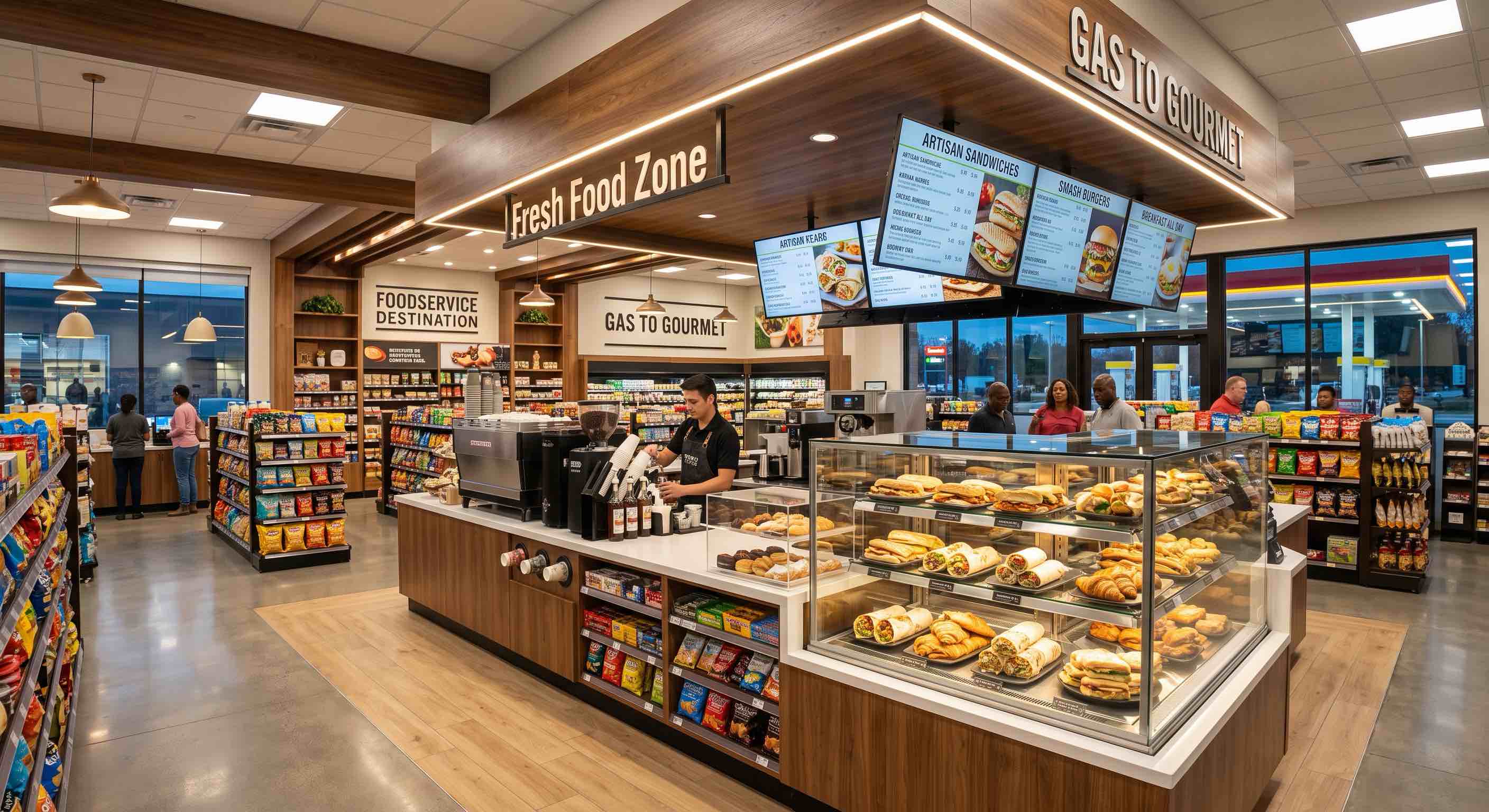
From “Gas to Gourmet” and the Rise of the “Third Place”
The foundational shift I’m seeing is the decline of traditional informal gathering spaces, the old neighborhood cafes. C-stores are filling that gap, becoming “Third Places” where guests choose to spend time. With 72% of consumers now viewing c-store food as a viable alternative to fast food, the opportunity to capture a “meal occasion” rather than just a “snack stop” is massive.
But here’s the catch: as an operator, you’re likely facing rising costs, labor challenges, and margin compression on fuel and tobacco. You can’t just “work harder” to bridge the gap. You need a system that handles the heavy lifting. That’s where AI moves from experimentation to infrastructure. In 2026, AI is the “behind-the-scenes” engine that safeguards your margins through smarter demand forecasting and inventory management.
The Psychology of Predictive Intent
The biggest change in the 2026 landscape is the move from reactive marketing to “predictive intent.” In the past, we sent a coupon for something a customer already bought. Today, AI senses their current mission. If a guest is using your mobile app, now a priority for 43% of consumers, the system can analyze their behavior to solve their next problem.
When a customer enters your store, the AI doesn’t just see a body; it sees a mission profile. Are they on a “morning rush” mission? A “late-night snack” mission? By understanding the intent, the store can adjust its digital touchpoints in real time. Moving to this intent-based merchandising can result in a 15% bump in your top-line revenue.
Understanding the 2026 Personalization Metrics
To understand why this shift is happening, we have to look at the numbers. In the traditional, pre-AI model, a top-line revenue lift of 1% to 3% was considered standard. With the AI-driven predictive models of 2026, that lift jumps to between 12% and 15%. The impact on Average Order Value (AOV) is even more staggering, with many operators seeing a 20% to 35% increase compared to baseline performance. Furthermore, while traditional stores struggle with an ignore rate for marketing messages as high as 81%, personalized messages in 2026 have an ignore rate of less than 5%.
What You Should Be Doing Now
- Audit Your Data Points: Start looking at your loyalty and POS data not just as “sales logs,” but as “mission logs.” What problems are your customers trying to solve at 7:00 AM versus 7:00 PM?
- Consolidate Your Systems: AI only works if it can see the whole picture. You must move toward a unified database that connects your pumps, your POS, and your mobile app.
- Identify Your “Dead Zones”: Walk your floor. Roughly 73% of in-store decisions still rely on “gut feeling,” which leads to products disappearing into zones where customers never go. We need to replace that gut feeling with behavioral data.
Strategic & Operational Execution: Redesigning the Store for a Digital-First World
As an industry partner focused on design and equipment, I can tell you that the physical layout of your store is no longer static. In 2026, your floor plan should be as dynamic as a website.
Digitizing the Workflow: The End of Manual Drudgery
The “Week 20” milestone in an AI rollout is where the technology stops being a “project” and starts being the “orchestrator.” This starts with digitizing workflows. We’re moving away from paper checklists and manual temperature logs.
In 2026, your equipment should be doing its own “self-diagnostics.” I’m talking about refrigeration units that generate their own maintenance tickets before the compressor fails, saving you thousands in spoiled inventory. When you digitize these tasks, you aren’t just saving time; you’re capturing the data that allows AI to predict your future needs.
Traditional Transactional vs. 2026 Third-Place Environments
The execution phase requires a shift in how we think about space. In a traditional transactional model, the primary goal was speed of throughput, often resulting in high-density shelving and a focus on pre-packaged staples. The 2026 “Third Place” model focuses on dwell time and experience. In this new environment, layout focus shifts to open spaces, seating, and customization zones. Technology’s role also evolves from merely facilitating a faster checkout to becoming a personalized engagement hub that uses AI to adjust lighting, music, and climate based on who is in the store.
Smart Equipment: Coolers that Sell and Signage that Listens
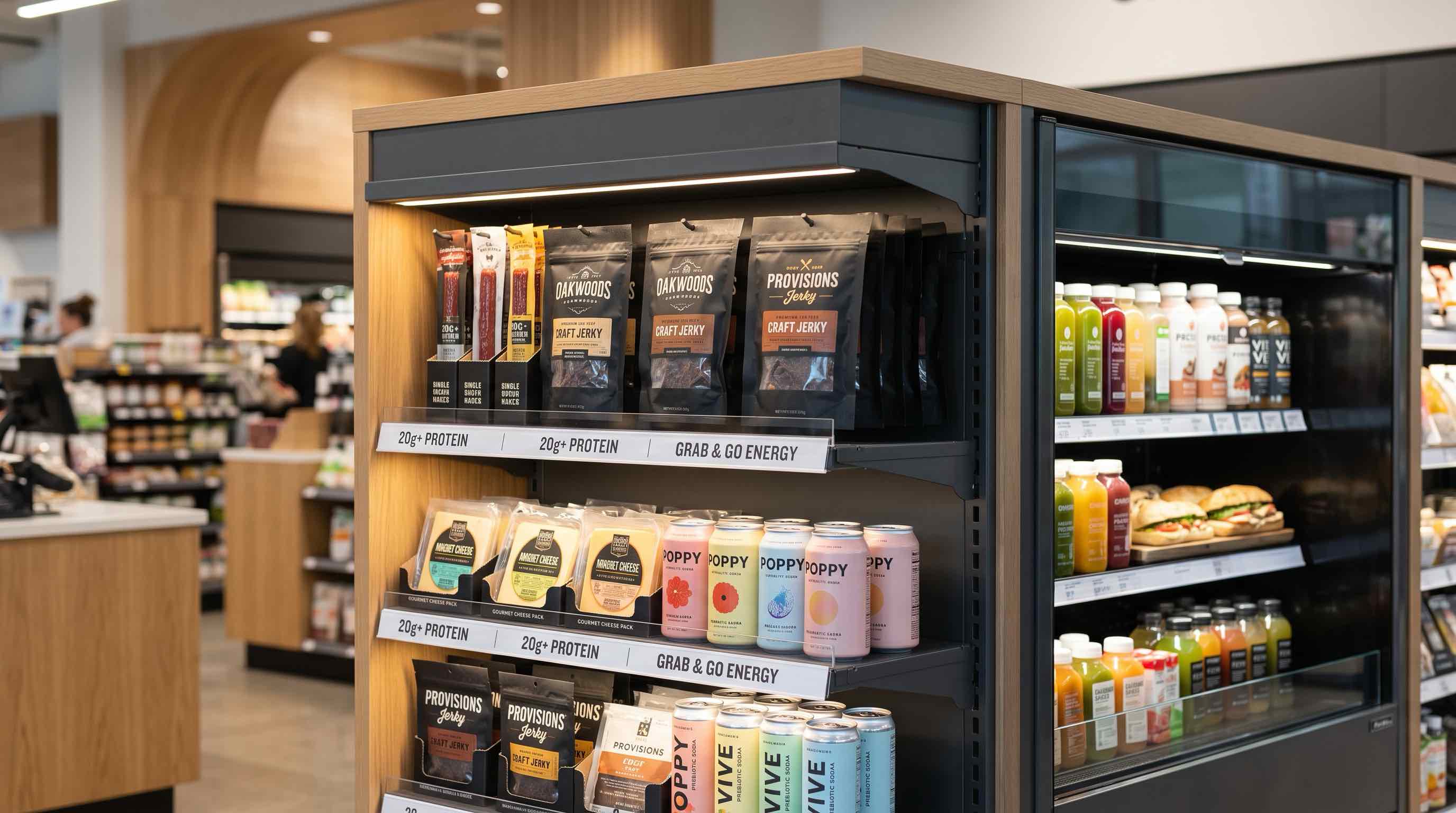
The equipment being installed in 2026 is “intelligent.” Take “Smart Coolers,” for example. These aren’t just fridges; they are grab-and-go revenue drivers. A guest taps a card, grabs three items, and walks away. The AI identifies what was taken and bills them automatically. Operators using these units report that once a customer opens the door, they shop like they are in a store rather than at a vending machine, increasing AOV by 30% to 50%.
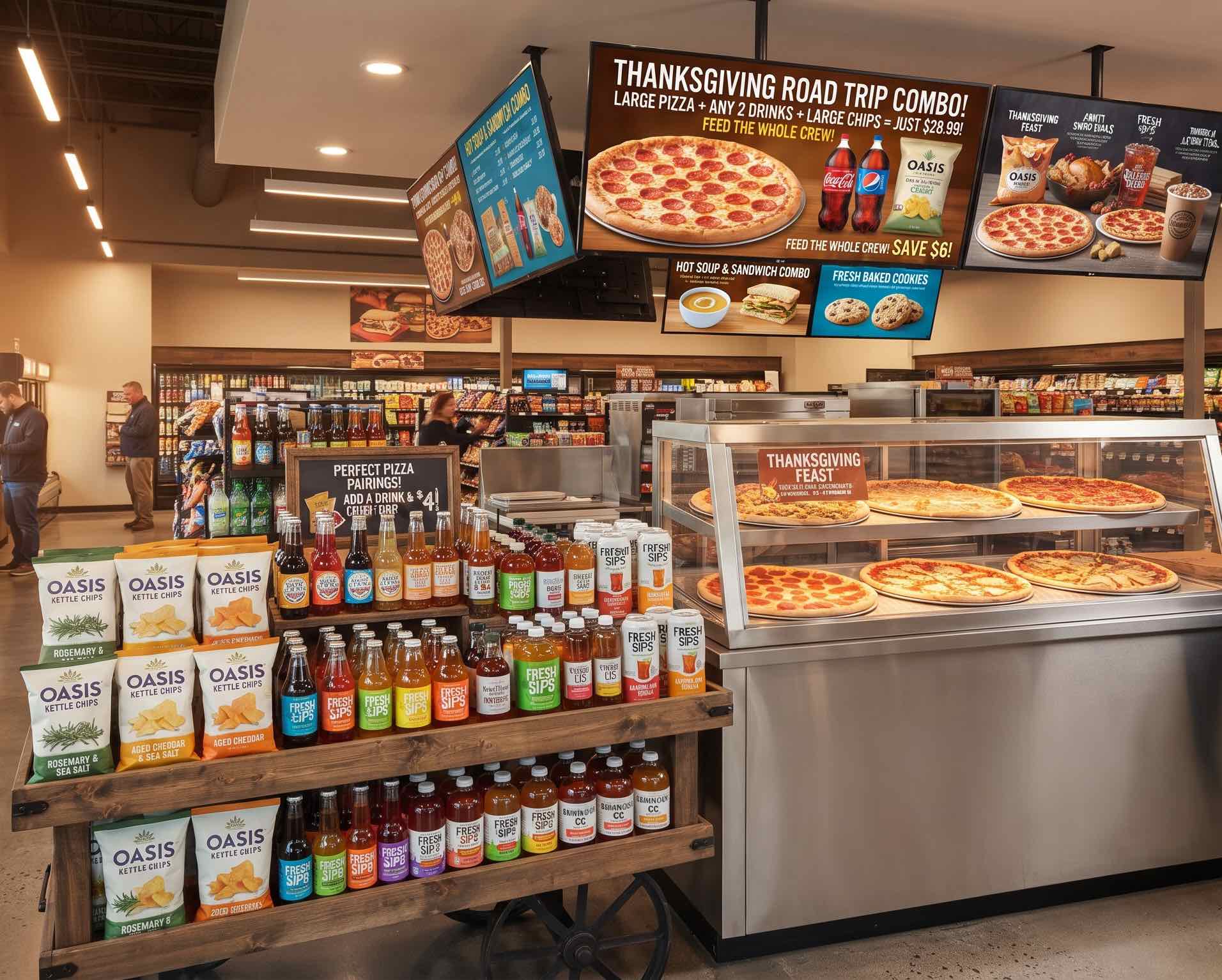
Then there is your signage. In 2026, digital menu boards are not just “screens”; they are programmatic marketing tools. Using AI vision and environmental sensors, your signage can change based on the weather or your current inventory levels. If a sudden heat wave hits, your screens should automatically pivot to highlight cold brew. If you are overstocked on breakfast burritos, the AI triggers a “Limited Time Offer” to guests fueling at the pump to move that inventory before it expires.
What You Should Be Doing Now
- Implement Smart Signage: Move past static loops. Ensure your digital CMS can pull in external data like weather and inventory to trigger relevant creative automatically.
- Adopt Modular Store Systems: Stop building fixed, permanent fixtures. Modular cabinetry allows you to shift your layout as AI-driven heatmaps identify new traffic patterns.
- Upgrade to IoT-Enabled Equipment: When replacing refrigeration or coffee systems, ensure they have “self-healing” diagnostic capabilities to reduce unplanned downtime.
Innovation & Profit Maximization: The Foodservice Margin Shield

If you want to survive the next five years, you have to be in the food business. But food is hard. It’s risky, it’s labor-intensive, and the waste can kill you. In 2026, AI is the “shield” that protects your foodservice profits.
High-Margin Bundling and “Complete the Mission”
The core of your 2026 profitability is the “food-forward” strategy. To understand why, look at the typical margin structure. Fuel often sits at low margins around 10%, while cigarettes and tobacco range between 10% and 20%. Alcoholic beverages improve to 25% to 30%. However, prepared food is the clear winner with gross margins typically between 40% and 65%.
AI maximizes this by identifying “co-purchase” behaviors. When a guest scans a sandwich at a kiosk, a format preferred by over 52% of consumers, the AI recommendation engine shouldn’t just ask “want fries with that?” It should suggest a high-margin fountain drink or a personalized “meal deal” based on what that specific guest has enjoyed in the past. This “predictive intent” creates a 20% to 35% increase in average order value.
Computer Vision and Waste Reduction
One of the most exciting innovations I’ve seen is the use of computer vision to monitor roller grills and hot cases. Systems now use cameras to track exactly which items sell and when. The AI then creates a “prep plan” for your staff, telling them exactly how many items to put on the grill based on today’s weather and local traffic patterns. This reduces food waste by up to 30%, which is straight profit back into your pocket.

AI and the “Employee Morale” Factor
We’ve all felt the pain of the labor crisis. But I’ve noticed that the stores with the best morale in 2026 aren’t just paying more; they are using AI to make the job better.
- Predictive Scheduling: Platforms like TimeForge use sales trends and peak hours to create schedules that actually make sense. Your team isn’t stressed by a sudden rush while understaffed, and they aren’t bored when it’s quiet. This precision can reduce labor costs by 10% to 15%.
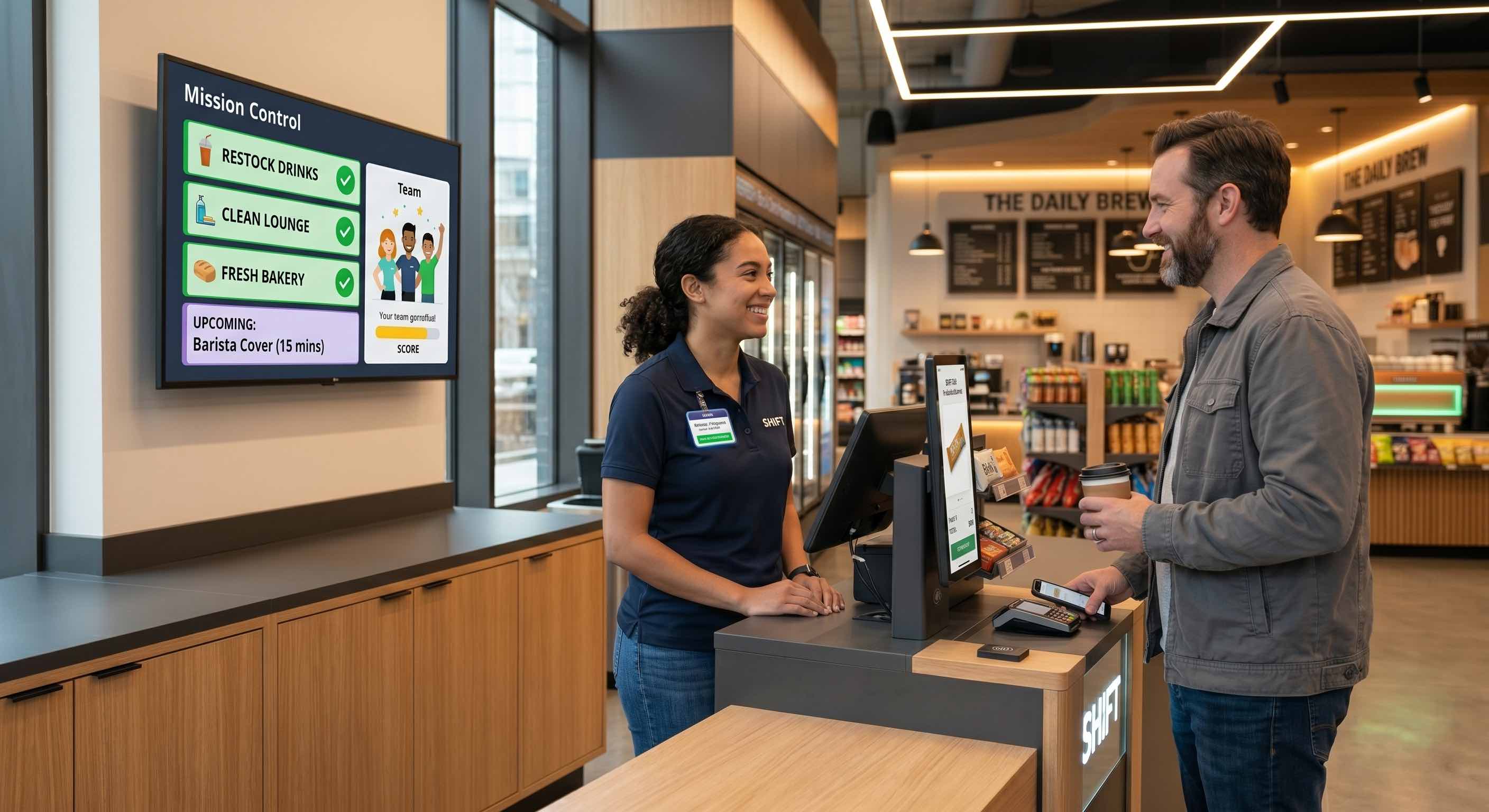
- Gamified Learning: We’re replacing boring training videos with bite-sized, AI-driven “micro-learning.” New hires engage in challenges, earn badges, and get real-time coaching at the counter. Studies show that 83% of employees with gamified training feel motivated, compared to 61% who feel bored with traditional methods.
- Eliminating the “Heavy Lifting”: When AI handles the “heavy lifting” of inventory rebalancing and task management, your employees can focus on what they actually enjoy, serving the guest.
What You Should Be Doing Now
- Launch a Kiosk-First Food Program: Give your guests the customization they crave. Kiosks manage the complexity of the morning rush while ensuring 100% order accuracy.
- Use AI for Waste Tracking: Stop guessing on your prep levels. Even a basic AI-driven forecasting tool can reduce overproduction and save you thousands in “dumped” food.
- Invest in Mobile Scheduling: Give your team the power to swap shifts and view schedules from their phones. Fairness and stability in scheduling are the #1 drivers of retention in 2026.
The Executive Action Plan: Your Roadmap to C-Store Excellence
You don’t have to do all of this at once. In fact, if you try to, you’ll probably fail. The goal is to move from “idea” to “deployment” with measurable impact.
Phase 1: The Foundation (Weeks 1–4)
The initial focus must be on data readiness and baseline metrics. You need to establish a unified data foundation and define master data standards. During these first four weeks, the goal is to secure executive sponsorship and align your AI vision with your long-term business strategy. This phase should also include an audit of your current tech stack and the identification of 5 to 10 assets where downtime hurts the most.
Phase 2: Pilot and Expansion (Weeks 5–12)
Once the foundation is set, you move into pilot execution and prototype development. I recommend choosing one high-frequency, time-consuming workflow to digitize, such as your food safety logs or automated replenishment for a specific category. You should also select an AI content optimization platform and begin testing personalized signage creative. By the end of Week 12, your goal is to have measurable ROI from these small-scale tests.
Phase 3: Scale and Optimization (Weeks 13–24)
In the optimization phase, you begin to refine your models based on performance data. You will move from simple predictive analytics to full enterprise scaling. This is when you implement agentic AI, systems that can autonomously reorder inventory or adjust pricing based on real-time shifts. By Week 20, your store should be functioning as an orchestrated ecosystem where the AI handles the routine execution while you and your team focus on the strategic “why” behind the guest experience.
What You Should Be Doing Now
- Clean the Data: AI is only as good as the data it eats. Ensure your POS, loyalty program, and inventory systems are talking to each other.
- The “Audit”: Identify your top bottlenecks. Where is the waste? Where is the downtime? Start there.
- Identify Business Owners: Each AI category needs a person responsible for using the outputs. This role prevents forecasts from sitting unused and helps the team trust the system.
The Bottom Line: Winning the Decade
In 2026, the gap between the “leaders” and the “laggards” in the convenience industry is widening. The operators who are winning aren’t necessarily the ones with the most sites or the biggest footprints. They are the ones who have realized that data is their most valuable inventory item.
As your industry partner, I see the difference every day. I see it in the store that feels effortless because the shelves are always full and the staff is engaged. I see it in the owner who isn’t stressed about their next maintenance bill because their equipment predicted the failure two weeks ago.
This isn’t just about “tech”; it’s about trust. When your store responds to your guests’ needs in real time, you build a level of loyalty that a simple discount card can never achieve. You move from being a “necessary pit stop” into a “preferred destination.”
The era of the “Invisible Orchestrator” is here. You don’t need a PhD in computer science to win; you just need the willingness to start digitizing your world and letting the data lead the way.
Are you ready to turn your footprint into a profit machine?

Leave a Reply