How I’d Turn Your Coffee Bar Into Your Store’s Biggest Profit Engine
If you run a convenience store, I want you to picture your coffee bar as your store’s handshake. It’s the first thing a lot of your customers judge you on, and whether they realize it or not, it’s telling them everything about the rest of your foodservice program before they ever reach the roller grill.
I’ve spent a long time working alongside operators on the equipment and design side of this business, and I keep coming back to the same uncomfortable number: nearly 3 in 10 customers walk into a convenience store for one specific item, then drive somewhere else entirely to buy their food. That’s not a small leak. That’s real revenue walking out your door and into a competitor’s drive-thru lane.
2026 has made this problem harder to ignore. Unemployment is edging toward 7.7%, and I’m watching middle- and lower-income households cut discretionary spending while higher earners keep spending steadily, which means brand loyalty is up for grabs in a way it hasn’t been in years. At the same time, shopping habits have changed. Trips are getting shorter (over 40% now last under 15 minutes), basket sizes are shrinking, and customers are running in for one thing and leaving. If your coffee program isn’t built to capture attention in that narrow window, you’re losing the sale before the customer even reaches your front door.
That’s exactly why I want to use National Coffee Day, September 29, as the forcing function for this conversation. It’s not just a promotional date on the calendar. It’s a natural checkpoint to audit your coffee program, and I’ll walk you through exactly what to look at.
In this post, I’ll cover four things: the consumer and health trends reshaping what your customers actually want (yes, GLP-1 medications are part of this), the physical setup and equipment that separates a mediocre coffee station from a “halo” that lifts your entire foodservice reputation, the profit mechanics that make coffee one of your highest-margin categories, and a 30-day action plan you can start running today to be ready for September 29.
By the end, you’ll have a clear, practical roadmap for turning your coffee bar from an afterthought into the single biggest driver of foot traffic, basket size, and repeat visits your store has.
The Landscape You’re Actually Operating In
Before you touch a single piece of equipment, I want you to understand why the coffee bar matters so much right now. This isn’t just about serving a better cup of coffee, it’s about what that cup of coffee signals to everyone who walks past it.
The 28% Revenue Leak and Your Foodservice Reputation
Here’s the pattern I see over and over: a customer stops for fuel or a packaged drink, but skips your prepared food entirely and buys lunch at the QSR next door. Roughly 28% of customers behave this way, and it almost always comes down to reputation, not price.
Variety and quality lead the charge in how customers judge your foodservice program, and coffee is your most visible proof point. A clean, well-lit, stainless-steel coffee bar pulling barista-quality drinks tells a customer, without a word being said, that your hot case and grab-and-go cooler are held to the same standard. A stained drip station tells them the opposite, and they’ll assume it before they even glance at your food.
The GLP-1 Effect on Your Basket
I don’t think enough operators are talking about this yet, but it’s reshaping demand in real time. In 2026, roughly one in six U.S. households has an active GLP-1 user, Ozempic, Wegovy, and similar medications. That’s dramatically cutting demand for sugary sodas and traditional candy, and pushing customers toward high-protein, portion-controlled, clean-label options.
The good news: this pairs naturally with a premium coffee program. Greek yogurt, fresh fruit, clean-label deli meats, protein bars, and advanced hydration drinks are all growing categories you can merchandise right alongside your coffee bar.
Beverages Are Their Own Reason to Visit
I want you to stop thinking of beverages as an add-on to a fuel purchase. Three-quarters of consumers visited a convenience store in the last 30 days specifically for a beverage, no fuel, no snacks, just the drink. Nearly 28% of those customers do this two to three times a month.
Here’s the gap that should get your attention: despite all that traffic, only 6% of consumers instinctively think “convenience store” when they want a specialty drink. That gap between how often people actually show up and how they perceive your brand is the single biggest growth opportunity in front of you right now.
What You Should Be Doing
- Audit your cross-merchandising ratio. Pull transaction data and check what percentage of beverage purchases include a food item. If it’s under 48%, you have a bundling problem to fix immediately.
- Build a visible food safety culture. ATP testing logs and visible sanitation stations reinforce the “halo effect” around your whole foodservice case.
- Reallocate cold vault space. Move 15–20% of the open-air cooler space nearest your coffee bar to clean-label, protein-forward items, using bright lighting and clean graphics to draw the eye.
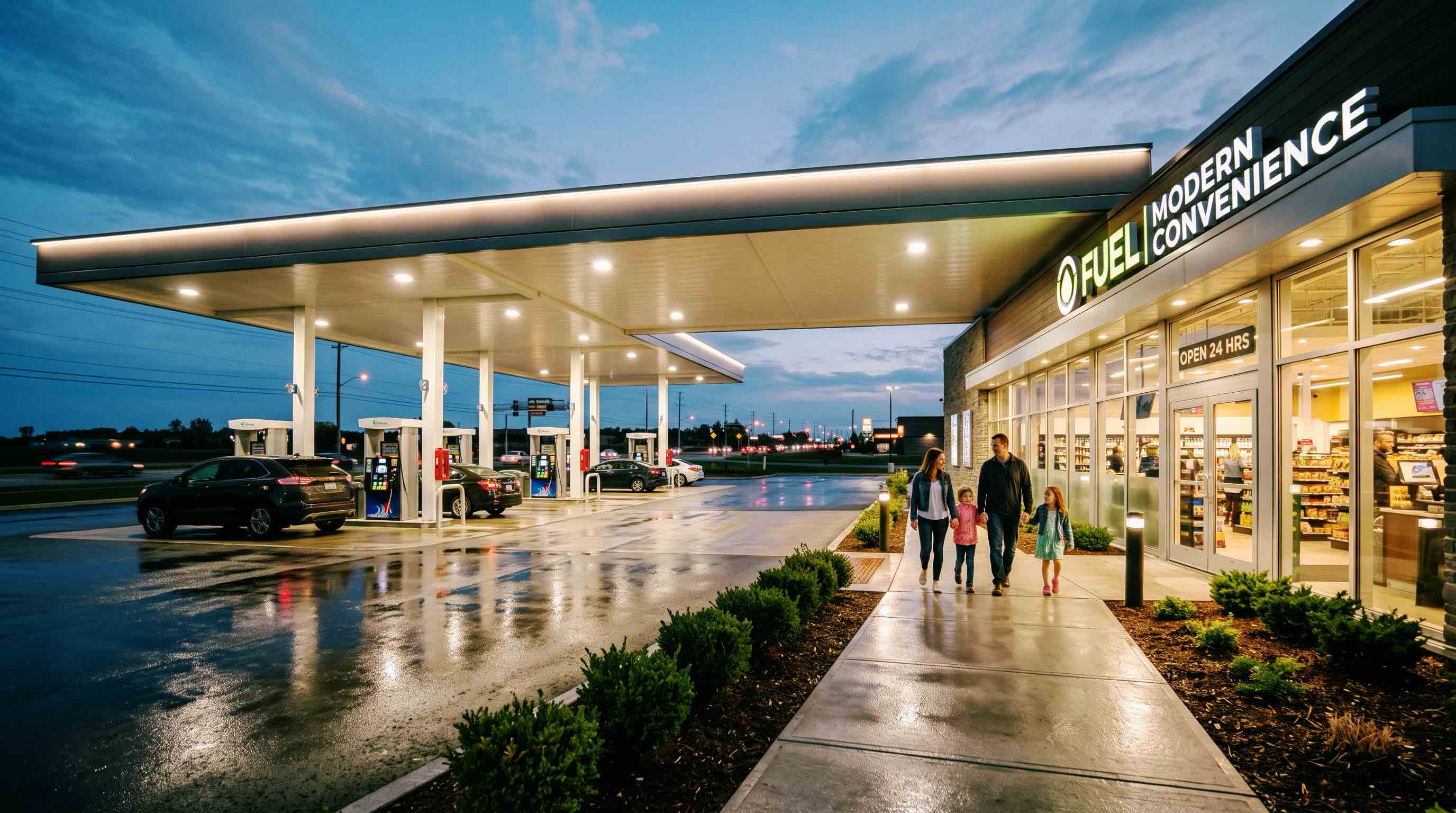
- Fix your sightlines from the pump. Make sure your forecourt window graphics are clean and uncluttered so a customer at the pump can actually see your coffee bar and grab-and-go coolers.
The Physical Setup: Why Cabinetry and Layout Matter More Than You Think

Understanding the trend is step one. Building the physical station that captures it is step two, and this is where I see the most operators underinvest.
Ditch the Wooden Millwork
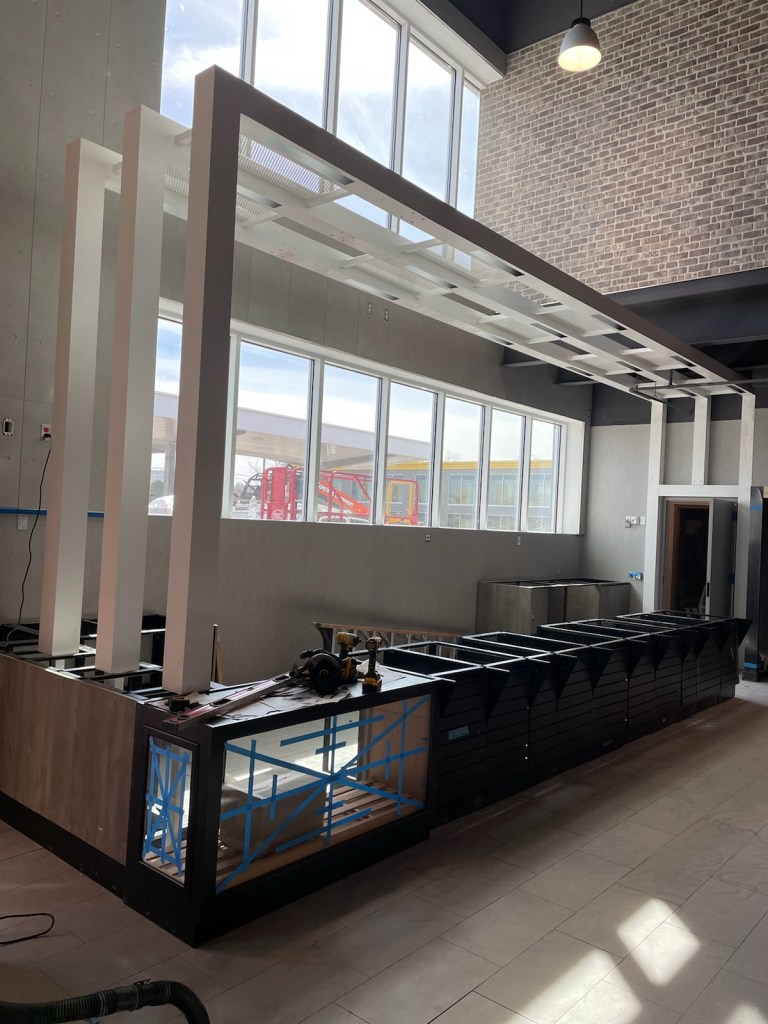
Residential-grade wood cabinetry breaks down fast under the heat, moisture, and traffic of a real coffee station. I always push operators toward powder-coated MTF steel cabinetry with removable doors and bottom HDPE floor panels, it gives you real access to electrical and plumbing without tearing the whole station apart for a repair.
Your countertops need to be solid surface, stone, or heavy-gauge stainless steel to stand up to moisture. Look for NSF-approved offset edges that keep liquid from running into the cabinet, stainless hinges that won’t sag over time, and tool-free adjustable cup dispensers. Mitered island designs with recessed condiment ledges save floor space and keep things organized during your morning rush.
Get Your Counter Heights Right
This one’s easy to overlook, but it affects both your staff’s comfort and your customers’ ease of use. Standard commercial counters sit at 36 inches, but coffee equipment has its own rules.
If you’re running manual espresso machines where a barista tamps by hand, drop the counter to 32–34 inches so the work surface hits belt-height and protects shoulders and wrists from repetitive strain. Most convenience stores, though, run super-automatic bean-to-cup machines with minimal manual work, for those, stick with the standard 34-inch height, which is friendlier for self-service customers.
Beyond height, think about flow. I call this the “18-Second Revolution”, your layout needs a clean left-to-right sequence: cup selection, dispensing, customization, lidding. Give your staff at least 36 inches of clearance behind a single counter, and up to 72 inches for a U-shaped layout.
Protect Your Uptime
A single bean-to-cup machine can turn out 50 to 100 cups a day. Every day it’s down can cost you around $150 in lost sales, plus real damage to customer trust. Machines like the Franke A-Series come with built-in guided rinses and automated milk-line cycles, but none of that matters if your team skips the protocol. Skipped steam wand purges and milk-line soaks are a direct path to hygiene failures and bad-tasting coffee. A maintenance contract with certified technicians protects your warranty and keeps small issues from becoming shutdowns.

Let AI Handle the Inventory Headache
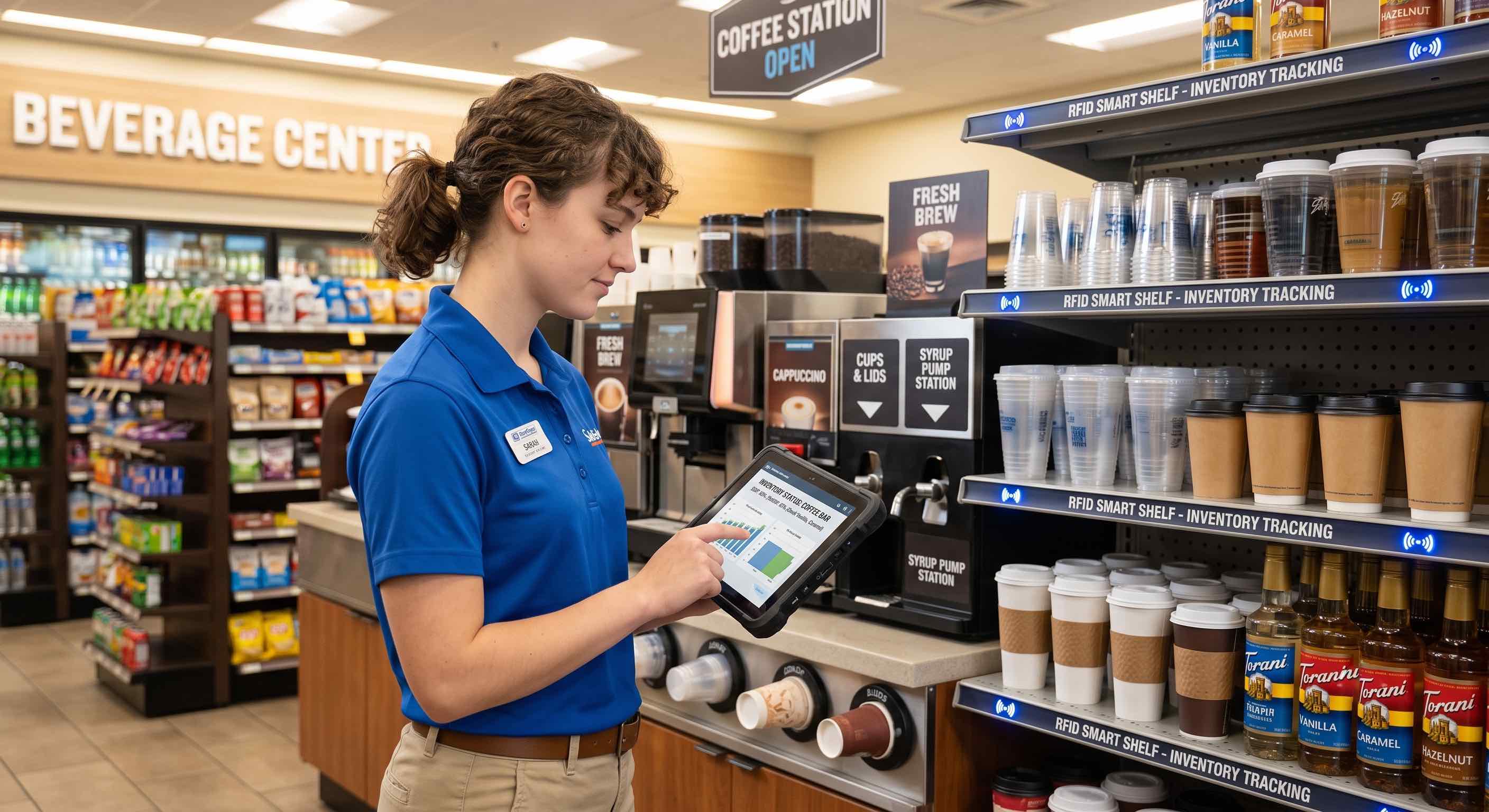
Pair your front-of-house equipment with back-of-house intelligence. Predictive AI forecasting tools can pull sales history, local traffic, and weather to automate your replenishment. RFID-enabled smart shelving and weight sensors can track cups, lids, and syrup levels in real time and alert your staff before you run out, some operators are seeing stock-out rates drop by up to 30% and manual inventory checks cut by nearly 40%.
What You Should Be Doing
- Replace aging wood millwork with powder-coated MTF steel cabinetry and solid-surface countertops with built-in utility access.
- Set your counter heights correctly, 32 to 34 inches for self-serve bean-to-cup stations, and never place refrigeration directly beneath heat-generating espresso equipment.
- Build a mobile back-office hub near checkout for tablets, scanners, and label printers so your inventory tools are always within reach.
- Post your cleaning protocols where staff can’t miss them, laminated, high-visibility rinse instructions mounted right above the machine.
Where the Real Profit Lives
Once your foundation and physical setup are right, it’s time to talk numbers, because coffee is quietly one of the best-margin categories you have.
The Math Behind the Cup
A cup of coffee typically costs you $0.15 to $0.40 to produce. Sell it for $1.99 to $2.99, and you’re looking at a wide margin no matter how you slice it.

Convenience stores actually post the highest cup-level margin of any segment, thanks to low labor overhead and self-serve models. But “good enough for the price” isn’t the bar anymore, customers now expect barista-quality drinks at convenience-store speed.

Cold Is Winning: You Need To Plan for It
Cold beverages now make up 21% of all coffee cups sold, driven heavily by Gen Z and Millennial customers, and that demand doesn’t slow down in the afternoon. Make sure whatever equipment you’re specifying has a real iced workflow built in, not an afterthought.
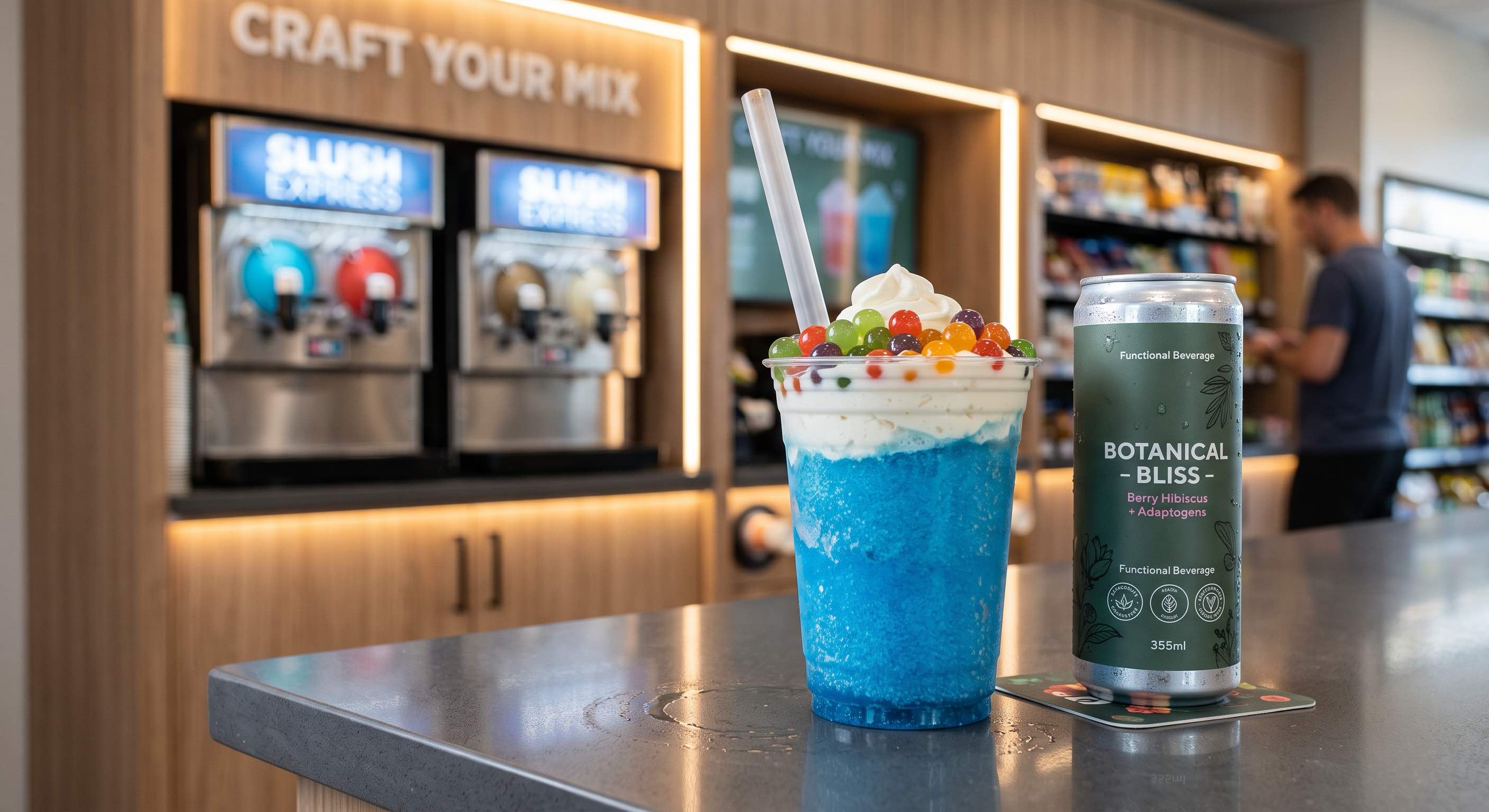
Customization matters just as much: nearly 60% of customers say the ability to customize their drink is a big deal. The features driving the most traffic are bean-to-cup machines (72%), flavor shot stations (56%), and cold foam or sweet cream toppings (44%). Functional add-ins, think matcha, protein infusions, protein cold foam, let you turn a $2.49 iced coffee into a $4.50 upsell, and they tap directly into the 61% of consumers actively trying to increase their protein intake.
Loyalty Is Where the Lift Comes From
None of this reaches its full potential without a real loyalty program behind it. Platforms like Paytronix and Punchh consistently produce a 20% sales lift when they’re deployed well, but only if you move past basic “earn and burn” points. You need seamless POS integration, order-ahead, mobile payment, and gamification: streaks, tier upgrades, visit challenges. These are the mechanics that turn a coffee run into a daily habit.
Push notifications are your accelerator here, used sparingly and with real value attached:
- Reward reminders: “You’ve got 50 points ready. Use them on a cold foam iced latte today.”
- Limited-time offer alerts: “Today only: 20% off a breakfast sandwich with any large coffee.” This is a direct shot at winning back that 28% who leave for food elsewhere.
- Geotriggered offers: GPS-fenced messages that welcome customers back the moment they’re within a mile of your store.
Making National Coffee Day Count
National Coffee Day gives you the perfect moment to run all of this at once. Bundle a seasonal specialty drink with a high-protein snack to lift your average ticket. Print bounce-back coupons on morning receipts offering an afternoon discount on iced tea or energy drinks, a great way to fill your slower 2 to 5 p.m. window. And run a low-cost, high-reach social contest with a branded hashtag to turn your regulars into free marketing.
What You Should Be Doing
- Add cold foam and functional add-ins, matcha, protein infusions, sweet cream, to your condiment station to drive premium upcharges.
- Run app-only exclusives for National Coffee Day, like double points or a free upsize for mobile orders only.
- Print bounce-back coupons on every morning coffee receipt to pull customers back for a slower-daypart visit.
- Merchandise food next to your coffee station to capture the customers already looking for a pairing.
Your 30-Day Action Plan for September 29
Knowing all of this doesn’t matter if you don’t execute it. Here’s the roadmap I’d run.
Days 1–7: Quality Audit & Physical Calibration
Run blind taste tests against local QSR competitors and adjust grind, filtration, or bean sourcing if you’re falling short. Get certified technicians in to descale lines, calibrate grinders, and check hot-holding equipment. Deep clean every stainless surface and put up bold directional graphics from the pump to your coffee bar.
Days 8–14: Digital Strategy & Loyalty Integration
Schedule your geotriggered and limited-time-offer push notifications for the week of September 29. Build a “Coffee Month” challenge in your app, three coffees in a week earns a badge and a free pastry. Confirm your POS can handle mobile redemptions, eGift cards, and bounce-back printing without slowing your line.
Days 15–21: Menu Innovation & Merchandising
Stock cold foams, matcha, and sugar-free syrups, and train your staff on restocking. Fix your countertop flow so cups, lids, and trash are positioned to prevent bottlenecks. Move protein bars, pastries, and fresh fruit right next to the coffee bar.
Days 22–30: Execution & Community Engagement
Launch a “Mug Shot” photo contest with a branded hashtag. Send loyalty members early access to your National Coffee Day deals. Run a final staff meeting to confirm everyone understands the promotion, the cleaning protocols, and the importance of greeting every customer at the coffee bar.
What You Should Be Doing
- Name a “Coffee Champion” for every shift, accountable for cleanliness, stock, and presentation at the station.
- Track your baseline metrics, daily cups sold, basket size, loyalty sign-ups, before you start, so you can measure real ROI afterward.
- Keep the momentum going past October 1. Use what you built for National Coffee Day as the foundation for your fall and holiday promotions.
The Bottom Line: A Better Cup of Coffee Means a Better Bottom Line
Here’s what I want you to take away from all of this: the days of coasting on fuel margins and a forgettable drip pot are over. Your customers are more price-conscious, more health-conscious, and more willing to switch brands than they’ve been in years, and they’re judging your entire store based on what your coffee bar looks and tastes like.
The 28% of customers leaving to buy food elsewhere isn’t a mystery you can’t solve. It’s a direct result of foodservice reputation, and coffee is the fastest, highest-visibility way to fix it. Get your cabinetry and layout right, keep your equipment running, meet customers where they actually are, cold, customized, and protein-forward, and back it all up with a loyalty program that actually rewards repeat visits.
National Coffee Day on September 29 isn’t just a date to slap a discount on your sign. It’s your stress test. Run the 30-day plan I’ve laid out, and you’re not just prepping for one good day, you’rebuilding the operating standard that carries your store through the rest of the year.
Leave a Reply