Convenience Excellence
Walk into ten convenience stores this week and you’ll notice something: the ones with cars parked out front, families walking in the door, and a line at the coffee counter almost never look like the ones you remember from a decade ago. They’re brighter. The shelves are lower. The food case smells like something you’d actually want to eat. And somewhere behind the counter, an employee is wearing a small badge that isn’t just a name tag.
That’s not an accident. It’s a business model.
The convenience channel is in the middle of a structural shift, and if you’re an owner-operator, you’ve probably already felt it even if you haven’t named it yet. Store counts nationwide remain strong, there are more than 150,000 retail locations across the country, but the traditional economic engine that used to carry this industry is sputtering. Fuel margins are thin and getting thinner. Fuel volumes are shrinking as vehicles get more efficient and remote work reshapes commuting patterns. Consumers are consolidating trips, which means fewer of those quick, incidental stops that used to fill your parking lot. Meanwhile, rent, labor, insurance, and utility costs keep climbing.
If your store still leans on gallons at the pump and a rack of cheap candy at the counter to carry the P&L, you’re not imagining the pressure. You’re standing on a business model that’s slowly being phased out by the market itself.
Here’s the opportunity hiding inside that pressure: independent owner-operators control roughly 63% of all convenience locations in the United States. That’s a huge, fragmented, mostly under-optimized footprint, which means the operators who move first on the things that actually drive today’s growth have an enormous amount of room to separate themselves from the pack. I spend my days designing retail layouts, building custom commercial cabinetry, and spec’ing out high-traffic equipment packages for stores just like yours, and I can tell you plainly: the stores winning right now aren’t the ones with the cheapest gas. They’re the ones that have turned themselves into destinations.
That transformation rests on three legs, and none of them work without the others. The first is physical and psychological safety, not as a compliance checkbox, but as the actual foundation that determines whether a customer feels comfortable enough to get out of their car, walk your aisles, and linger. The second is operational design, how your fixtures, sightlines, and incident-response systems either support that feeling of safety or quietly undercut it. The third is the profit engine itself, proprietary foodservice and destination beverage programs that give people an actual reason to choose you over the chain three miles away.
I want to be upfront about something: this isn’t a pitch for a specific product. It’s the same framework I use when I sit down with operators to plan a remodel, and I’m laying it out here because too many stores are investing in the third leg, the food and beverage programs, before they’ve built the first two. That’s backwards, and it shows up in the numbers. A beautiful cold brew tap program installed in a dim, cluttered store with 7-foot shelving and no clear sightlines will underperform every time, because the customer never felt comfortable enough to stick around and try it.
By the time you finish this guide, you’ll understand:
- How to apply Crime Prevention Through Environmental Design (CPTED) principles to your site so that safety becomes something customers feel the moment they pull in, which directly increases dwell time and basket size.
- How to modernize your incident response and injury triage systems so you protect your team, eliminate false alarms, and meaningfully reduce your workers’ comp exposure.
- How to build a proprietary foodservice and beverage identity that competes with, and beats, the QSR down the street.
- A prioritized, 30-day roadmap you can start executing this week, without shutting your doors or blowing your capital budget.
Let’s start where every successful transformation starts: the front door.
The Foundational Landscape: Safety as a Growth Engine
Before you spend a single dollar on a new espresso machine or a run of custom millwork, you have to deal with the psychological barrier standing between your parking lot and your front door. Customers make a risk assessment within seconds of pulling onto your lot, long before they ever read a sign or see a price. If your canopy lighting is dim, your windows are buried under a decade of promotional clings, or your aisles feel tight and closed-in, the customers you most want, specifically the households earning $100,000 or more who are currently driving the growth in convenience retail, will simply keep driving.
There’s a useful concept here from sociologist Ray Oldenburg: the idea of the “third place.” Your home is the first place. Work is the second. The third place is the community anchor in between, somewhere people go to gather, decompress, and reconnect that isn’t tied to obligation. Coffee shops built entire business models around this idea. There’s no reason a convenience store can’t do the same, but it only works once undisputed physical and psychological safety is established. Nobody lingers somewhere they don’t feel safe, no matter how good the coffee is.
The Retail Safety Flywheel
Think of this as a loop, not a checklist. A clean, open, well-lit store draws in more foot traffic. That traffic feels safe enough to actually browse instead of grabbing-and-going. Longer browsing time turns into larger baskets, especially in high-margin categories like grab-and-go food and dispensed beverages. That additional cash flow gets reinvested into the store and the team, which reinforces the safety and quality that started the loop in the first place. Operators who understand this stop treating “safety spend” and “growth spend” as two separate line items, they’re the same line item.
From Gas-and-Go to Destination Hub
The difference between a legacy c-store and a modern destination hub shows up in nearly every operational decision:
- Primary revenue driver. Legacy stores lean on gasoline gallons and packaged tobacco. Destination hubs lean on made-to-order food and premium dispensed beverages.
- Store layout. Legacy stores stack tall, dense shelving to cram in SKUs. Destination hubs keep sightlines open, generally 5 feet or lower, to prioritize comfort and natural surveillance over sheer product count.
- Safety posture. Legacy stores are reactive, pulling camera footage after something’s already gone wrong. Destination hubs are proactive, using environmental design and connected worker-response tools to prevent incidents before they escalate.
- Dwell time. A legacy stop is a 2-to-3-minute transaction. A destination visit runs 8 to 15 minutes, with customers browsing, ordering, and settling in.
- Target customer. Legacy stores serve commuters who need emergency fuel. Destination hubs pull in neighborhood families, remote workers, and customers specifically choosing that daypart to eat or drink something they actually want.
None of this requires a full rebuild. It requires a deliberate audit of what your store is currently signaling to the people driving past it.
What You Should Be Doing
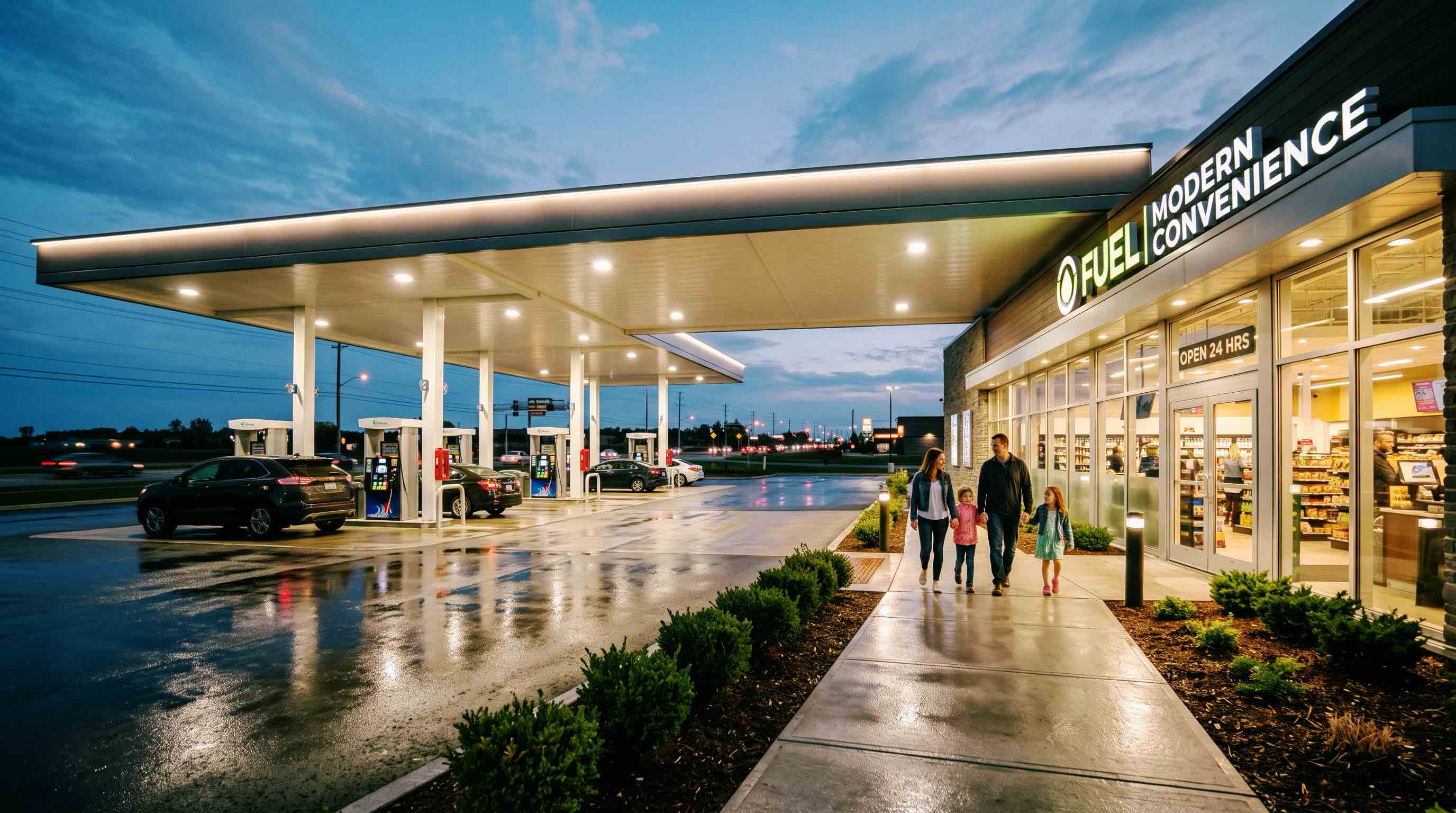
- Audit your perimeter lighting. Your pump canopy, walkways, and parking perimeter should carry bright, high-CRI LED lighting around the clock, with zero dark zones anywhere a customer or employee might walk.
- Adopt the 2ft/6ft landscaping rule. Keep shrubs and bushes trimmed to 2 feet or under, and lift tree canopies to at least 6 feet, so sightlines from the street stay open in every direction.
- De-clutter your glass. Strip away outdated posters, temporary banners, and opaque window clings so there’s a clear visual line between your cash counter and the forecourt.
- Reframe your brand promise. Your store isn’t just a pit stop, position it, in your signage and your service, as a clean, bright, dependable community asset.
Strategic & Operational Execution: Layouts, Fixtures, and Incident Control

Once the “why” is settled, the real work starts: looking at your sales floor through the lens of both industrial design and risk mitigation. You don’t need to turn your store into a fortress to make it safe. You need to use Crime Prevention Through Environmental Design (CPTED) to quietly shape how people move and feel inside your walls.
1. Natural Surveillance and Fixture Architecture
The single most common mistake I see when I walk into a store for the first time is 6-foot or 7-foot center-store gondolas, installed to squeeze in a few extra SKUs. High shelving creates blind spots. Blind spots invite shrink, and, just as important, they make legitimate customers feel uneasy without ever consciously knowing why.
To fix this:
- Cap center-store displays at 5 feet (60 inches). A lower fixture profile lets both your cashier and your customers hold sightlines across the entire footprint of the store.
- Anchor your cash wrap near the entry. The checkout counter should have a direct, unobstructed line of sight to the door, the main beverage aisle, and the exterior approach.
- Install protective access barriers. Decorative bollards or heavy architectural planters along the storefront prevent vehicle-into-building incidents while quietly guiding pedestrian foot traffic exactly where you want it.
2. Modernizing Incident Response and Injury Triage
Outdated, static response tools fail your frontline team when they need them most, and they quietly erode your operating margin over time. Two upgrades matter more than almost anything else on this list.
24/7 nurse tele-triage. Minor kitchen burns, slips, and stocking strains can spiral into inflated Experience Modification Rates (EMR) if they’re routed straight to the ER out of habit. A 24/7 nurse triage line lets an injured employee talk to a registered nurse by phone or telehealth immediately. Roughly 40% of workplace incidents get safely resolved through guided first aid and self-care this way, logged as zero-claim, incident-only events that don’t count against your workers’ comp renewal. When formal care genuinely is needed, early case management through a triage line saves an average of nearly $4,300 per claim.
Wearable duress badges over stationary panic buttons. An under-counter button does nothing for the employee restocking the walk-in cooler, breaking down boxes in the back room, or squeegeeing the forecourt. Those buttons are also notorious for accidental false alarms, which cost you fines and credibility with dispatch over time. A lightweight wearable badge, running on BLE, cellular, or LoRa, gives full interior and exterior coverage. Paired with real-time location tracking and a discreet haptic confirmation, it sends exact coordinates and, where needed, silent ambient audio straight to a dispatcher or E911 without escalating an already tense situation.
Core Incident Response Tools, at a Glance
| Tool | What It Does | Operational Impact |
| 24/7 Nurse Tele-Triage | Direct phone/video triage with registered occupational nurses | Resolves ~40% of incidents at zero claim cost; saves ~$4,300 per clinical incident on average |
| Wearable E911 Duress Badges | RTLS tracking, BLE/cellular connectivity, silent ambient audio | Eliminates false-alarm penalties; gives solo workers full property-wide protection |
| Daily Shift Micro-Training | 90-second focused modules delivered at POS shift login | Counters the roughly 90% monthly retention decay of standard training; cuts frontline errors |
| Standardized Incident Data | Discrete-choice categorization replacing vague, unstructured logs | Produces clean loss-prevention data you can actually act on for staffing and fixture decisions |
What You Should Be Doing
- Standardize fixture heights. Audit every aisle and drop center-floor shelving to 60 inches or below, store-wide.
- Enroll in tele-triage. Talk to your workers’ comp carrier about activating a 24/7 nurse triage program, this is often available at little or no added cost through your existing policy.
- Upgrade your panic hardware. Replace legacy under-counter buttons with wearable badges that offer real location tracking and silent dispatch.
- Institute shift-start micro-learning. A 90-second safety or de-escalation refresher at the start of every shift does more for retention of that knowledge than a once-a-year training binder ever will.
Innovation & Profit Maximization: Foodservice, Beverage, and Data

Once your environment is safe, visible, and structurally sound, it’s time to focus on where the real margin actually lives. Packaged snacks and general merchandise carry thin margins by design, they’re commodity categories, and everyone sells them. Proprietary foodservice and destination beverages are where a modern convenience store actually makes its money.
The Profit Margin Hierarchy
- Specialty dispensed and bean-to-cup coffee: roughly 65% to 75% gross margin
- Proprietary made-to-order foodservice: roughly 55% to 62% gross margin
- Center-store packaged merchandise: roughly 30% to 38% gross margin
- Retail fuel: roughly 3% to 7% net margin
That gap tells you everything about where to focus your next capital dollar.
1. Building a Proprietary Foodservice Identity
More than 60% of convenience retailers now offer made-to-order food, going head-to-head with drive-thru chains for lunch and dinner traffic. The operators winning that fight aren’t the ones running a generic, unbranded hot case, they’re the ones who built a signature item people specifically drive to their store to get.
You’ve seen the national examples: a breakfast pizza that became a brand identity, a hoagie built around a proprietary recipe, a smoked-meat program that turned a fuel stop into a destination worth a highway detour. The pattern is consistent, research shows 58% of consumers will bypass a closer competitor specifically to buy a signature, proprietary food item from a c-store brand they already trust.
Traditional heating case (low margin, high waste): bulk frozen product goes into a fryer or heater, sits in a stale warmer, and gets marked down or thrown away when it doesn’t move.
Modern modular QSR line (high margin, fast throughput): fresh, prepped ingredients move through high-speed convection cooking into custom assembly, landing in a customer’s hand, and driving a premium basket, in under two minutes.
To build this out:
- Invest in modular, high-speed equipment. Ventless high-speed convection/microwave combination ovens can turn out fresh sandwiches and flatbreads in under 90 seconds, fast enough to compete directly with drive-thru speed.
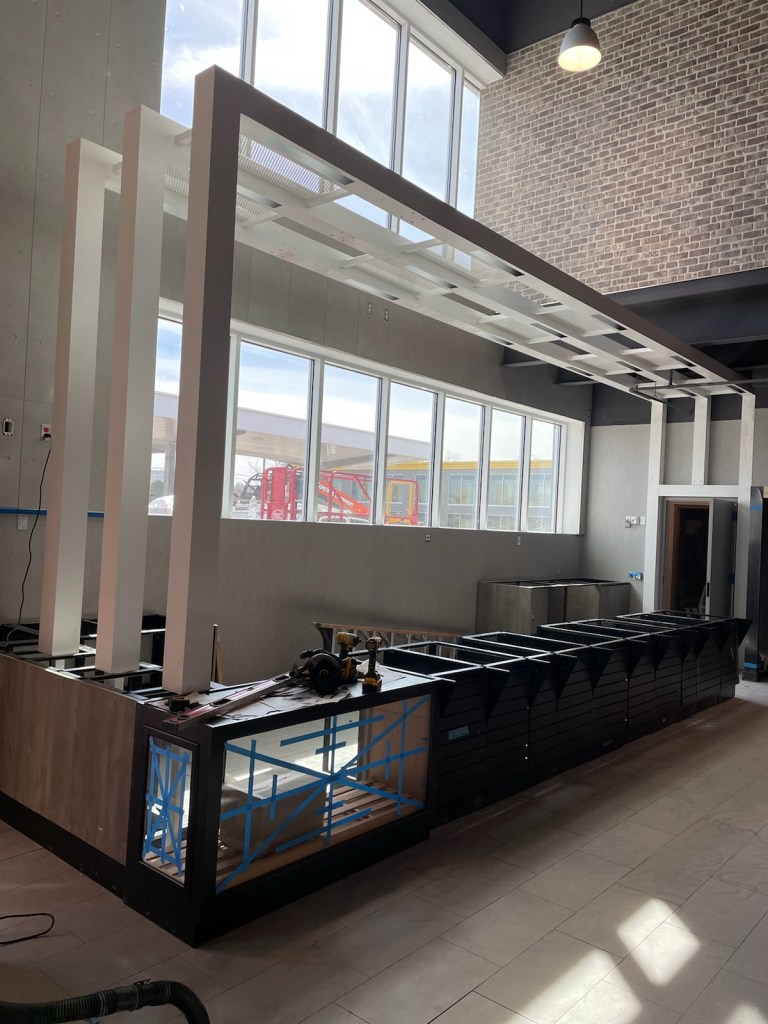
- Design ergonomic prep counters. Commercial-grade solid surface tops and stainless casework, built for rapid wipe-downs and continuous workflow, keep your team moving efficiently under NSF sanitation standards.
- Build around the dayparts that matter. Pair portable breakfast items with the morning rush, and offer take-home meal bundles or whole pizzas for the evening commute crowd.
2. Destination Dispensed Beverages: The Foot Traffic Engine
Beverages routinely carry the highest gross margins in convenience retail, frequently 65% to 70% or better. And they don’t just add margin; they generate visits on their own. Roughly 75% of convenience store shoppers report visiting at least once a month for a beverage alone, with no fuel or tobacco purchase attached to that trip.
The modern beverage hub has three pillars:
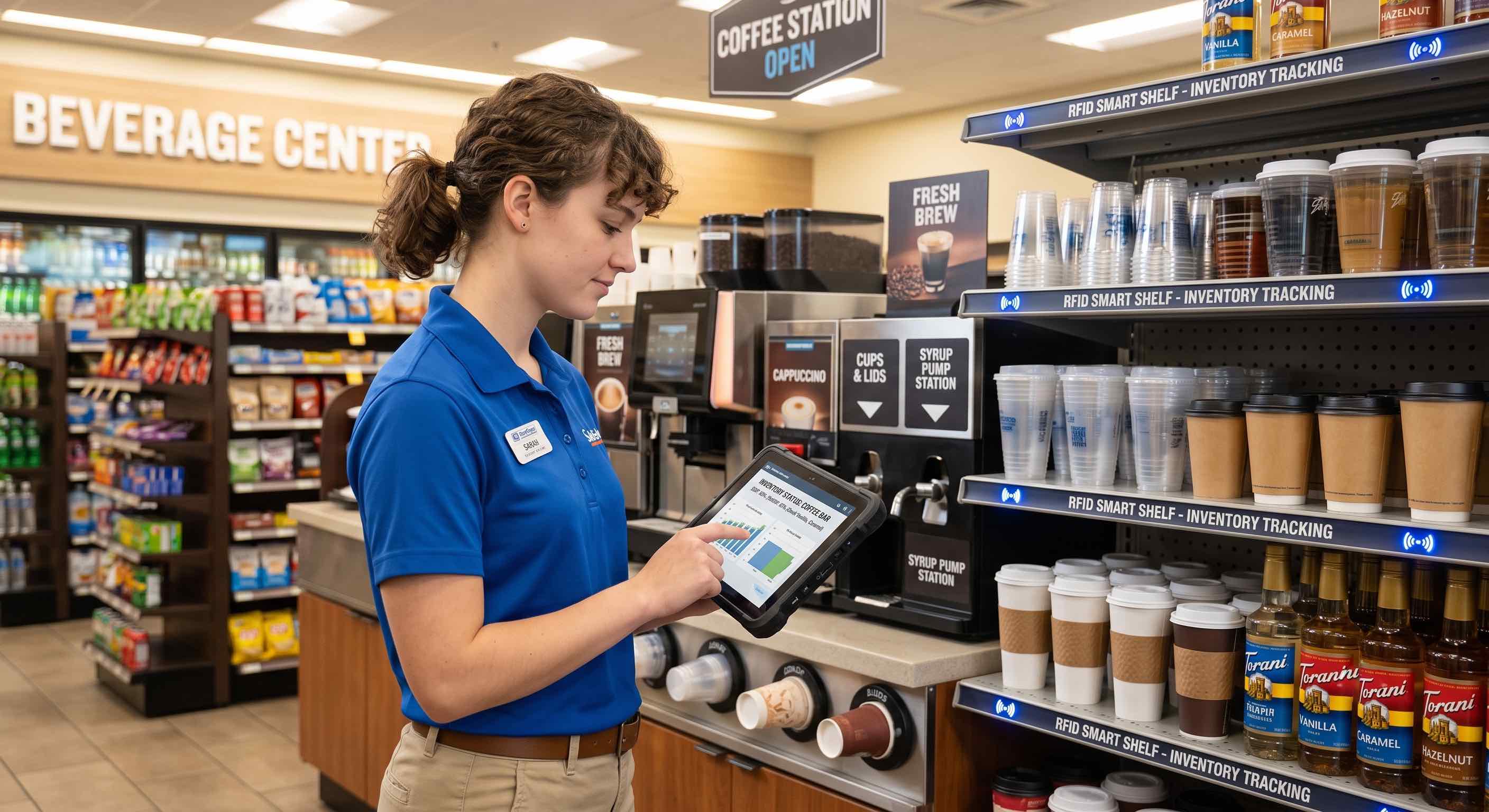
- Bean-to-cup coffee: fresh whole-bean grinding for every single cup, no carafes, no thermal airpots sitting stale for hours, and zero hot-plate burn-off waste.
- Cold brew and nitro on tap: kegged or bag-in-box cold brew and nitrogen-infused iced coffee capture younger demographics who are actively looking for a premium afternoon draw.
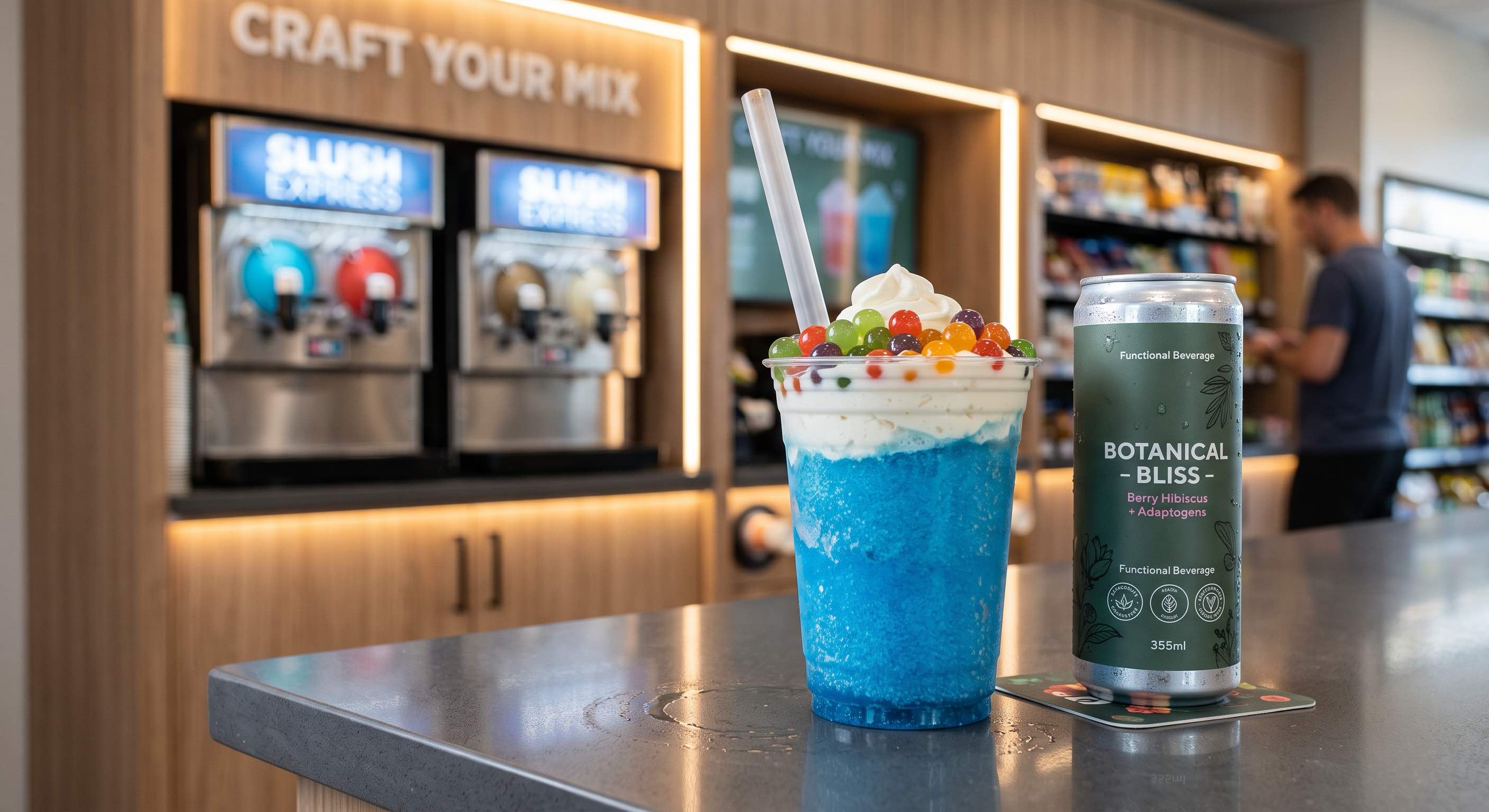
- Flavor and functional customization: syrup pumps, flavor shots, and shelf space dedicated to functional wellness drinks, zero-sugar energy formulas, and specialty teas turn a routine purchase into a personalized one.
3. Data-Driven Merchandising and Loss Prevention
Large chains isolate shrink and sales performance by category because it lets them act on specifics instead of guessing. There’s no reason an independent operator can’t apply the same discipline using nothing more than their existing point-of-sale data:
- Target high-shrink zones. Match your loss logs against your floor plan and position high-theft categories, premium electronics, energy shots, over-the-counter health items, within direct line of sight of the register.
- Bundle high-margin items together. Pairing a proprietary food item with a bean-to-cup coffee (a simple “add a coffee for $1” prompt at checkout) is one of the easiest incremental basket-size wins available to you.
What You Should Be Doing
- Develop one signature food item. A single, craveable, proprietary recipe, a breakfast biscuit, a flatbread, a specific burrito, is worth more marketing value than a dozen generic SKUs.
- Upgrade to bean-to-cup systems. Eliminating glass carafes cuts waste to zero while delivering a genuinely fresher cup than anything sitting in a thermal pot.
- Bundle foodservice with beverages. Build automatic combo pricing into your POS so food and drink pair naturally at checkout.
- Track shrink with structured categories. Replace vague loss notes with discrete categories, internal shrink, grab-and-run, vendor discrepancy, so you can actually see where the problem lives.
The Executive Action Plan: Your 30-Day Roadmap
None of this has to happen all at once, and it shouldn’t. Trying to execute everything in this guide simultaneously is how remodels stall out and budgets blow up. Here’s a sequenced, four-week plan that builds momentum without shutting your doors.
Week 1: Foundational Safety and Visibility Baseline
- Clear your glass: remove outdated signage and clings to open sightlines between the register and the pumps.
- Audit lot and canopy lighting, replacing anything dim, flickering, or inconsistent with high-efficiency LEDs.
- Contact your workers’ comp carrier to enroll in a 24/7 nurse tele-triage program and post the triage contact number at every register.
Week 2: Sales Floor and Cash Handling Re-Engineering
- Enforce the 2ft/6ft landscaping rule to restore sightlines from the street.
- Drop center-store fixture heights to a maximum of 60 inches.
- Tighten cash-handling procedures, a strict $100 active till limit, time-delayed drop safes, and visible policy signage at the entrance.
Week 3: Technology Rollout and Staff Training
- Outfit every team member, especially stockroom and late-night staff, with a wearable duress badge.
- Launch 90-second, single-topic shift-start training modules covering situational awareness and de-escalation.
- Schedule on-site demos with bean-to-cup and draft cold brew equipment distributors.
Week 4: Menu Development and Community Activation
- Finalize a signature foodservice item and dial in prep time to under 90 seconds.
- Configure your POS to run automatic combo pricing that pairs prepared food with specialty beverages.
- Invite local police, fire, and EMS for a complimentary morning coffee, a small gesture that builds genuine, lasting neighborhood goodwill and visible foot traffic.
The Bottom Line: Building an Enduring Convenience Brand
The convenience channel in 2026 doesn’t reward operators who are waiting for the commuter traffic of ten years ago to come back. It rewards the operators willing to rethink what their store is actually for.
That starts with safety, not as a line item you check off for insurance purposes, but as the foundation everything else stands on. A customer has to feel comfortable enough to get out of their car and walk inside before any of your food or beverage programs have a chance to work. CPTED principles, open sightlines, trimmed landscaping, bright and consistent lighting, are inexpensive relative to almost everything else in this guide, and they’re the highest-leverage investment most operators are currently skipping.
From there, operational execution matters just as much as intent. Fixture heights, cash-wrap placement, and modern incident-response tools, tele-triage lines and wearable duress badges in particular, protect your team, reduce turnover, and quietly insulate your business from rising insurance costs that most operators only notice after they’ve already climbed.
And once that foundation is in place, the innovation layer, proprietary foodservice, destination beverages, and disciplined, data-driven merchandising, is what actually captures the margin. This is where a store stops competing on gas price and starts competing on identity. A signature sandwich, a genuinely great cup of coffee, and a store that feels good to be in are things a competitor three miles away can’t undercut with a two-cent fuel discount.
None of this requires reinventing your business overnight. It requires walking your own lot after dark, standing at the pumps, and looking back at your store the way a first-time customer would. Notice the overgrown shrub blocking the sightline. Notice the 7-foot shelving unit creating a blind corner. Notice the injury-reporting process that still runs on a clipboard behind the register. Pick one friction point and fix it this week.
Your team, your customers, and your bottom line will notice the difference before you expect them to.
Leave a Reply